Extinct goat was cold-blooded
Nov 18, 2009 |
4.9 / 5 (37) |
12
(PhysOrg.com) -- An extinct goat that lived on a barren Mediterranean island survived for millions of years by reducing in size and by becoming cold-blooded, which has never before been discovered in mammals.
Ancient penguin DNA raises doubts about accuracy of genetic dating techniques
Nov 10, 2009 |
4.7 / 5 (23) |
15
Penguins that died 44,000 years ago in Antarctica have provided extraordinary frozen DNA samples that challenge the accuracy of traditional genetic aging measurements, and suggest those approaches have been ...
First-ever blueprint of a minimal cell is more complex than expected
Nov 26, 2009 |
4.9 / 5 (19) |
4
What are the bare essentials of life, the indispensable ingredients required to produce a cell that can survive on its own? Can we describe the molecular anatomy of a cell, and understand how an entire organism ...
Bigger not necessarily better, when it comes to brains
Nov 17, 2009 |
4.5 / 5 (19) |
12
(PhysOrg.com) -- Tiny insects could be as intelligent as much bigger animals, despite only having a brain the size of a pinhead, say scientists at Queen Mary, University of London.
Antarctic lake home to diverse community of viruses
Nov 11, 2009 |
4.9 / 5 (17) |
1
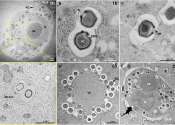
(PhysOrg.com) -- A study of the genetic structure of viruses in an Antarctic lake has revealed an astonishing genetic richness in the large number of viral families discovered.
Bioengineers succeed in producing plastic without the use of fossil fuels
Nov 23, 2009 |
4.9 / 5 (17) |
0
A team of pioneering South Korean scientists have succeeded in producing the polymers used for everyday plastics through bioengineering, rather than through the use of fossil fuel based chemicals. This groundbreaking research, ...
Beyond sunlight: Explorers census 17,650 ocean species between edge of darkness and black abyss (w/ Video)
Nov 22, 2009 |
4.9 / 5 (15) |
0
Census of Marine Life scientists have inventoried an astonishing abundance, diversity and distribution of deep sea species that have never known sunlight - creatures that somehow manage a living in a frigid ...
Jellyfish swarm northward in warming world
Nov 15, 2009 |
4.3 / 5 (15) |
1
(AP) -- A blood-orange blob the size of a small refrigerator emerged from the dark waters, its venomous tentacles trapped in a fishing net. Within minutes, hundreds more were being hauled up, a pulsating ...
Laser etching safe alternative for labeling grapefruit
Nov 03, 2009 |
4.4 / 5 (14) |
8
Laser labeling of fruit and vegetables is a new, patented technology in which a low-energy carbon dioxide laser beam is used to label, or "etch" information on produce, thereby eliminating the need for common ...
Red Sea coral seen to feed on jellyfish
Nov 17, 2009 |
4.5 / 5 (12) |
2
(PhysOrg.com) -- Corals depends on the products of photosynthetic algae for most of their food, but they also eat tiny plankton. Now, for the first time, there is evidence of a coral eating jellyfish.
Scientists visualize how bacteria talk to one another
Nov 08, 2009 |
4.8 / 5 (11) |
1
Using imaging mass spectrometry, researchers at the University of California, San Diego have developed tools that will enable scientists to visualize how different cell populations of cells communicate. Their ...
Rapacious Rasberry ants march north
Nov 13, 2009 |
4.4 / 5 (10) |
10
Poor Texas. First it was killer bees, then fire ants. Now, it's the Rasberry ants.
Computational microscope peers into the working ribosome (w/ Video)
Nov 23, 2009 |
4.9 / 5 (9) |
2
Two new studies reveal in unprecedented detail how the ribosome interacts with other molecules to assemble new proteins and guide them toward their destination in biological cells. The studies used molecular ...
Ice Cold: Cooler Than Being Cool
Nov 24, 2009 |
4.2 / 5 (10) |
0
(PhysOrg.com) -- Water expands when it freezes. Anyone who has ever left a can of soda or bottle of water in the freezer too long has witnessed this first hand. So how do plants and animals survive severe ...
Mom was right: Why nice guys usually get the girls
Nov 05, 2009 |
4.6 / 5 (9) |
1
(PhysOrg.com) -- Female water striders often reject their most persistent and aggressive suitors and prefer the males who aren't so grabby, according to new research. Water striders are insects commonly seen ...