Last update:
Nanophysics news
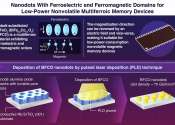
Enhancing memory technology: Multiferroic nanodots for low-power magnetic storage
Traditional memory devices are volatile and the current non-volatile ones rely on either ferromagnetic or ferroelectric materials for data storage. In ferromagnetic devices, data is written or stored by aligning magnetic ...
Nanophysics
Apr 26, 2024
0
2

Ultrasensitive photonic crystal detects single particles down to 50 nanometers
Using an ultrasensitive photonic crystal, TU/e researchers were able to detect single particles down to 50 nanometers in diameter. The new research has just been published in the journal Optica.
Nanophysics
Apr 24, 2024
0
126

Scientists reveal working mechanism of multilayer MoS₂ photodetector with broad spectral range and multiband response
As a typical two-dimensional material, MoS2 exhibits unique optical and electrical properties due to its atomic thickness in the vertical dimension, making it a research hotspot in the field of optoelectronic detection.
Nanophysics
Apr 24, 2024
0
1

New model extends theory of pattern formation to the nano-cosmos
A new model developed by scientists from the Max Planck Institute for Dynamics and Self-Organization (MPI-DS) extends the theory of elastic phase separation towards nanoscopic structures. Such patterns are frequent in biological ...
Nanophysics
Apr 24, 2024
0
4

Breaking boundaries in tiny labs: New technology using sound waves has implications for nanoparticle manipulation
Acoustofluidics elegantly merges acoustics with fluid mechanics, enabling precise manipulation of fluids and particles on both micro and nanoscales. This interdisciplinary field plays a crucial role in biomedicine, tissue ...
Nanophysics
Apr 23, 2024
0
38

Magnetic with a pinch of hydrogen: Research team develops new idea to improve the properties of ultra-thin materials
Magnetic two-dimensional materials consisting of one or a few atomic layers have only recently become known and promise interesting applications, for example for the electronics of the future. So far, however, it has not ...
Nanophysics
Apr 22, 2024
0
66
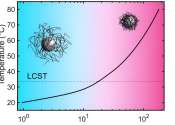
European XFEL elicits secrets from an important nanogel
An international team at the world's largest X-ray laser European XFEL at Schenefeld near Hamburg has scrutinized the properties of an important nanogel that is often used in medicine to release drugs in a targeted and controlled ...
Nanophysics
Apr 19, 2024
0
60

Comprehensive model unravels quantum-mechanical effects behind photoluminescence in thin gold films
EPFL researchers have developed the first comprehensive model of the quantum-mechanical effects behind photoluminescence in thin gold films; a discovery that could drive the development of solar fuels and batteries.
Nanophysics
Apr 19, 2024
0
86

Thermal properties of new 2D materials for microchips can now be measured well
Making ever smaller and more powerful chips requires new ultrathin materials: 2D materials that are only 1 atom thick, or even just a couple of atoms. Think about graphene or ultra-thin silicon membrane for instance.
Nanophysics
Apr 18, 2024
0
17
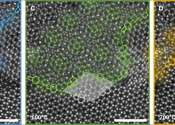
Atom-by-atom: Imaging structural transformations in 2D materials
Silicon-based electronics are approaching their physical limitations and new materials are needed to keep up with current technological demands. Two-dimensional (2D) materials have a rich array of properties, including superconductivity ...
Nanophysics
Apr 17, 2024
0
109

Two-dimensional nanomaterial sets expansion record
It is a common hack to stretch a balloon out to make it easier to inflate. When the balloon stretches, the width crosswise shrinks to the size of a string. Noah Stocek, a Ph.D. student collaborating with Western physicist ...
Nanophysics
Apr 17, 2024
2
50

Novel method developed for phosphorescent multi-color carbon dots
A research team has devised a novel method to prepare carbonized polymer nanodots capable of emitting multi-color ultra-long room-temperature phosphorescence (RTP) from blue to green.
Nanophysics
Apr 16, 2024
0
9

Evidence for reversible oxygen ion movement during electrical pulsing: Emerging ferroelectricity in binary oxides
Ferroelectric binary oxides thin films are garnering attention for their superior compatibility over traditional perovskite-based ferroelectric materials. Its compatibility and scalability within the CMOS framework make it ...
Nanophysics
Apr 16, 2024
0
1

Quantum electronics: Charge travels like light in bilayer graphene
An international research team led by the University of Göttingen has demonstrated experimentally that electrons in naturally occurring double-layer graphene move like particles without any mass, in the same way that light ...
Nanophysics
Apr 16, 2024
0
439

'Nano stitches' enable lighter and tougher composite materials
To save on fuel and reduce aircraft emissions, engineers are looking to build lighter, stronger airplanes out of advanced composites. These engineered materials are made from high-performance fibers that are embedded in polymer ...
Nanophysics
Apr 16, 2024
0
61

A magnetic nanographene butterfly poised to advance quantum technologies
Researchers from the National University of Singapore (NUS) have developed a new design concept for creating next-generation carbon-based quantum materials, in the form of a tiny magnetic nanographene with a unique butterfly-shape ...
Nanophysics
Apr 15, 2024
0
159

Unraveling the behavior of nanoconfined water and ice in extreme conditions
Understanding water behavior in nanopores is crucial for both science and practical applications. Scientists from City University of Hong Kong (CityU) have revealed the remarkable behavior of water and ice under high pressure ...
Nanophysics
Apr 11, 2024
0
21

Building block for magnetoelectric spin-orbit logic opens new avenue for low-power beyond-CMOS technologies
In an article published in Nature Communications, an international team led by researchers from the Nanodevices group at CIC nanoGUNE succeeded in voltage-based magnetization switching and reading of magnetoelectric spin-orbit ...
Nanophysics
Apr 10, 2024
0
9

Propelling atomically layered magnets toward green computers
Globally, computation is booming at an unprecedented rate, fueled by the boons of artificial intelligence. With this, the staggering energy demand of the world's computing infrastructure has become a major concern, and the ...
Nanophysics
Apr 5, 2024
0
361

Unlocking exotic physics: Exploring graphene's topological bands in super-moiré structures
In a new study, scientists from Singapore and Spain have presented a new avenue for exploring exotic physics in graphene. They focus on electronic interactions in graphene when it is sandwiched in a three-layer structure ...
More news


Nano-oscillator hits record quality factor

A new fullertube molecule is found


Other news


Global study shows a third more insects come out after dark


Getting dynamic information from static snapshots

Large Hadron Collider experiment zeroes in on magnetic monopoles


Optical barcodes expand range of high-resolution sensor


Gigantic Jurassic raptor footprints unearthed in China


Unveiling a new quantum frontier: Frequency-domain entanglement


A new way to study and help prevent landslides


Study details a common bacterial defense against viral infection


Scientists capture X-rays from upward positive lightning


Energy trades could help resolve Nile conflict

New multi-task deep learning framework integrates large-scale single-cell proteomics and transcriptomics data

