Chemical & Engineering News picks photo contest winner
October 28, 2010
Chemical & Engineering News picks photo contest winner

Enlarge

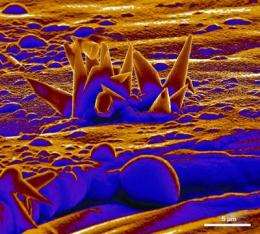
This electron microscope image won first prize in the Chemical & Engineering News photo contest. Credit: Jennifer Atchison

Chemical & Engineering News (C&EN) today announced the winners of its inaugural photo contest. C&EN is the weekly newsmagazine of the American Chemical Society (ACS), the world's largest scientific society.

First place went to Drexel University materials science graduate student Jennifer S. Atchison. She made the silicon nanocones shown (right) in a dazzling, scanning electron microscope image. The cones, barely 1/50,000th the width of a human hair, formed through the decomposition of silane, a silicon-like compound, at a high temperature in a chemical vapor deposition apparatus. It produced the kind of thin films often used by the semiconductor industry.

The second place winner, Robert L. D'Ordine, Ph.D., a biochemist in Ballwin, Mo., submitted a picture of a magnetic stirrer, a beaker of water, and colored paper used to capture a whirring mass of water (water vortex), a familiar laboratory phenomenon. Third place winner Ryan O'Donnell, now a graduate student at Johns Hopkins University, submitted a colorful light microscopy image of ammonium nitrate crystals.

Readers responded enthusiastically to the contest, submitting nearly 250 images on all things chemical. Connected loosely by the broad theme, "Your Science Up Close," the photos in this collection range from the macroscopic to the microscopic and from the everyday lab scene to the "that wasn't supposed to happen." Winners will receive gift cards.

More information: http://pubs.acs.or … 844sci3.html

Provided by American Chemical Society (news : web)


Rank not rated yet
Tags

Related Stories
Relevant PhysicsForums posts
  • Cis-trans Selectivity in Wittig Reactions
    created4 hours ago
  • Chemical Kinetics
    created4 hours ago
  • heat-driven chemical reaction and thermodynamics
    created11 hours ago
  • phenol to benzene
    created15 hours ago
  • TQM, QA and QC
    created16 hours ago
  • oxidising power
    created22 hours ago
  • More from Physics Forums - Chemistry

More news stories

Flesh-eating bacteria inspire superglue

(PhysOrg.com) -- A bio-inspired superglue has been developed by Oxford University researchers that can’t be matched for sticking molecules together and not letting go.

Chemistry / Biochemistry

created 21 hours ago | popularity 5 / 5 (8) | comments 3 | with audio podcast

Scientists create potent molecules aimed at treating muscular dystrophy

While RNA is an appealing drug target, small molecules that can actually affect its function have rarely been found. But now scientists from the Florida campus of The Scripps Research Institute have for the first time designed ...

Chemistry / Biochemistry

created 10 hours ago | popularity 5 / 5 (4) | comments 0 | with audio podcast

Researchers discover what cancer cells need to travel

(PhysOrg.com) -- Cancer cells must prepare for travel before invading new tissues, but new Cornell research has found a possible way to stop these cells from ever hitting the road.

Chemistry / Biochemistry

created 20 hours ago | popularity 4.9 / 5 (12) | comments 0 | with audio podcast

New microfluidic device could be used to diagnose and monitor cancer and other diseases

Separating complex mixtures of cells, such as those found in a blood sample, can offer valuable information for diagnosing and treating disease. However, it may be necessary to search through billions of other ...

Chemistry / Analytical Chemistry

created 20 hours ago | popularity 5 / 5 (2) | comments 0 | with audio podcast

New way to tap largest remaining treasure trove of potential new antibiotics

Scientists are reporting use of a new technology for sifting through the world's largest remaining pool of potential antibiotics to discover two new antibiotics that work against deadly resistant microbes, ...

Chemistry / Biochemistry

created 13 hours ago | popularity 5 / 5 (4) | comments 0


Researchers build first physical 'metatronic' circuit

(PhysOrg.com) -- The technological world of the 21st century owes a tremendous amount to advances in electrical engineering, specifically, the ability to finely control the flow of electrical charges using ...

Spitzer finds solid buckyballs in space

(PhysOrg.com) -- Astronomers using data from NASA's Spitzer Space Telescope have, for the first time, discovered buckyballs in a solid form in space. Prior to this discovery, the microscopic carbon spheres ...

Faster than light neutrinos? More like faulty wiring

You can shelf your designs for a warp drive engine (for now) and put the DeLorean back in the garage; it turns out neutrinos may not have broken any cosmic speed limits after all.

Physicists surprised by disappearing and reappearing superconductivity in iron selenium chalcogenides

Superconductivity is a rare physical state in which matter is able to conduct electricity -- maintain a flow of electrons -- without any resistance. This phenomenon can only be found in certain materials at low temperatures, ...

Stanford research team cracks animated NuCaptcha

(PhysOrg.com) -- The research team from Stanford University, led by Elie Bursztein, that previously had cracked regular CAPTCHAs and then audio CAPTCHAs, now has also successfully cracked the animated version called NuCapt ...

Going up: Japan builder eyes space elevator

A Japanese construction firm claimed Wednesday it could execute an out-of-this-world plan to put tourists in space within 40 years by building an elevator that stretches a quarter of the way to the moon.