Balloon filled with ground coffee makes ideal robotic gripper (w/ Video)
October 25, 2010 By Anne Ju
Balloon filled with ground coffee makes ideal robotic grippe

Enlarge

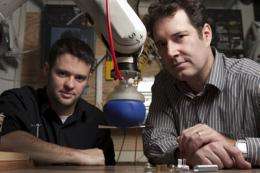
Graduate student John Amend, left, and associate professor Hod Lipson with the universal robotic gripper.

(PhysOrg.com) -- The human hand is an amazing machine that can pick up, move and place objects easily, but for a robot, this "gripping" mechanism is a vexing challenge. Opting for simple elegance, researchers from Cornell University, University of Chicago and iRobot have bypassed traditional designs based around the human hand and fingers, and created a versatile gripper using everyday ground coffee and a latex party balloon.

They call it a universal gripper, as it conforms to the object it's grabbing rather than being designed for particular objects, said Hod Lipson, Cornell associate professor of and computer science. The research is a collaboration between the groups of Lipson, Heinrich Jaeger at the University of Chicago, and Chris Jones at iRobot Corp. It is published today (Oct. 25) online in .

This video is not supported by your browser at this time.

Watch the gripper in action.

"This is one of the closest things we've ever done that could be on the market tomorrow," Lipson said. He noted that the universality of the gripper makes future applications seemingly limitless, from the military using it to dismantle explosive devises or to move potentially dangerous objects, robotic arms in factories, on the feet of a that could walk on walls, or on .

Here's how it works: An everyday party balloon filled with ground coffee – any variety will do – is attached to a robotic arm. The coffee-filled balloon presses down and deforms around the desired object, and then a vacuum sucks the air out of the balloon, solidifying its grip. When the vacuum is released, the balloon becomes soft again, and the gripper lets go.

Jaeger said coffee is an example of a particulate material, which is characterized by large aggregates of individually solid particles.
Particulate materials have a so-called jamming transition, which turns their behavior from fluid-like to solid-like when the particles can no longer slide past each other.
Balloon filled with ground coffee makes ideal robotic gripper (w/ Video)
Enlarge

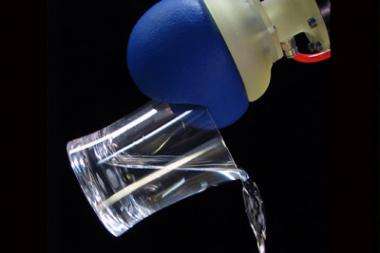
The robotic gripper conforms to the shape of the item it is lifting.

This phenomenon is familiar to coffee drinkers familiar with vacuum-packed coffee, which is hard as a brick until the package is unsealed.

"The ground coffee grains are like lots of small gears," Lipson said. "When they are not pressed together they can roll over each other and flow.
When they are pressed together just a little bit, the teeth interlock, and they become solid."

Jaeger explains that the concept of a "jamming transition" provides a unified framework for understanding and predicting behavior in a wide range of disordered, amorphous materials. All of these materials can be driven into a 'glassy' state where they respond like a solid yet structurally resemble a liquid, and this includes many liquids, colloids, emulsions or foams, as well as particulate matter consisting of macroscopic grains.

"What is particularly neat with the gripper is that here we have a case where a new concept in basic science provided a fresh perspective in a very different area – robotics – and then opened the door to applications none of us had originally thought about," Jaeger said.

Eric Brown, a postdoctoral researcher, and Nick Rodenberg, a physics undergraduate, worked with Jaeger on characterizing the basic mechanisms that enable the gripping action.
Prototypes of the gripper were built and tested by Lipson and Cornell graduate student John Amend as well as at iRobot.

As for the right particulate material, anything that can jam will do in principle, and early prototypes involved rice, couscous and even ground- up tires. They settled on coffee because it's light but also jams well, Amend said. Sand did better on jamming but was prohibitively heavy. What sets the jamming-based gripper apart is its good performance with almost any object, including a raw egg or a coin – both notoriously difficult for traditional robotic grippers.

Provided by Cornell University (news : web)

Filter


Move the slider to adjust rank threshold, so that you can hide some of the comments.


Display comments: newest first

Husky
Oct 25, 2010

Rank: 4 / 5 (1)
sweet! i work with suctioncup robots in the packagingindustry but they only fare good with smooth surfaces and fail at handeling irregular shaped object, i like the elegant low tech solution as compared to individual fingers with costly feedback sensors, micromachinery and complex software algorithms.
random
Oct 25, 2010

Rank: 5 / 5 (1)
One of the oldest problems in robotics has been its anthropocentric fixation on making human- or animal-like robots. All you roboticists out there should take a lesson from this. And tweet it to all your friends while you're at it.
Quantum_Conundrum
Oct 25, 2010

Rank: 3.5 / 5 (4)
I have my reservations about the usefulness of this type of gripper in any manufacturing environment.

New plastic bottles can have edges and "burs" on them which could quickly cut open something like a latex balloon under high positive or negative pressure. Thus any defective product could seriously damage or destroy your palletizer's gripper, and of course, anyone who has ever worked in quality assurance knows it's impossible to prevent all defects of this type.

The other thing is it's very clumsy and unreliable, because of the fact that it is non-intelligent. The operator, or the controlling computer has no way of knowing whether the item is really secure enough to be carried from a conveyor belt to a pallet, for example. It might just fall out on the way over there.

From the demonstration video, it looked as if some of the objects nearly fell out ahead of time just being moved about 1 ft in several seconds.
Quantum_Conundrum
Oct 25, 2010

Rank: 3.5 / 5 (2)
random:

You're getting ahead of yourself.

Everything has it's time and place.

Human-like hands are of course a major goal because they are so flexible and adaptable to such a wide variety of tasks, including building and interfacing with other tools, obviously.

I seriously doubt coffee and balloons will replace a significant number of suction systems or even other grippers, because in the real world it will break too often and make too big of a mess, and in general be a cleaning and maintenance nightmare.

In this guy's laboratory, looks nice. In a real production facility, it's just going to get busted and make a mess.
Husky
Oct 25, 2010

Rank: 4.8 / 5 (4)
i suppose one could find practical ways in a hybrid system, ie, giving plieable flesh to gripper fingers cushioned with this sort of stuff, i can imagine tearing resistant kevlar like skin could replace the latex and coffee could be replaced with magnetic fluids, but then the robot would miss out on the caffeine buzz and stop working after 8 hours...
HealingMindN
Oct 25, 2010

Rank: 5 / 5 (1)
One of the oldest problems in robotics has been its anthropocentric fixation on making human- or animal-like robots. All you roboticists out there should take a lesson from this. And tweet it to all your friends while you're at it.


I agree, this is more like 'Rover' gripping power from 'The Island' in Patrick McGoohan's "The Prisoner."
BrianH
Oct 27, 2010

Rank: not rated yet
Excellent! Obviously, the flexible covering could be made tear-resistent. There are already many tear-proof plastics used in consumer packaging. >:(

Edit note: "devises" is a verb. "Devices" is the noun form.
Rank 5 /5 (26 votes)
Related Stories
Relevant PhysicsForums posts

More news stories

Stanford research team cracks animated NuCaptcha

(PhysOrg.com) -- The research team from Stanford University, led by Elie Bursztein, that previously had cracked regular CAPTCHAs and then audio CAPTCHAs, now has also successfully cracked the animated version called NuCapt ...

Technology / Computer Sciences

created 17 hours ago | popularity 5 / 5 (3) | comments 6 | with audio podcast report

Tiny, implantable medical device can propel itself through bloodstream

Someday, your doctor may turn to you and say, "Take two surgeons and call me in the morning." If that day arrives, you may just have Ada Poon to thank.

Technology / Engineering

created 17 hours ago | popularity 5 / 5 (9) | comments 8 | with audio podcast

Italian engineer invents floating solar panels

Rays of the winter sun bounce off gleaming mirrors on the tiny lake of Colignola in Italy, where engineers have built a cost-effective prototype for floating, rotating solar panels.

Technology / Energy & Green Tech

created 21 hours ago | popularity 4.7 / 5 (6) | comments 5

Microsoft hits Motorola, Google with EU complaint

Microsoft on Wednesday lodged a formal complaint with the European Union's competition regulator against Motorola Mobility and its soon-to-be owner Google, saying Motorola's aggressive enforcement of patent ...

Technology / Business

created 16 hours ago | popularity 2 / 5 (1) | comments 2

Calif. pledges better mobile privacy disclosures

(AP) -- Mobile applications seeking to collect personal information will have to forewarn users as part of an agreement reached in California.

Technology / Internet

created 9 hours ago | popularity not rated yet | comments 0


Researchers build first physical 'metatronic' circuit

(PhysOrg.com) -- The technological world of the 21st century owes a tremendous amount to advances in electrical engineering, specifically, the ability to finely control the flow of electrical charges using ...

Spitzer finds solid buckyballs in space

(PhysOrg.com) -- Astronomers using data from NASA's Spitzer Space Telescope have, for the first time, discovered buckyballs in a solid form in space. Prior to this discovery, the microscopic carbon spheres ...

Faster than light neutrinos? More like faulty wiring

You can shelf your designs for a warp drive engine (for now) and put the DeLorean back in the garage; it turns out neutrinos may not have broken any cosmic speed limits after all.

Physicists surprised by disappearing and reappearing superconductivity in iron selenium chalcogenides

Superconductivity is a rare physical state in which matter is able to conduct electricity -- maintain a flow of electrons -- without any resistance. This phenomenon can only be found in certain materials at low temperatures, ...

CT colonography shown to be comparable to standard colonoscopy

Computerized tomographic (CT) colonography (CTC), also known as virtual colonoscopy, is comparable to standard colonoscopy in its ability to accurately detect cancer and precancerous polyps in people ages 65 and older, according ...

Study: Virtual colonoscopy effective screening tool for adults over 65

Computed tomography (CT) colonography can be used as a primary screening tool for colorectal cancer in adults over the age of 65, according to a new study published online in the journal Radiology.