Identity of Pompeii's mystery horse revealed
November 3, 2010
Pompeii's mystery horse revealed

(PhysOrg.com) -- The identity of a mysterious breed of "horse" which has baffled experts since its remains were uncovered at Pompeii has been resolved by a Cambridge University researcher – who realised it was a donkey.

Academics initially believed that they had unearthed a new, now-extinct, breed of horse when they analysed DNA sequences from skeletons found at a house in the ancient Roman town in 2004.

But Susan Gurney, working with Dr Peter Forster on horse genetics at the University of Cambridge, revisited the study and found that their initial excitement was misplaced.

Writing in the new issue of the Journal of Cellular Biochemistry, Gurney, from the University's Institute of Continuing Education, explains that there appears to have been a mix-up in the lab, which resulted in horse DNA being combined with that of a donkey to create an artificial hybrid.

The research could still prove important, however, as the newly identified donkey may well be the first proof that the "Somali" ass lineage normally found in Italy dates back to at least Roman times.

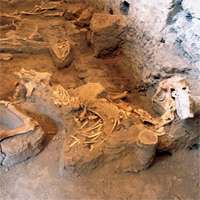
The original study six years ago analysed the skeletons of equids that belonged to a rich Roman household in Pompeii. All five were well preserved by the volcanic ash which covered Pompeii and the nearby settlement of Herculaneum when Mount Vesuvius erupted in AD79.

They were found in the stables at the house of the Casti Amanti (chaste lovers), so-called because its walls have frescoes depicting a romantic scene. This house was probably owned by Caius Iulius Polybius, a wealthy politician and baker in ancient - as shown by the fact that the house contains an open oven and four wheat grindstones.

The team looked at the mitochondrial DNA sequences (mtDNA) of each of the . Four standard mtDNA types were quickly identified, but the fifth "horse" appeared to be of an exotic and mysterious DNA type no longer found today.

In a subsequent paper, the researchers reported that this must be from a different, unknown breed of horse, which had perhaps since disappeared.

When Susan Gurney re-examined the research, however, she realised that they had made an error in the laboratory, accidentally combining a donkey mtDNA sequence with that of a horse, and thus generating a hybrid which had actually never existed at all.

In her journal article, she explains that the first 177 nucleotides (molecules which form the structural units of a DNA sequence) match existing patterns for donkeys. The remaining 193 nucleotides match those of an existing breed of horse.

"Looking at the research with hindsight, it's possible to recognise two separate strands of horse and donkey DNA," she said. "In addition, the horse DNA that appears to have been inadvertently mixed in with the donkey's genetic information is the same type as that found in another Herculaneum horse, which might be the source of the mistake."

Despite the erroneous conclusion, however, the finding is still an important one: The donkey DNA finds its closest match with the DNA of domestic donkeys that are related to the Somali wild ass, typically found in Italy today.

In other European countries, asses are often descended from the Nubian lineage instead.

As a result, the ancient Pompeiian donkey DNA sequence, if confirmed, may well represent the origins of that division, and provide valuable early evidence that the Somali breed appeared in Italy at least as early as Roman times.

Provided by University of Cambridge (news : web)

4.3 /5 (15 votes)  

Rank 4.3 /5 (15 votes)
Related Stories
Relevant PhysicsForums posts
  • Cis-trans Selectivity in Wittig Reactions
    created5 hours ago
  • Chemical Kinetics
    created5 hours ago
  • heat-driven chemical reaction and thermodynamics
    created12 hours ago
  • phenol to benzene
    created16 hours ago
  • TQM, QA and QC
    created16 hours ago
  • oxidising power
    created23 hours ago
  • More from Physics Forums - Chemistry

More news stories

Flesh-eating bacteria inspire superglue

(PhysOrg.com) -- A bio-inspired superglue has been developed by Oxford University researchers that can’t be matched for sticking molecules together and not letting go.

Chemistry / Biochemistry

created 21 hours ago | popularity 5 / 5 (8) | comments 3 | with audio podcast

Scientists create potent molecules aimed at treating muscular dystrophy

While RNA is an appealing drug target, small molecules that can actually affect its function have rarely been found. But now scientists from the Florida campus of The Scripps Research Institute have for the first time designed ...

Chemistry / Biochemistry

created 10 hours ago | popularity 5 / 5 (4) | comments 0 | with audio podcast

Researchers discover what cancer cells need to travel

(PhysOrg.com) -- Cancer cells must prepare for travel before invading new tissues, but new Cornell research has found a possible way to stop these cells from ever hitting the road.

Chemistry / Biochemistry

created 20 hours ago | popularity 4.9 / 5 (12) | comments 0 | with audio podcast

New microfluidic device could be used to diagnose and monitor cancer and other diseases

Separating complex mixtures of cells, such as those found in a blood sample, can offer valuable information for diagnosing and treating disease. However, it may be necessary to search through billions of other ...

Chemistry / Analytical Chemistry

created 20 hours ago | popularity 5 / 5 (2) | comments 0 | with audio podcast

New way to tap largest remaining treasure trove of potential new antibiotics

Scientists are reporting use of a new technology for sifting through the world's largest remaining pool of potential antibiotics to discover two new antibiotics that work against deadly resistant microbes, ...

Chemistry / Biochemistry

created 13 hours ago | popularity 5 / 5 (4) | comments 0


Researchers build first physical 'metatronic' circuit

(PhysOrg.com) -- The technological world of the 21st century owes a tremendous amount to advances in electrical engineering, specifically, the ability to finely control the flow of electrical charges using ...

Spitzer finds solid buckyballs in space

(PhysOrg.com) -- Astronomers using data from NASA's Spitzer Space Telescope have, for the first time, discovered buckyballs in a solid form in space. Prior to this discovery, the microscopic carbon spheres ...

Faster than light neutrinos? More like faulty wiring

You can shelf your designs for a warp drive engine (for now) and put the DeLorean back in the garage; it turns out neutrinos may not have broken any cosmic speed limits after all.

Physicists surprised by disappearing and reappearing superconductivity in iron selenium chalcogenides

Superconductivity is a rare physical state in which matter is able to conduct electricity -- maintain a flow of electrons -- without any resistance. This phenomenon can only be found in certain materials at low temperatures, ...

Stanford research team cracks animated NuCaptcha

(PhysOrg.com) -- The research team from Stanford University, led by Elie Bursztein, that previously had cracked regular CAPTCHAs and then audio CAPTCHAs, now has also successfully cracked the animated version called NuCapt ...

Going up: Japan builder eyes space elevator

A Japanese construction firm claimed Wednesday it could execute an out-of-this-world plan to put tourists in space within 40 years by building an elevator that stretches a quarter of the way to the moon.