Researchers kick-start ancient DNA
November 22, 2010
Researchers kick-start ancient DNA

Enlarge

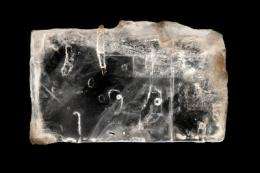
Binghamton University researchers recently revived ancient bacteria trapped for thousands of years in water droplets embedded in salt crystals. Credit: Dave Tuttle

Binghamton University researchers recently revived ancient bacteria trapped for thousands of years in water droplets embedded in salt crystals.

For decades, geologists have looked at these water droplets — called fluid inclusions — and wondered whether microbes could be extracted from them. Fluid inclusions have been found inside salt crystals ranging in age from thousands to hundreds of millions years old.

But there has always been a question about whether the organisms cultured from salt crystals are genuinely ancient material or whether they are modern-day contaminants, said Tim Lowenstein, professor of geological sciences and environmental studies at Binghamton.

Lowenstein and Binghamton colleague J. Koji Lum, professor of anthropology and of biological sciences, believe they have resolved this doubt. And they've received $400,000 from the National Science Foundation to support further research on the topic.

Lowenstein's team, which has been pursuing this problem for years, began by examining the fluid inclusions under a microscope. "Not only did we find bacteria, we found several types of algae as well," he said. "The algae actually may be the food on which the bacteria survive for tens of thousands of years."

When Lum got involved, the researchers began to wonder about the DNA of the organisms they were finding.

"You have a little trapped ecosystem," Lum said. "Some of these guys are feeding on other ones trapped in this space. The things that aren't alive in there, their DNA is still preserved."

Lum's graduate student Krithivas Sankaranarayanan reviewed existing literature on ancient DNA and helped to develop a protocol for use with Lowenstein's samples.

"We have these samples going back from the present to over 100,000 years in one exact location," Lum said. "So Tim can look at the salinity and reconstruct ancient climates. Now we're looking at the DNA from bacteria, the algae, the fungi and what was living in those waters and how those things changed over time. We have a view of all the different organisms that were in the lakes at the time these inclusions were formed."
Researchers kick-start ancient DNA
Enlarge

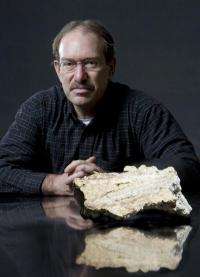
Tim Lowenstein, professor of geological sciences and environmental studies at Binghamton University, recently revived ancient bacteria trapped for thousands of years in water droplets embedded in salt crystals. Credit: Jonathan Cohen

The researchers sequence the DNA and culture the bacteria they find. Then it's time to think big. Lum's most optimistic view of the project goes like this: "It's possible that we can observe organisms evolving and see how they're reacting to climate change over geologic time."

The samples Lowenstein works with are drawn from Death Valley and Saline Valley in California as well as from sites in Michigan, Kansas and Italy.

Temperatures at these locations may have reached 130 degrees Fahrenheit in the past, and the pockets of water trapped inside the rocks are generally very salty.

The environment may sound harsh — in fact, it's among the most extreme on Earth — but the creatures that survive there are tough.

"These are some of the hardiest beasts on the planet," Lum said. And the conditions inside these are ideally suited to preserving DNA.

"They're like time capsules," Lowenstein agreed.

Provided by Binghamton University

4.4 /5 (9 votes)  

Filter


Move the slider to adjust rank threshold, so that you can hide some of the comments.


Display comments: newest first

ThanderMAX
Nov 23, 2010

Rank: not rated yet
Is it really worth reviving ?
tkjtkj
Nov 23, 2010

Rank: 5 / 5 (1)
This is very valuable work! It is NOT about the value of the DNA to our daily lives: it is about a 'recording' of some of earth's ancient history to the present.. like a virtual 'library' into history!

Very commendable, and totally understandable that it was funded!

Rank 4.4 /5 (9 votes)
Related Stories
Relevant PhysicsForums posts
  • Eye biology videos
    created4 hours ago
  • Flowering Plant Revived After 30,000 Years in Permafrost
    createdFeb 21, 2012
  • Toba volcano eruptions - 1.000 - 10,000 breeding pairsunb
    createdFeb 20, 2012
  • How is a specific gene removed from DNA
    createdFeb 20, 2012
  • Reproduction and Human evolution
    createdFeb 19, 2012
  • Viruses: Living or Non-living organisms
    createdFeb 19, 2012
  • More from Physics Forums - Biology

More news stories

Surprising diversity at a synapse hints at complex diversity of neural circuitry

A new study reveals a dazzling degree of biological diversity in an unexpected place – a single neural connection in the body wall of flies.

Biology / Other

created 11 hours ago | popularity 5 / 5 (4) | comments 0 | with audio podcast

Men might not 'become extinct' after all: Theory of the 'rotting' Y chromosome dealt a fatal blow

If you were to discover that a fundamental component of human biology has survived virtually intact for the past 25 million years, you'd be quite confident in saying that it is here to stay.

Biology / Biotechnology

created 14 hours ago | popularity 5 / 5 (6) | comments 1 | with audio podcast

New family of legless amphibians found in India

Since before the age of dinosaurs it has burrowed unbothered beneath the monsoon-soaked soils of remote northeast India - unknown to science and mistaken by villagers as a deadly, miniature snake.

Biology / Plants & Animals

created 21 hours ago | popularity 5 / 5 (9) | comments 3

Climate change affects bird migration timing in North America

Bird migration timing across North America has been affected by climate change, according to a study published Feb. 22 in the open access journal PLoS ONE.

Biology / Ecology

created 10 hours ago | popularity 4.5 / 5 (2) | comments 2

New iridescent lizard species found in Cambodia

A new species of lizard with striking iridescent rainbow skin, a long tail and very short legs has been discovered in the rainforest in northeast Cambodia, conservationists announced Wednesday.

Biology / Plants & Animals

created 10 hours ago | popularity not rated yet | comments 0


Researchers build first physical 'metatronic' circuit

(PhysOrg.com) -- The technological world of the 21st century owes a tremendous amount to advances in electrical engineering, specifically, the ability to finely control the flow of electrical charges using ...

Spitzer finds solid buckyballs in space

(PhysOrg.com) -- Astronomers using data from NASA's Spitzer Space Telescope have, for the first time, discovered buckyballs in a solid form in space. Prior to this discovery, the microscopic carbon spheres ...

Faster than light neutrinos? More like faulty wiring

You can shelf your designs for a warp drive engine (for now) and put the DeLorean back in the garage; it turns out neutrinos may not have broken any cosmic speed limits after all.

Physicists surprised by disappearing and reappearing superconductivity in iron selenium chalcogenides

Superconductivity is a rare physical state in which matter is able to conduct electricity -- maintain a flow of electrons -- without any resistance. This phenomenon can only be found in certain materials at low temperatures, ...

Stanford research team cracks animated NuCaptcha

(PhysOrg.com) -- The research team from Stanford University, led by Elie Bursztein, that previously had cracked regular CAPTCHAs and then audio CAPTCHAs, now has also successfully cracked the animated version called NuCapt ...

Going up: Japan builder eyes space elevator

A Japanese construction firm claimed Wednesday it could execute an out-of-this-world plan to put tourists in space within 40 years by building an elevator that stretches a quarter of the way to the moon.