Neuroscience of instinct: How animals overcome fear to obtain food (w/ Video)
November 29, 2010
Neuroscience of instinct: How animals overcome fear to obtain food

Enlarge

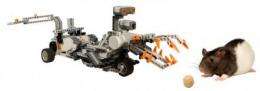
Pictured is a LEGO Mindstorms robot programmed to simulate predatory attack on a rat seeking food in a semi-naturalistic environment. The findings demonstrate that without the functioning amygdala and consequently devoid of fear, the animal’s foraging behavior becomes perilously maladaptive, whereas an overactive amygdala hinders foraging decision even under safe circumstances. Credit: Image courtesy of June-Seek Choi and Jeansok Kim.

(PhysOrg.com) -- When crossing a street, we look to the left and right for cars and stay put on the sidewalk if we see a car close enough and traveling fast enough to hit us before we're able to reach the other side. It's an almost automatic decision, as though we instinctively know how to keep ourselves safe.

Now neuroscientists have found that other animals are capable of making similar instinctive safety decisions. In a study published online the week of Nov. 29 in the , University of Washington researcher Jeansok Kim demonstrates that weigh their odds of safely retrieving pellets placed at varying distances from a perceived predator.

"When animals go out to , they're taking a risk," said Kim, a UW psychology professor. "They're leaving the safety of their nests, venturing out where there may be that could eat them."

But staying in the nest is not a safe option either, rats need to get out and find food. How do they decide whether it's safe to leave the nest? Kim and co-author June-Seek Choi, a visiting professor in the UW psychology department from Korea University, studied how the amygdala – known to be an important brain area for perceiving and reacting to fear – was involved in the rats' decisions to risk their safety for food.

In humans, impaired amygdala activity has been linked to risky decision-making, such as gambling. And an overactive amygdala could explain anxiety disorders, including post-traumatic stress disorder and phobias.

Kim and Choi trained male rats to retrieve a food pellet placed at varying distances from a safety zone, or nest. The rats, hungry from a restricted food supply for several days, quickly learned to retrieve the food pellets. (See a video of rats foraging, watch "Foraging baseline day 5" below).

This video is not supported by your browser at this time.

Foraging baseline day 5

The researchers introduced a "predator," an alligator-shaped robot that was programmed to snap its jaws and surge at the rats. With a body made of gray LEGO blocks and fangs of bright orange LEGOS, the LEGO Mindstorms Robogator was about twice the size of the rats. The researchers programmed the robot to lurch forward about 9 inches, open and shut its mouth and then return to its resting spot far away from the rats' nest.

With the robot in place, the rats began foraging as usual. When they neared the food, the Robogator quickly moved toward the rats and snapped its jaws. The rats scurried back to the safety of the nest and then momentarily froze – a typical fear response.

Still hungry, the rats paced back in forth in the nest areas, hidden from the Robogator (see video "Robot encounter day 1: Pre-amygdalar lesion"). Slowly they re-emerged and cautiously approached the food, while the Robogator continued its aggressive movements whenever the rats neared the food pellet. Most rats learned that they could safely retrieve the food pellet placed closest, 10 inches, from their nest and not intersect the robot's path. None of the rats obtained the pellet nearer the Robogator, about 30 inches from the nest.

This video is not supported by your browser at this time.

Robot encounter day 1 - Pre-amygdalar lesion

Kim compared the rats' decision-making process to the classic math problem that asks when two trains leaving at different times from different places and traveling at different speeds will pass each other. With a predator nearby, Kim said, rats gauge how quickly they can run to the food, how quickly the predator moves and how far away the pellet is from the rat and from the predator. If they judge that there's a chance the rat and robot will cross paths, they don't attempt to get the food.

"Like when people cross the street, we just tend to automatically have a sense of what is safe," Kim said. "I think that most animals have that capability in their nervous system. Through our amygdala, we instinctively know what keeps us safe."

Overactive amygdala could explain anxiety disorders and irrational fears in humans, Kim said. Brain imaging studies show heightened amygdala activity in patients with post-traumatic stress disorder. Underactive amygdala could be linked to risk-taking and impulsive behaviors.

To study this in rats, the researchers created amygdala lesions and observed the rats' subsequent interactions with the robot. Rats with lesions were unperturbed by the Robogator, and when food was placed near the predator the rats ran straight for the food, barely flinching when the Robogator lunged and snapped (see video "Robot encounter day 2: Post-amygdalar lesion" below). The same was true when the researchers inactivated the amygdala with the chemical muscimol.

This video is not supported by your browser at this time.

Robot encounter day 2 - Post-amygdalar lesion

When Kim and Choi increased the activity, the rats showed greater fear. Even when the food was at a safe distance from the robot, rats treated with the drug bicuculline, which increases neural activity, were too afraid to venture out for the pellet.

"Because humans share many biological and behavioral features with animals, experimental studies with rats provide valuable information toward understanding the physiological as well as the psychological aspects of fear," Kim said.

Provided by University of Washington (news : web)

4.9 /5 (9 votes)  

Filter


Move the slider to adjust rank threshold, so that you can hide some of the comments.


Display comments: newest first

jtdrexel
Nov 30, 2010

Rank: not rated yet
Title: "Neuroscience of instinct: How animals overcome fear to obtain food". The rat didn't overcome fear to obtain food. Inhibiting the amygdala reduces its anxiety and makes the rat more or a risk taker to obtain food! Wasn't this information already known or is this new finding?
El_Nose
Nov 30, 2010

Rank: not rated yet
wow -- just a minor disagreement with the author of the article - he state we automatically look left and right as an instint to keep ourselves safe-- but this is not an instinct it is a learned responce to crossing a street... my mom taught me to look both ways --- the reason children get hit by cars is because they have not been taught to look before crossing, is he suggesting they have bad instincts? -- there are no instincts about streets a man made infrastructure... otherwise the deaths of dogs would be lower... and they would know better than to chase a 5 ton piece of stell going 30 mph
Rank 4.9 /5 (9 votes)
Related Stories
Relevant PhysicsForums posts
  • stomach not emptying
    createdFeb 16, 2012
  • White reflections in photos in one eye
    createdFeb 15, 2012
  • Is Everyday Technology Killing Us?
    createdFeb 08, 2012
  • Exercise and weight loss
    createdFeb 08, 2012
  • Why do we have head aches? Our brains can't feel anything.
    createdFeb 07, 2012
  • "The end of diseases" by David Agus, interview from Daily Show with Jon Stewart
    createdFeb 04, 2012
  • More from Physics Forums - Medical Sciences

More news stories

What can animals' survival instincts tell us about understanding human emotion?

Can animals' survival instincts shed additional light on what we know about human emotion? New York University neuroscientist Joseph LeDoux poses this question in outlining a pioneering theory, drawn from two decades of research, ...

Medicine & Health / Neuroscience

created 14 hours ago | popularity 5 / 5 (3) | comments 4 | with audio podcast

CT colonography shown to be comparable to standard colonoscopy

Computerized tomographic (CT) colonography (CTC), also known as virtual colonoscopy, is comparable to standard colonoscopy in its ability to accurately detect cancer and precancerous polyps in people ages 65 and older, according ...

Medicine & Health / Cancer

created 3 hours ago | popularity not rated yet | comments 0

Study: Virtual colonoscopy effective screening tool for adults over 65

Computed tomography (CT) colonography can be used as a primary screening tool for colorectal cancer in adults over the age of 65, according to a new study published online in the journal Radiology.

Medicine & Health / Other

created 3 hours ago | popularity not rated yet | comments 0

Injectable gel could repair tissue damaged by heart attack

(Medical Xpress) -- University of California, San Diego researchers have developed a new injectable hydrogel that could be an effective and safe treatment for tissue damage caused by heart attacks.

Medicine & Health / Cardiology

created 18 hours ago | popularity 4.7 / 5 (6) | comments 3 | with audio podcast

Mini molecules could help fight battle of aortic bulge

When aortic walls buckle, the body's main blood pipe forms an ever-growing bulge. To thwart a deadly rupture, a team of Stanford University School of Medicine researchers has found two tiny molecules that may be able to orchestrate ...

Medicine & Health / Cardiology

created 13 hours ago | popularity 5 / 5 (1) | comments 0 | with audio podcast


Researchers build first physical 'metatronic' circuit

(PhysOrg.com) -- The technological world of the 21st century owes a tremendous amount to advances in electrical engineering, specifically, the ability to finely control the flow of electrical charges using ...

Spitzer finds solid buckyballs in space

(PhysOrg.com) -- Astronomers using data from NASA's Spitzer Space Telescope have, for the first time, discovered buckyballs in a solid form in space. Prior to this discovery, the microscopic carbon spheres ...

Faster than light neutrinos? More like faulty wiring

You can shelf your designs for a warp drive engine (for now) and put the DeLorean back in the garage; it turns out neutrinos may not have broken any cosmic speed limits after all.

Physicists surprised by disappearing and reappearing superconductivity in iron selenium chalcogenides

Superconductivity is a rare physical state in which matter is able to conduct electricity -- maintain a flow of electrons -- without any resistance. This phenomenon can only be found in certain materials at low temperatures, ...

Stanford research team cracks animated NuCaptcha

(PhysOrg.com) -- The research team from Stanford University, led by Elie Bursztein, that previously had cracked regular CAPTCHAs and then audio CAPTCHAs, now has also successfully cracked the animated version called NuCapt ...

Going up: Japan builder eyes space elevator

A Japanese construction firm claimed Wednesday it could execute an out-of-this-world plan to put tourists in space within 40 years by building an elevator that stretches a quarter of the way to the moon.