Study suggests reliance on GPS may reduce hippocampus function as we age
November 18, 2010 by Lin Edwards
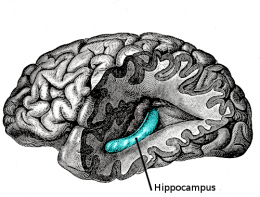
The hippocampus is located in the medial temporal lobe of the brain. Image via Wikipedia.
(PhysOrg.com) -- McGill University researchers have presented three studies suggesting depending on GPS to navigate may have a negative effect on brain function, especially on the hippocampus, which is involved in memory and navigation processes.
There are two major ways of navigating: by spatial navigation or by stimulus-response methods. The spatial method uses landmarks and visual cues to develop cognitive maps that enable us to know where we are and how to get where we want to go. The second method relies on repeatedly traveling by the most efficient route, as though on auto-pilot. The second method will be familiar to those using GPS.
Functional magnetic resonance imaging (fMRI) scans were taken of older adults who were GPS and non-GPS users. The subjects accustomed to navigating by spatial means were found to have higher activity and a greater volume of grey matter in the hippocampus than those used to relying on GPS. These adults also did better on a standardized test used in the diagnosis of mild cognitive impairment, which often precedes the onset of Alzheimers disease.
The hippocampus is believed to be involved in memory and in navigation processes such as the ability to find new routes and identify short cuts. It is one of the first areas of the brain to be affected by Alzheimers disease, which results in memory loss and difficulties in spatial orientation.
An earlier study by University of London researchers showed that in London taxi drivers, who spend three years learning their way around London by spatial methods rather than GPS), part of their hippocampus is larger than in a control group of non-taxi drivers. See the PhysOrg article: http://www.physorg.com/news140336390.html, for example. As in the current research, the presence of a link does not necessarily show causality, and in the London cabbies, the sheer volume of knowledge they must gather may also be involved.
Neuroscientist Veronique Bohbot of McGill University in Montreal, Canada, said the results of the studies suggest using spatial memory regularly may improve the function of the hippocampus and could help ward off cognitive impairment as we age.
Bohbot suggested it may be wise to restrict GPS use to an aid in finding the way to a new destination, but to turn it off on the way back or when going somewhere that is not new. Building cognitive maps takes time and effort, but with the hippocampus, it may be a case of use it or lose it, and Bohbot said she does have fears that reducing the use of spatial navigation strategies may lead to earlier onset of Alzheimers or dementia.
The McGill University studies were presented at the Society for Neuroscience's annual meeting last weekend.
More information: Neuroscience's annual meeting: http://www.sfn.org/am2010/
© 2010 PhysOrg.com
-
Physical fitness improves spatial memory, increases size of brain structure
Feb 24, 2009 |
not rated yet |
0
-
'Mind-reading' experiment highlights how brain records memories
Mar 12, 2009 |
not rated yet |
0
-
Automated MRI technique assists in earlier Alzheimer's diagnosis
Jun 24, 2008 |
not rated yet |
0
-
Researchers seek to map the brain patterns of Alzheimer's disease
Jan 17, 2009 |
not rated yet |
0
-
Cracking the spatial memory code
Mar 12, 2009 |
not rated yet |
0
-
Stars containing dark matter should look different from other stars
Feb 20, 2012 |
4.5 / 5 (17) |
11
-
Physicists discover evidence of rare hypernucleus, a component of strange matter
Feb 17, 2012 |
4.7 / 5 (38) |
22
-
Fast photon control brings quantum photonic technologies closer
Feb 13, 2012 |
5 / 5 (8) |
1
-
Engineers build first sub-10-nm carbon nanotube transistor
Feb 01, 2012 |
4.9 / 5 (36) |
32
-
Something old, something new: Evolution and the structural divergence of duplicate genes
Jan 31, 2012 |
4.6 / 5 (7) |
1
-
stomach not emptying
Feb 16, 2012
-
White reflections in photos in one eye
Feb 15, 2012
-
Is Everyday Technology Killing Us?
Feb 08, 2012
-
Exercise and weight loss
Feb 08, 2012
-
Why do we have head aches? Our brains can't feel anything.
Feb 07, 2012
-
"The end of diseases" by David Agus, interview from Daily Show with Jon Stewart
Feb 04, 2012
- More from Physics Forums - Medical Sciences
More news stories
CT colonography shown to be comparable to standard colonoscopy
Computerized tomographic (CT) colonography (CTC), also known as virtual colonoscopy, is comparable to standard colonoscopy in its ability to accurately detect cancer and precancerous polyps in people ages 65 and older, according ...
3 hours ago |
not rated yet |
0
What can animals' survival instincts tell us about understanding human emotion?
Can animals' survival instincts shed additional light on what we know about human emotion? New York University neuroscientist Joseph LeDoux poses this question in outlining a pioneering theory, drawn from two decades of research, ...
Medicine & Health / Neuroscience
14 hours ago |
5 / 5 (3) |
4
|
Study: Virtual colonoscopy effective screening tool for adults over 65
Computed tomography (CT) colonography can be used as a primary screening tool for colorectal cancer in adults over the age of 65, according to a new study published online in the journal Radiology.
3 hours ago |
not rated yet |
0
Injectable gel could repair tissue damaged by heart attack
(Medical Xpress) -- University of California, San Diego researchers have developed a new injectable hydrogel that could be an effective and safe treatment for tissue damage caused by heart attacks.
Medicine & Health / Cardiology
17 hours ago |
4.7 / 5 (6) |
3
|
Mini molecules could help fight battle of aortic bulge
When aortic walls buckle, the body's main blood pipe forms an ever-growing bulge. To thwart a deadly rupture, a team of Stanford University School of Medicine researchers has found two tiny molecules that may be able to orchestrate ...
Medicine & Health / Cardiology
13 hours ago |
5 / 5 (1) |
0
|
Researchers build first physical 'metatronic' circuit
(PhysOrg.com) -- The technological world of the 21st century owes a tremendous amount to advances in electrical engineering, specifically, the ability to finely control the flow of electrical charges using ...
Spitzer finds solid buckyballs in space
(PhysOrg.com) -- Astronomers using data from NASA's Spitzer Space Telescope have, for the first time, discovered buckyballs in a solid form in space. Prior to this discovery, the microscopic carbon spheres ...
Faster than light neutrinos? More like faulty wiring
You can shelf your designs for a warp drive engine (for now) and put the DeLorean back in the garage; it turns out neutrinos may not have broken any cosmic speed limits after all.
Physicists surprised by disappearing and reappearing superconductivity in iron selenium chalcogenides
Superconductivity is a rare physical state in which matter is able to conduct electricity -- maintain a flow of electrons -- without any resistance. This phenomenon can only be found in certain materials at low temperatures, ...
Stanford research team cracks animated NuCaptcha
(PhysOrg.com) -- The research team from Stanford University, led by Elie Bursztein, that previously had cracked regular CAPTCHAs and then audio CAPTCHAs, now has also successfully cracked the animated version called NuCapt ...
Going up: Japan builder eyes space elevator
A Japanese construction firm claimed Wednesday it could execute an out-of-this-world plan to put tourists in space within 40 years by building an elevator that stretches a quarter of the way to the moon.
Nov 18, 2010
Rank: 3 / 5 (1)
Also, comparing London taxi drivers to the normal population is a bit of a stretch - it's like comparing elite Olympic athletes to weekend golfers.
Nov 18, 2010
Rank: 4 / 5 (1)
Nov 18, 2010
Rank: 4 / 5 (1)
On the other hand, I now have to remember 20 different password-login combinations, some of which I have to change every 3 months, the PINs of multiple credit/debit cards, and a couple phone numbers.
Nov 18, 2010
Rank: 4 / 5 (1)
Nov 18, 2010
Rank: not rated yet
Dec 16, 2010
Rank: not rated yet