Scientists show universality in the brain evolution
November 4, 2010
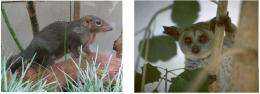
The ancestors of tree shrew (left) and bush baby (right) have been on separate evolutionary paths since 65 million years. Visual processing centers of their brains, nevertheless, display a common design. Picture source: Wikimedia Commons
(PhysOrg.com) -- Scientists have uncovered a self-organizing biological principle in the brains of three very different, genetically diverse mammals -- but in all three they found the same mathematically precise "pinwheel" organization and orientation of neurons.
The scientists found that this visual cortex is self-organized, through neuronal activity and not through genes or environment (for example, ferrets raised in the dark still have this type of organization in their developing brains).
The most straightforward way to summarize the importance of this work is to say that this new study demonstrates that complex patterns of connections in the brain are capable of self-organizing with mathematical precision.
In fact, the notion that a complex pattern can appear in a dynamical system without a central authority or planner has been understood, for example, in the field of physics.
However, in the biological sciences, and in the field neuroscience in particular, self-organization as a developmental force seldom has been recognized. This study, of which Duke researcher Leonard White, PhD., in Duke neurobiology was an author, provides, if not the first, certainly the most well documented case for this agency in brain development. This precise structure arises both from ongoing activity and lateral interactions of the neurons as well as across a neural network.
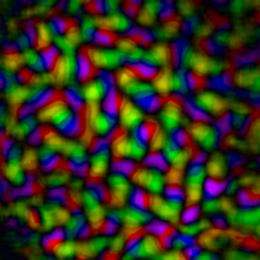
This image shows an orientation preference map from a prosimian primate, the galago. In this image, the colors represent the activity of columns of neurons that respond preferentially to particular angles in the visual world, such as horizontal (red regions) and vertical (blue regions). The brightness of the colors indicates how selective is the response of neurons in any given position in the map. Pinwheels are those smaller regions in the map where all colors are organized around a central dark point. The entire image shows about 60 square millimeters of the primary visual processing area in the brain of a galago. Image credit: Duke University
The findings, published today in Science, may cause scientists to think in new ways about how such a complex system as the human brain with its 100 billion neurons, gets wired up to begin with, given the relative dearth of genes in the human genome and the relative lack of environmental experiences in the newborn that already has advanced neural architecture in its cerebral cortex.This demonstration of self-organization in brain development may also have implications for rehabilitation in the brains of people recovering from neurological injury or disease. As neural circuits in the recovering brain reactivate growth programs that shaped development earlier in life, it seems likely that self-organization will continue to influence the architecture of neural circuits whenever they are plastic and capable of changing their strength and the distribution of their connections.
The challenge for future studies will be to understand how genetic instructions and early life experiences interact within a self-organizing network of brain cells, and how such interactions can be optimized to enhance function in normal developing brains, as well as in mature brains that have to adapt to injury and disease.
A word about the orientation of the neurons: The orientation is such that from any central neuron, the surrounding neurons are in a repeat pattern of orientation, and that central neuron is also a part of the repeat pattern in a neighboring pinwheel, with mathematical precision. Neurons respond to vertical, horizontal or oblique patterns to create the images that brains can assimilate and process as our 3-D world.
More information: Universality in the Evolution of Orientation Columns in the Visual Cortex, Matthias Kaschube et al., Science, November 5, 2010.
-
New adult brain cells may be central to lifelong learning
May 23, 2007 |
not rated yet |
0
-
Nerve fibers need specific growth factor chemical to form connections within the brain
Nov 20, 2006 |
not rated yet |
0
-
Brain's timing linked with timescales of the natural visual world
Sep 05, 2007 |
not rated yet |
0
-
Stem-cell therapies for brain more complicated than thought
Nov 27, 2007 |
not rated yet |
0
-
Yale team finds neural thermostat keeps brain running efficiently
Jan 13, 2010 |
not rated yet |
0
-
Stars containing dark matter should look different from other stars
Feb 20, 2012 |
4.5 / 5 (17) |
11
-
Physicists discover evidence of rare hypernucleus, a component of strange matter
Feb 17, 2012 |
4.7 / 5 (38) |
22
-
Fast photon control brings quantum photonic technologies closer
Feb 13, 2012 |
5 / 5 (8) |
1
-
Engineers build first sub-10-nm carbon nanotube transistor
Feb 01, 2012 |
4.9 / 5 (36) |
32
-
Something old, something new: Evolution and the structural divergence of duplicate genes
Jan 31, 2012 |
4.6 / 5 (7) |
1
-
Eye biology videos
4 hours ago
-
Flowering Plant Revived After 30,000 Years in Permafrost
Feb 21, 2012
-
Toba volcano eruptions - 1.000 - 10,000 breeding pairsunb
Feb 20, 2012
-
How is a specific gene removed from DNA
Feb 20, 2012
-
Reproduction and Human evolution
Feb 19, 2012
-
Viruses: Living or Non-living organisms
Feb 19, 2012
- More from Physics Forums - Biology
More news stories
Surprising diversity at a synapse hints at complex diversity of neural circuitry
A new study reveals a dazzling degree of biological diversity in an unexpected place a single neural connection in the body wall of flies.
11 hours ago |
5 / 5 (4) |
0
|
Men might not 'become extinct' after all: Theory of the 'rotting' Y chromosome dealt a fatal blow
If you were to discover that a fundamental component of human biology has survived virtually intact for the past 25 million years, you'd be quite confident in saying that it is here to stay.
14 hours ago |
5 / 5 (6) |
1
|
New family of legless amphibians found in India
Since before the age of dinosaurs it has burrowed unbothered beneath the monsoon-soaked soils of remote northeast India - unknown to science and mistaken by villagers as a deadly, miniature snake.
21 hours ago |
5 / 5 (9) |
3
Climate change affects bird migration timing in North America
Bird migration timing across North America has been affected by climate change, according to a study published Feb. 22 in the open access journal PLoS ONE.
10 hours ago |
4.5 / 5 (2) |
2
New iridescent lizard species found in Cambodia
A new species of lizard with striking iridescent rainbow skin, a long tail and very short legs has been discovered in the rainforest in northeast Cambodia, conservationists announced Wednesday.
10 hours ago |
not rated yet |
0
Researchers build first physical 'metatronic' circuit
(PhysOrg.com) -- The technological world of the 21st century owes a tremendous amount to advances in electrical engineering, specifically, the ability to finely control the flow of electrical charges using ...
Spitzer finds solid buckyballs in space
(PhysOrg.com) -- Astronomers using data from NASA's Spitzer Space Telescope have, for the first time, discovered buckyballs in a solid form in space. Prior to this discovery, the microscopic carbon spheres ...
Faster than light neutrinos? More like faulty wiring
You can shelf your designs for a warp drive engine (for now) and put the DeLorean back in the garage; it turns out neutrinos may not have broken any cosmic speed limits after all.
Physicists surprised by disappearing and reappearing superconductivity in iron selenium chalcogenides
Superconductivity is a rare physical state in which matter is able to conduct electricity -- maintain a flow of electrons -- without any resistance. This phenomenon can only be found in certain materials at low temperatures, ...
Stanford research team cracks animated NuCaptcha
(PhysOrg.com) -- The research team from Stanford University, led by Elie Bursztein, that previously had cracked regular CAPTCHAs and then audio CAPTCHAs, now has also successfully cracked the animated version called NuCapt ...
Going up: Japan builder eyes space elevator
A Japanese construction firm claimed Wednesday it could execute an out-of-this-world plan to put tourists in space within 40 years by building an elevator that stretches a quarter of the way to the moon.

Nov 05, 2010
Rank: 1 / 5 (7)
So that's the only fact that can be deduced from the research. NOT that the brains of the animals evolved in a universal manner - that's just speculation. And on top of it, the article's heading is totally misleading, implying an evolutionary conclusion where non is to be had. When sticking to the facts, no place can be found for any evolutionary thinking in this case [ and most other cases as well ]. The [molecules to man] evolutionary thought usually simply pays homage to the god of evolution rather than contributes to the research. It is just ad-hoc additions to show that the researchers are in the evo camp and should therefore continue to be funded.
Nov 05, 2010
Rank: 1 / 5 (1)
Nov 05, 2010
Rank: 5 / 5 (3)
Nov 05, 2010
Rank: 5 / 5 (4)
Nov 05, 2010
Rank: 3.7 / 5 (3)
Nov 05, 2010
Rank: 4.7 / 5 (3)
He's been repeatedly educated and given multiple references by which he could rectify his fantastic ignorance, yet he refuses to so much as read.
He is the king of fools.
Nov 06, 2010
Rank: 1 / 5 (5)
Nov 07, 2010
Rank: 4 / 5 (4)
The idea that all existing things must have been created is a fundamentally abrahamistic idea.
There are other belief systems where things never are created, but only transformed.
And even without any belief system there's nothing to prevent one from assuming that the universe knows no creation, but only transformations.
Read about the "Cyclic Universe" by Steinhardt and Turok.
Nov 07, 2010
Rank: 5 / 5 (2)
Nov 07, 2010
Rank: 1 / 5 (2)
Mr skeptic should be just as skeptical of evolution as he is creation. I am still sensing some ad hominem emotion in his text. At least frajo is offering replies related to the subject.
We all come to the table with philisophical vantage points. Your evolutionist scientists do that all the time. They can look at a fossil and the idea of creation doesn't even enter their mind.
They assume millions of years without a second thought. By the way, I am not Catholic, unfortunately, most of them follow the Pope, who believes your way. So your last comment there, makes no sense for me.
Nov 07, 2010
Rank: 1 / 5 (3)
1) The process still had to have a beginning
2) Entropy demands that the energy would eventually run out, unless there is a new energy source.
But where would that new energy come from? Does the universe follow other laws of physics, where some perpetual motion device provides energy? But, where would that have come from? So this cyclical idea is full of logical obsticles, and is only a deterent from facing the truth, that in the beginning, God created the universe.
Science says that matter and energy cannot be created, only destroyed, so then the universe has to be closed, and finite. The amount of matter and energy that exists, what God created, is all there is. Thus, science agrees with creation.