Baking soda dramatically boosts oil production in algae
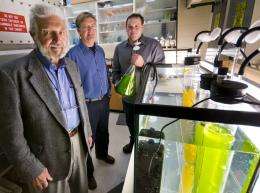
Montana State University researchers have discovered that baking soda can dramatically increase algae's production of the key oil precursors for biodiesel.
The same ingredient that causes cookies to rise in the oven, the same agent that calms upset stomachs and removes odors from refrigerators is the elusive chemical trigger that scientists have sought since the early 1990s, said Rob Gardner, an MSU graduate student in chemical and biological engineering and a native of Afton, Wyo.
When added at a particular time in the growing cycle, baking soda more than doubled the amount of oil produced in half the time in three different types of algae.
"It took a lot of work. I was pretty thrilled when it all came together," Gardner said. "I'm still kind of in shock about it."
Gardner is part of the team that developed the algal biofuel technology that MSU is now offering for licensing. Other members are longtime algae experts -- Keith Cooksey, research professor emeritus in microbiology, and Brent Peyton, professor in chemical and biological engineering and associate director of MSU's Thermal Biology Institute. Representing the College of Engineering and College of Letters and Science, all three belong to MSU's Algal Biofuels Group, "one of the best cooperative research groups on campus," according to Cooksey.
The Algal Biofuels Group is part of MSU's MSU's Energy Research Institute, an umbrella for roughly 35 faculty working in a variety of disciplines. About $15 million in sponsored energy research is conducted at MSU annually.
"We are looking at everything from biofuels, to fuel cells, to wind, to carbon sequestration," said Lee Spangler, Energy Research Institute director. "This work by the algal group is an exciting example of how we take university research and make it available to the private sector through licensing."
The algal group also belong to the Algal Biomass Organization, the world's largest group devoted to algal biofuel. Peyton presented MSU's discovery to that group in late September. It was one of four presentations on biofuel from MSU.
The search for a chemical trigger to boost oil production in algae was a long, sometimes torturous, journey, according to the three MSU scientists. Not only did they have to find a chemical that would work, but they had to figure out the best time to add it to the algae. Cooksey taught Gardner how to grow the algae they used in their experiments. Gardner grew the algae in beakers and tubes in three labs across campus. He then conducted experiments and shared his progress with Cooksey and Peyton. Gardner worked for about 1 1/2 years before the trio confirmed that baking soda was the chemical trigger they'd been seeking. They made their initial discovery in two kinds of brown algae and one type of green.
"It was a lot of trial and error and failure," Gardner said. "We finally came across the right combination."
Cooksey said baking soda may work because it gives algae extra carbon dioxide necessary for its metabolism at a key point in its life cycle. If the baking soda is added too early or too late, the algae don't respond. But when added at just the right time in the growth cycle, algae produce two to three times the oil in half the time of conventional growth models. The oil, or lipid, is composed of triacylglycerides, the key precursors to biodiesel and biojet fuel.
"For industry, if you double your output in half the time, that's a big deal," Cooksey said.
Reducing the amount of time needed to produce oil is also good because algal-producing ponds are prone to contamination, he added. If growers can produce oil faster, they can reduce the opportunity for contamination to ruin the product.
Peyton said the three types of algae used in the MSU study were not closely related, so the MSU discovery should have broad application.
"We are working on demonstrating this in other varieties," he said.
Peyton and Cooksey said the baking soda discovery demonstrated the value of interdisciplinary work on campus.
"The ties between the chemical and biological engineering and microbiology departments have never been stronger," Peyton said. "We work so closely with so many of the microbiologists that it's a very good collaboration, very fruitful."
He added that algal biofuel is the "fastest moving area I have ever been involved with. It's hard to keep up with all the new developments."
Cooksey, 75, researched algal biofuel 20 years ago and published more than 40 papers in the general area, but said the government eventually lost interest and withdrew its funding. The trend has reversed itself, however, and the field is exploding. Cooksey doesn't think the interest will disappear this time because some of the biggest energy users in the world -- members of the defense and commercial airline industries -- have thrown their support behind pursuing the idea.
Cooksey is now in demand for his expertise, but he is still miffed about the lost years.
"It's great, but it's frustrating," Cooksey said. "Why the hell didn't we do this 20 years ago because we would be where we'd like to be by now."
Provided by Montana State University


