Next generation of algorithms inspired by problem-solving ants
December 10, 2010
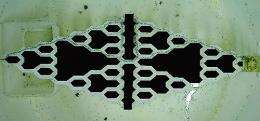
The ants were able to find the shortest route from one end of the maze to the other in under an hour, then were able to adapt and find the second shortest route when obstacles were put in their path.
(PhysOrg.com) -- An ant colony is the last place you'd expect to find a maths whiz, but University of Sydney researchers have shown that the humble ant is capable of solving difficult mathematical problems.
These findings, published in the Journal of Experimental Biology, deepen our understanding of how even simple animals can overcome complex and dynamic problems in nature, and will help computer scientists develop even better software to solve logistical problems and maximise efficiency in many human industries.
Using a novel technique, Chris Reid and Associate Professor Madeleine Beekman from the School of Biological Sciences, working with Professor David Sumpter of Uppsala University, Sweden, tested whether Argentine ants (Linepithema humile) could solve a dynamic optimisation problem by converting the classic Towers of Hanoi maths puzzle into a maze.
Finding the most efficient path through a busy network is a common challenge faced by delivery drivers, telephone routers and engineers. To solve these optimisation problems using software, computer scientists have often sought inspiration from ant colonies in nature - creating algorithms that simulate the behaviour of ants who find the most efficient routes from their nests to food sources by following each other's volatile pheromone trails. The most widely used of these ant-inspired algorithms is known as Ant Colony Optimisation (ACO).
"Although inspired by nature, these computer algorithms often do not represent the real world because they are static and designed to solve a single, unchanging problem," says lead author Chris Reid, a doctoral student from the Behaviour and Genetics of Social Insects Laboratory.
"But nature is full of unpredictability and one solution does not fit all. So we turned to ants to see how well their problem solving skills respond to change. Are they fixed to a single solution or can they adapt?"
The researchers tested the ants using the three-rod, three-disk version of the Towers of Hanoi problem - a toy puzzle that requires players to move disks between rods while obeying certain rules and using the fewest possible moves. But since ants cannot move disks, the researchers converted the puzzle into a maze where the shortest path corresponds to the solution with fewest moves in the toy puzzle. The ants at the entry point of the maze could chose between 32,768 possible paths to get to the food source on the other side, with only two of the paths being the shortest path and thus the optimal solution.
The ants were given one hour to solve the maze by creating a high traffic path between their nest and the food source, after which time the researchers blocked off paths and opened up new areas of the maze to test the ants' dynamic problem solving ability.
After an hour, the ants solved the Towers of Hanoi by finding the shortest path around the edge of the maze. But when that path was blocked off, the ants responded first by curving their original path around the obstacle and establishing a longer, suboptimal, route. But after a further hour, the ants had successfully resolved the maze by abandoning their suboptimal route and establishing a path that traversed through the centre of the maze on the new optimal route.
But not all the colonies' problem solving skills were equal: ants that were allowed to explore the maze without food for an hour prior to the test made fewer mistakes and were faster at resolving the maze compared to the ants that were naive. This result suggests that the "exploratory pheromone" laid down by ants searching a new territory is key in helping them adapt to changing conditions.
"Even simple mass-recruiting ants have much more complex and labile problem solving skills than we ever thought. Contrary to previous belief, the pheromone system of ants does not mean they get stuck in a particular path and can't adapt. Having at least two separate pheromones gives them much more flexibility and helps them to find good solutions in a changing environment. Discovering how ants are able to solve dynamic problems can provide new inspiration for optimisation algorithms, which in turn can lead to better problem-solving software and hence more efficiency for human industries."
Provided by University of Sydney
-
Common house ants form supercolonies, prosper in urban settings
Mar 30, 2010 |
not rated yet |
0
-
Scientists: Ants have internal pedometer
Jul 04, 2006 |
not rated yet |
0
-
Desert ants smell their way home
Feb 27, 2009 |
not rated yet |
0
-
Herding aphids -- how 'farmer' ants keep control of their food
Oct 10, 2007 |
not rated yet |
0
-
Ants get their place in Smithsonian exhibit
May 29, 2009 |
not rated yet |
0
-
Stars containing dark matter should look different from other stars
Feb 20, 2012 |
4.5 / 5 (17) |
11
-
Physicists discover evidence of rare hypernucleus, a component of strange matter
Feb 17, 2012 |
4.7 / 5 (38) |
22
-
Fast photon control brings quantum photonic technologies closer
Feb 13, 2012 |
5 / 5 (8) |
1
-
Engineers build first sub-10-nm carbon nanotube transistor
Feb 01, 2012 |
4.9 / 5 (36) |
32
-
Something old, something new: Evolution and the structural divergence of duplicate genes
Jan 31, 2012 |
4.6 / 5 (7) |
1
-
Eye biology videos
4 hours ago
-
Flowering Plant Revived After 30,000 Years in Permafrost
Feb 21, 2012
-
Toba volcano eruptions - 1.000 - 10,000 breeding pairsunb
Feb 20, 2012
-
How is a specific gene removed from DNA
Feb 20, 2012
-
Reproduction and Human evolution
Feb 19, 2012
-
Viruses: Living or Non-living organisms
Feb 19, 2012
- More from Physics Forums - Biology
More news stories
Surprising diversity at a synapse hints at complex diversity of neural circuitry
A new study reveals a dazzling degree of biological diversity in an unexpected place a single neural connection in the body wall of flies.
10 hours ago |
5 / 5 (4) |
0
|
Men might not 'become extinct' after all: Theory of the 'rotting' Y chromosome dealt a fatal blow
If you were to discover that a fundamental component of human biology has survived virtually intact for the past 25 million years, you'd be quite confident in saying that it is here to stay.
13 hours ago |
5 / 5 (6) |
1
|
New family of legless amphibians found in India
Since before the age of dinosaurs it has burrowed unbothered beneath the monsoon-soaked soils of remote northeast India - unknown to science and mistaken by villagers as a deadly, miniature snake.
21 hours ago |
5 / 5 (8) |
3
Climate change affects bird migration timing in North America
Bird migration timing across North America has been affected by climate change, according to a study published Feb. 22 in the open access journal PLoS ONE.
9 hours ago |
4.5 / 5 (2) |
2
New iridescent lizard species found in Cambodia
A new species of lizard with striking iridescent rainbow skin, a long tail and very short legs has been discovered in the rainforest in northeast Cambodia, conservationists announced Wednesday.
10 hours ago |
not rated yet |
0
Researchers build first physical 'metatronic' circuit
(PhysOrg.com) -- The technological world of the 21st century owes a tremendous amount to advances in electrical engineering, specifically, the ability to finely control the flow of electrical charges using ...
Spitzer finds solid buckyballs in space
(PhysOrg.com) -- Astronomers using data from NASA's Spitzer Space Telescope have, for the first time, discovered buckyballs in a solid form in space. Prior to this discovery, the microscopic carbon spheres ...
Faster than light neutrinos? More like faulty wiring
You can shelf your designs for a warp drive engine (for now) and put the DeLorean back in the garage; it turns out neutrinos may not have broken any cosmic speed limits after all.
Physicists surprised by disappearing and reappearing superconductivity in iron selenium chalcogenides
Superconductivity is a rare physical state in which matter is able to conduct electricity -- maintain a flow of electrons -- without any resistance. This phenomenon can only be found in certain materials at low temperatures, ...
CT colonography shown to be comparable to standard colonoscopy
Computerized tomographic (CT) colonography (CTC), also known as virtual colonoscopy, is comparable to standard colonoscopy in its ability to accurately detect cancer and precancerous polyps in people ages 65 and older, according ...
Stanford research team cracks animated NuCaptcha
(PhysOrg.com) -- The research team from Stanford University, led by Elie Bursztein, that previously had cracked regular CAPTCHAs and then audio CAPTCHAs, now has also successfully cracked the animated version called NuCapt ...
Dec 10, 2010
Rank: 5 / 5 (1)
Dec 10, 2010
Rank: 3 / 5 (2)
Just a random thought. It could lead somewhere. It might need a bit of adapting but maybe a two state model is the way to go.
Dec 10, 2010
Rank: 5 / 5 (2)
Dec 10, 2010
Rank: 5 / 5 (2)
I suspect they have at least half a dozen tracking pheromones: possibly one for each type of main expedition they go on. EG, defensive patrol and nest maintenance, foraging patrol, egg or baby transport, and other journey types. They very probably secrete combinations of pheromones when traveling, based on the relative priorities of the various corporate needs of the moment.
One thing is clear: the pathways ants evolve over the "hour"or so the authors talk of embody the path of least resistance between two nest sites, not simply the shortest linear pathway.
Dec 10, 2010
Rank: not rated yet
As for the long term control of ants, a little boric acid powder dissolved in hot water and sprayed around the perimeter of your paths and structures does wonders and is dirt cheap.
Mixed with a bit of automobile antifreeze and sprayed sparingly on exterior wood surfaces, it also eliminates termites and wood rot, without hiring expensive knuckleheads who use stuff that doesn't last a week.
Dec 10, 2010
Rank: not rated yet
Sure, if you want to kill your pets too while you're at it...
Dec 11, 2010
Rank: 3 / 5 (2)
Few of the really new algorithms in these regard : Artificial Bee Colony Algorithm (proposed in 2005), Gravitational search algorithm etc...
Dec 11, 2010
Rank: not rated yet
Dec 12, 2010
Rank: not rated yet
one example showed a robot in an arena where a nnumber of balls were scattered. a number of robots (i believe it was something like a dozen) where deployed in the arena. those robots had a "pusher" in the front (like a shovel of sort). the robot behavior was programmed to be "keep going forward, turn when you hit a wall, backup and then turn if you have 3 balls in the "pusher". turned out that the secondary side effect of that behavior was to collect and push all the balls back together, and maintaining it that way.
we know that the ants use the pheromones to identify "already used paths". it could be that simply the ants mark paths as they use them, putting weights to each "path". the ants simply confirm or invalidate those (as the environment changes). that is how network routers do their job. check weights and advertise to neighbors.
how they establish the path would be interesting...
Dec 13, 2010
Rank: 5 / 5 (1)
Dec 25, 2010
Rank: not rated yet
My understanding is that however many the pheromones are, a key factor in ant ecology is the speed at which the pheromones evaporate or become chemically altered by the environment. The rate of dissipation of the pheromone is what allows the build up of useful information about a pathway. There is _no_ pathway to start with, just widely spread and basically random traces left by foragers and scouts. Over time, useful destinations become the focus points of ever fresher pheromone markings and the spread of relatively fresher markings from individual ants narrows to the most energetically efficient pathway between such currently useful places. With no 'thought' involved, just detection, discrimination, then selection based on current priority.