Gerbils also get the winter blues
December 20, 2010 By Katharine Gammon
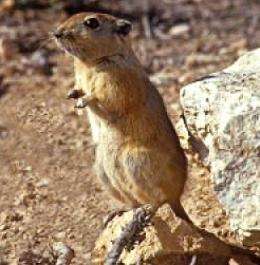
A species of gerbil can get a bit moody when it doesn't get enough sunlight. Credit: American Friends of Tel Aviv University
December 21 -- the date of the winter solstice -- marks the shortest day of the year. Many people may find themselves wanting to spend more time on the couch and less time with friends -- one of the effects of seasonal affective disorder.
Zoologist Noga Kronfeld-Schor of Tel Aviv University in Israel thinks that studying mood disorders in animals -- specifically, wild gerbils -- may yield new clues about the way seasonal affective disorder, or SAD, works.
Kronfeld-Schor and her colleagues took a group of fat sand rats -- actually a type of gerbil -- from the a research zoo in Tel Aviv and kept them in a room where they received only about five hours a day of light for three weeks, instead of the usual 12. The gerbils began to respond to the effects of less light.
"No, the rats don't lie down on the couch," said Haim Einat of the University of Minnesota Duluth, who also worked on the study. "But there are some behavioral aspects to depression."
The gerbils behaved strangely: they mated less, turned down tempting sugar water (usually ambrosia for rodents), acted more submissively and explored their surroundings less often. The scientists also noticed that the animals gave up more quickly trying to swim out of a cylinder partially filled with water and no way to escape.
Previous studies examined depression in mice and rats, naturally nocturnal animals. This research marks the first time scientists have studied seasonal disorders in animals that are active during the day.
After triggering winter blues in the rodents, the researchers then tested some of the available treatments for SAD. Depressed gerbils blasted with an hour of bright light each morning quickly regained their normal socializing behaviors. The researchers also tested a common anti-depressant, which helped the animals, but not as much as the morning light.
"The results with light were even better than any drug we used before," said Kronfeld-Schor, in research to be published in the journal Neuropsychobiology in early 2011. "And in humans it's been observed that light treatment in the morning works better than in the evening."
But what about animals in the wild that experience only a few hours of light per day during the winter? Can polar bears feel down? Kronfeld-Schor said that while it may not be exactly depression, there's an evolutionary reason for slowing down in the winter.
"If food availability decreases during winter, and mating success decreases during winter, and it's dangerous to be outside because of the temperature, then it makes sense to decrease activity level," Kronfeld-Schor said.
"It's difficult to tell if animals get depressed," said Randy Nelson, a professor at Ohio State University who has studied depressive-like behavior in Siberian hamsters.
He said that animals reduce their behavior in winter to focus on survival, and that humans were no different in our evolutionary history.
But while slothful behavior may have kept early humans ancestors alive, blaming evolution still isn't a great excuse for missing a holiday party.
-
Fat sand rats are SAD like us
Nov 08, 2010 |
not rated yet |
0
-
Seasonal depression may affect hamsters
Nov 16, 2005 |
not rated yet |
0
-
Networking around the clock
Apr 05, 2007 |
not rated yet |
0
-
Mice Brains Shrink During Winter, Impairing Some Learning And Memory
May 12, 2005 |
not rated yet |
0
-
Seasonal affective disorder may be linked to genetic mutation, study suggests
Nov 03, 2008 |
not rated yet |
0
-
Stars containing dark matter should look different from other stars
Feb 20, 2012 |
4.5 / 5 (17) |
11
-
Physicists discover evidence of rare hypernucleus, a component of strange matter
Feb 17, 2012 |
4.7 / 5 (38) |
22
-
Fast photon control brings quantum photonic technologies closer
Feb 13, 2012 |
5 / 5 (8) |
1
-
Engineers build first sub-10-nm carbon nanotube transistor
Feb 01, 2012 |
4.9 / 5 (36) |
32
-
Something old, something new: Evolution and the structural divergence of duplicate genes
Jan 31, 2012 |
4.6 / 5 (7) |
1
-
Eye biology videos
4 hours ago
-
Flowering Plant Revived After 30,000 Years in Permafrost
Feb 21, 2012
-
Toba volcano eruptions - 1.000 - 10,000 breeding pairsunb
Feb 20, 2012
-
How is a specific gene removed from DNA
Feb 20, 2012
-
Reproduction and Human evolution
Feb 19, 2012
-
Viruses: Living or Non-living organisms
Feb 19, 2012
- More from Physics Forums - Biology
More news stories
Surprising diversity at a synapse hints at complex diversity of neural circuitry
A new study reveals a dazzling degree of biological diversity in an unexpected place a single neural connection in the body wall of flies.
11 hours ago |
5 / 5 (4) |
0
|
Men might not 'become extinct' after all: Theory of the 'rotting' Y chromosome dealt a fatal blow
If you were to discover that a fundamental component of human biology has survived virtually intact for the past 25 million years, you'd be quite confident in saying that it is here to stay.
14 hours ago |
5 / 5 (6) |
1
|
New family of legless amphibians found in India
Since before the age of dinosaurs it has burrowed unbothered beneath the monsoon-soaked soils of remote northeast India - unknown to science and mistaken by villagers as a deadly, miniature snake.
21 hours ago |
5 / 5 (9) |
3
Climate change affects bird migration timing in North America
Bird migration timing across North America has been affected by climate change, according to a study published Feb. 22 in the open access journal PLoS ONE.
10 hours ago |
4.5 / 5 (2) |
2
New iridescent lizard species found in Cambodia
A new species of lizard with striking iridescent rainbow skin, a long tail and very short legs has been discovered in the rainforest in northeast Cambodia, conservationists announced Wednesday.
10 hours ago |
not rated yet |
0
Researchers build first physical 'metatronic' circuit
(PhysOrg.com) -- The technological world of the 21st century owes a tremendous amount to advances in electrical engineering, specifically, the ability to finely control the flow of electrical charges using ...
Spitzer finds solid buckyballs in space
(PhysOrg.com) -- Astronomers using data from NASA's Spitzer Space Telescope have, for the first time, discovered buckyballs in a solid form in space. Prior to this discovery, the microscopic carbon spheres ...
Faster than light neutrinos? More like faulty wiring
You can shelf your designs for a warp drive engine (for now) and put the DeLorean back in the garage; it turns out neutrinos may not have broken any cosmic speed limits after all.
Physicists surprised by disappearing and reappearing superconductivity in iron selenium chalcogenides
Superconductivity is a rare physical state in which matter is able to conduct electricity -- maintain a flow of electrons -- without any resistance. This phenomenon can only be found in certain materials at low temperatures, ...
Stanford research team cracks animated NuCaptcha
(PhysOrg.com) -- The research team from Stanford University, led by Elie Bursztein, that previously had cracked regular CAPTCHAs and then audio CAPTCHAs, now has also successfully cracked the animated version called NuCapt ...
Going up: Japan builder eyes space elevator
A Japanese construction firm claimed Wednesday it could execute an out-of-this-world plan to put tourists in space within 40 years by building an elevator that stretches a quarter of the way to the moon.