Scientists find first evidence that many universes exist
December 17, 2010 by Lisa Zyga
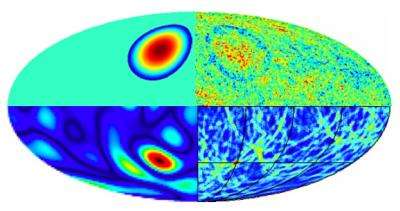
The signatures of a bubble collision: A collision (top left) induces a temperature modulation in the CMB temperature map (top right). The “blob” associated with the collision is identified by a large needlet response (bottom left), and the presence of an edge is determined by a large response from the edge detection algorithm (bottom right). Image credit: Feeney, et al.
(PhysOrg.com) -- By looking far out into space and observing whats going on there, scientists have been led to theorize that it all started with a Big Bang, immediately followed by a brief period of super-accelerated expansion called inflation. Perhaps this was the beginning of everything, but lately a few scientists have been wondering if something could have come before that, setting up the initial conditions for the birth of our universe.
In the most recent study on pre-Big Bang science posted at arXiv.org, a team of researchers from the UK, Canada, and the US, Stephen M. Feeney, et al, have revealed that they have discovered four statistically unlikely circular patterns in the cosmic microwave background (CMB). The researchers think that these marks could be bruises that our universe has incurred from being bumped four times by other universes. If they turn out to be correct, it would be the first evidence that universes other than ours do exist.
The idea that there are many other universes out there is not new, as scientists have previously suggested that we live in a multiverse consisting of an infinite number of universes. The multiverse concept stems from the idea of eternal inflation, in which the inflationary period that our universe went through right after the Big Bang was just one of many inflationary periods that different parts of space were and are still undergoing. When one part of space undergoes one of these dramatic growth spurts, it balloons into its own universe with its own physical properties. As its name suggests, eternal inflation occurs an infinite number of times, creating an infinite number of universes, resulting in the multiverse.
These infinite universes are sometimes called bubble universes even though they are irregular-shaped, not round. The bubble universes can move around and occasionally collide with other bubble universes. As Feeney, et al., explain in their paper, these collisions produce inhomogeneities in the inner-bubble cosmology, which could appear in the CMB. The scientists developed an algorithm to search for bubble collisions in the CMB with specific properties, which led them to find the four circular patterns.
Still, the scientists acknowledge that it is rather easy to find a variety of statistically unlikely properties in a large dataset like the CMB. The researchers emphasize that more work is needed to confirm this claim, which could come in short time from the Planck satellite, which has a resolution three times better than that of WMAP (where the current data comes from), as well as an order of magnitude greater sensitivity. Nevertheless, they hope that the search for bubble collisions could provide some insight into the history of our universe, whether or not the collisions turn out to be real.
The conclusive non-detection of a bubble collision can be used to place stringent limits on theories giving rise to eternal inflation; however, if a bubble collision is verified by future data, then we will gain an insight not only into our own universe but a multiverse beyond, the researchers write in their study.
This is the second study in the past month that has used CMB data to search for what could have occurred before the Big Bang. In the first study, Roger Penrose and Vahe Gurzadyan found concentric circles with lower-than-average temperature variation in the CMB, which could be evidence for a cyclic cosmology in which Big Bangs occur over and over.
More information: Stephen M. Feeney, Matthew C. Johnson, Daniel J. Mortlock, and Hiranya V. Peiris. "First Observational Tests of Eternal Inflation." arXiv:1012.1995v1 [astro-ph.CO]
via: The Physics arXiv Blog
© 2010 PhysOrg.com
-
Scientists glimpse universe before the Big Bang
Nov 23, 2010 |
not rated yet |
0
-
Physicists Calculate Number of Parallel Universes
Oct 16, 2009 |
not rated yet |
0
-
Cosmologists aim to observe first moments of universe
Feb 16, 2009 |
not rated yet |
0
-
Across the multiverse: FSU physicist considers the big picture
Jan 12, 2010 |
not rated yet |
0
-
Planck Satellite ready to measure the Big Bang
May 11, 2009 |
not rated yet |
0
-
Stars containing dark matter should look different from other stars
Feb 20, 2012 |
4.5 / 5 (17) |
11
-
Physicists discover evidence of rare hypernucleus, a component of strange matter
Feb 17, 2012 |
4.7 / 5 (38) |
22
-
Fast photon control brings quantum photonic technologies closer
Feb 13, 2012 |
5 / 5 (8) |
1
-
Engineers build first sub-10-nm carbon nanotube transistor
Feb 01, 2012 |
4.9 / 5 (36) |
32
-
Something old, something new: Evolution and the structural divergence of duplicate genes
Jan 31, 2012 |
4.6 / 5 (7) |
1
-
linear wave equation vs. linear system
1 hour ago
-
adhesive force and surface tension
1 hour ago
-
Newbie here.
3 hours ago
-
Rainbows in space?
3 hours ago
-
taking mechanical physics next fall
5 hours ago
-
Help: maximum force of an object when given impulse and time on a graph
8 hours ago
- More from Physics Forums - General Physics
More news stories
Researchers build first physical 'metatronic' circuit
(PhysOrg.com) -- The technological world of the 21st century owes a tremendous amount to advances in electrical engineering, specifically, the ability to finely control the flow of electrical charges using ...
10 hours ago |
4.7 / 5 (17) |
5
|
Faster than light neutrinos? More like faulty wiring
You can shelf your designs for a warp drive engine (for now) and put the DeLorean back in the garage; it turns out neutrinos may not have broken any cosmic speed limits after all.
9 hours ago |
4.2 / 5 (22) |
23
|
Physicists surprised by disappearing and reappearing superconductivity in iron selenium chalcogenides
Superconductivity is a rare physical state in which matter is able to conduct electricity -- maintain a flow of electrons -- without any resistance. This phenomenon can only be found in certain materials at low temperatures, ...
13 hours ago |
5 / 5 (5) |
2
|
Less is more: Study of tiny droplets could have big impact on industrial applications
(PhysOrg.com) -- Under a microscope, a tiny droplet slides between two fine hairs like a roller coaster on a set of rails until poof it suddenly spreads along them, a droplet no more.
10 hours ago |
3.7 / 5 (3) |
0
|
Study reveals switching mechanism in promising computer memory device
(PhysOrg.com) -- Sometimes knowing that a new technology works is not enough. You also must know why it works to get marketplace acceptance. New information from the National Institute of Standards and Technology ...
17 hours ago |
4 / 5 (4) |
0
|
Spitzer finds solid buckyballs in space
(PhysOrg.com) -- Astronomers using data from NASA's Spitzer Space Telescope have, for the first time, discovered buckyballs in a solid form in space. Prior to this discovery, the microscopic carbon spheres ...
Stanford research team cracks animated NuCaptcha
(PhysOrg.com) -- The research team from Stanford University, led by Elie Bursztein, that previously had cracked regular CAPTCHAs and then audio CAPTCHAs, now has also successfully cracked the animated version called NuCapt ...
CT colonography shown to be comparable to standard colonoscopy
Computerized tomographic (CT) colonography (CTC), also known as virtual colonoscopy, is comparable to standard colonoscopy in its ability to accurately detect cancer and precancerous polyps in people ages 65 and older, according ...
Going up: Japan builder eyes space elevator
A Japanese construction firm claimed Wednesday it could execute an out-of-this-world plan to put tourists in space within 40 years by building an elevator that stretches a quarter of the way to the moon.
Scientists create potent molecules aimed at treating muscular dystrophy
While RNA is an appealing drug target, small molecules that can actually affect its function have rarely been found. But now scientists from the Florida campus of The Scripps Research Institute have for the first time designed ...
Flesh-eating bacteria inspire superglue
(PhysOrg.com) -- A bio-inspired superglue has been developed by Oxford University researchers that cant be matched for sticking molecules together and not letting go.
Dec 17, 2010
Rank: 3.1 / 5 (10)
Also, if our detectible universe is expanding at an ever increasing rate, would that mean that these proposed other universes, that ours bumpped into, are now contracting to allow room for ours to expand, or even more interesting - pulling our universe apart?
Dec 17, 2010
Rank: 3.9 / 5 (10)
Dec 17, 2010
Rank: 2.9 / 5 (10)
Now if the scientific community would agree that quantum weirdness is a rediscovery of Kant's transcendental deduction wrt epistemology and noumenal reality, then I don't have a problem with multiverse speculations.
Dec 17, 2010
Rank: 2 / 5 (4)
Dec 17, 2010
Rank: 3.6 / 5 (13)
"Universe" is just a made up word representing a human concept. It can mean anything we want, but it has traditionally meant an all-encompassing description of everything in existence.
Dec 17, 2010
Rank: 1.2 / 5 (24)
All visible Universe energyconcentrations expanding.
Onesimpleprinciple told how and why.
Nobody cant tell how and why space expanding.
Space dont expanding at all.
.
Dec 17, 2010
Rank: 3.5 / 5 (11)
No, that's not quite right. The term universe was made to describe the totality of everything, to encompass all of existence. The problem isn't the concept, the problem is what we know. The word is fine, it doesn't need to be touched, it will always mean to imply everything. However, what does change is what we know to be 'everything.'
The change which has to occur is in our minds, that the idea of 'everything' is more than we thought. The idea of a 'multi-verse' is absurd, because by definition universe IS everything. So universe by definition should include all multi-verses.
That contradiction implies the need to rename the thing we called 'universe' as some kind of larger expanding ball of mass and energy; a bubble. Then universe can go on to correctly describe everything that exists, including all bubbles which exist.
Hence forth we live inside of a bubble, and that bubble is inside of the universe.
Dec 17, 2010
Rank: 4.5 / 5 (2)
I wonder if some other bubble bumped in to our bubble, or if something pierced our bubble. Maybe bubbles exploding has something to do with extreme vacuum fluctuations, or some similar concept.
My mind is exploding, this is cool stuff.
Dec 17, 2010
Rank: 4.3 / 5 (6)
What do they move around in, space? And what is the universe expanding into?
Dec 17, 2010
Rank: 4 / 5 (3)
1) when the collision happened in relation to the evolution of our bubble?
2)how big the other bubbles are?
3)how "hard" they hit our bubble?
to lead us to some understanding of the media that these bubbles are in?
My question would be, are we essentially in a "solid" that can exist with "space" in between other bubbles or are we in a foam where its more like soap suds intersecting in lines...maybe I answered my own question, if the interaction is circular, wouldn't that mean discrete and separate "solid" "spheres" rather than a foam??
Dec 17, 2010
Rank: 2 / 5 (3)
Dec 17, 2010
Rank: 2.8 / 5 (8)
But I think the universe is part of unfathomably larger entity, whereby we are 'cells' unable to see beyond out celluar walls. Other universes may simply be other cells. A single cell within our own bodies would view the staggering number of cells/organisms within us yet outside itself as similarly incomprehensible.
Star bith and destruction, circular structures created by gravity, electromagnetics, are seen on smaller scales within us, no? Cells live and die, are altered, consumed, split. Sounds familar.
Not a scientist and don't pretend to be. Just random, not so original, and rather incoherent thought I pondered while reading this. I picture the idea of relative size and scales...from quantum/sub atomic to galaxies to the universe. Maybe the next big picture includes multiverses, then after that?
Dec 17, 2010
Rank: 4.3 / 5 (4)
Right there with you. I've always toyed with the thought that it's fractal-like, and exponential. Whatever 'limits' the universe has, it's very exciting to see when we come to threshholds like this, and see that things can be more vast than we previously imagined.
Wow, I feel very small today.. ;)
Dec 17, 2010
Rank: 1 / 5 (1)
But here's my not so original idea that will certainly be shot down ellipsis
Dec 17, 2010
Rank: 4 / 5 (2)
Dec 17, 2010
Rank: 1 / 5 (1)
i wonder, if there are circular patterns in the CMB, could they possibly have been caused by imperfections at the very beginning?
being in our bubble, it's not like we can ever know what's out there, because it isn't in our universe, and therefore doesn't really exist. Unprovable science at it's best, never anything more than a theory.
Dec 17, 2010
Rank: 3.3 / 5 (4)
Now imagine a parallel universe as a second 2D plane. It has its own contects of energy that fluctuates over time.
Now imagine the planes flexing or warping. They can touch each other and bump giving rise to perturbations in the energy density of each Universe.
Dec 17, 2010
Rank: 2.9 / 5 (9)
Dec 17, 2010
Rank: 1.3 / 5 (6)
Dec 17, 2010
Rank: 3 / 5 (4)
It's always been the hobby of man to conjure up the most amazing explanations for whatever is beyond current grasp. In the old days you could hear that the earth is a shield, carried around by 3 elephants (or whatever). And people would debate it profoundly, and the next generation "knew" that the earth was floating in gravy.
Well, today there are alternate universes that bump into eachother while expanding preposterously. Our grandchildren will weep when they read about this.
Dec 17, 2010
Rank: 3 / 5 (2)
Dec 17, 2010
Rank: 4.5 / 5 (4)
Or they'll just laugh...like we do now about Celestial Spheres.
Dec 17, 2010
Rank: 1 / 5 (1)
@ SteveL,
Really? You think a discovery like this is just semantics? You don't think there is a REAL difference between living in a single, isolated Universe or a multiverse? All we need to do is change the meaning of a word and everything is just as it was? It doesn't matter what you call it. Go ahead and redefine "universe" if you want. It still matters that things aren't what we thought they were...
Dec 17, 2010
Rank: 3 / 5 (1)
Yes, M-Theory is very intriguing.
Dec 17, 2010
Rank: 4 / 5 (1)
Dec 17, 2010
Rank: 2.7 / 5 (3)
Bubble-Verse is the new in word from now on. It will be proved correct I guarantee 'ya.
Where once people believed the Earth was flat and carried by Elephants etc, today and tomorrow will see evidence that the Bubble-Verse is much more than scientists know today. It's part of a 'living' entity of which there is no explanation, as yet.
Dec 17, 2010
Rank: 5 / 5 (7)
Of course we could just choose to stick with excitably adding to the internet's overflowing stash of random opinionated nonsense... :-)
Dec 17, 2010
Rank: 1 / 5 (1)
Dec 17, 2010
Rank: 2 / 5 (2)
Dec 17, 2010
Rank: 1 / 5 (3)
I can understand it - the question is, if someone is interested about it.
Dec 17, 2010
Rank: 3 / 5 (5)
http://www.bbc.co...b00vdkmj
http://www.youtub...37BE94CA
Dec 17, 2010
Rank: 3.5 / 5 (4)
Dec 17, 2010
Rank: 4.5 / 5 (2)
Dec 17, 2010
Rank: 1.7 / 5 (3)
Dec 17, 2010
Rank: 1 / 5 (1)
Dec 17, 2010
Rank: 1 / 5 (1)
Why should there be only one of anything? You can only name 2 things that there are one of and you can't prove one of them exists and the other may not be the only one, they are god and the universe. It makes no sense that there is one of anything which is why god is unlikely too, if not for many other reasons.
Dec 17, 2010
Rank: 3.4 / 5 (5)
"The multiverse (or meta-universe, metaverse) is the hypothetical set of multiple possible universes (including the historical universe we consistently experience) that together comprise everything that exists: the entirety of space, time, matter, and energy as well as the physical laws and constants that describe them. The term was coined in 1895 by the American philosopher and psychologist William James."
Dec 17, 2010
Rank: 2 / 5 (2)
Dec 18, 2010
Rank: 1 / 5 (11)
The creator of the universe answers some of your question in the first verse of the Bible. Genesis 1:1 "In the beginning God created the heaven and the earth." The following verses give some details. As to 'when' I rely on those that have studied recorded history including the Bible and put the beginning at 4004 BC or somewhere near there. The Bible has much to say on the end. Check out 2 Peter 3:10-13.
Dec 18, 2010
Rank: 2 / 5 (2)
Dec 18, 2010
Rank: 2.3 / 5 (3)
Strawberry Fields...
nothing is real..."
-- The Beatles
works for me...
Dec 18, 2010
Rank: 3.5 / 5 (11)
Why did you rate a quote from Wikipedia a 1 for the definition of a term that has been widely used for over a hundred years? Were you born without a brain?
Dec 18, 2010
Rank: 2.3 / 5 (9)
http://www.physor...activity
Dec 18, 2010
Rank: 3 / 5 (4)
Dec 18, 2010
Rank: 2 / 5 (1)
Dec 18, 2010
Rank: 4.3 / 5 (12)
I'm the moron, though not for the reason you state. This whole thread was pretty much derailed by the opening post that nitpicked the semantics of the word universe. You then proceeded to post three consecutive posts picking over the same carcass, which is tantamount to spamming.
The subject of the article is far more intriguing than your tortured quibbling about definitions. That is why I gave you a 1 on your third such post.
Dec 18, 2010
Rank: 4.1 / 5 (9)
We only down vote cretinous sock-puppets.
Dec 18, 2010
Rank: 3 / 5 (2)
Dec 18, 2010
Rank: 1 / 5 (7)
I discussed these models here well before you ever started to visit PhysOrg. Whereas you're just wasting place on this server. You're not able predict anything, explain anything, etc..
http://www.physfo...ry189687
Dec 18, 2010
Rank: 4.7 / 5 (12)
Dec 18, 2010
Rank: 4 / 5 (1)
Dec 18, 2010
Rank: 1 / 5 (7)
Physics is not IT stuff - forget the holographic projectors and computer screens models, developed with freaky nerds. It's simply water surface with many intersecting ripples..
http://www.istock...ples.jpg
Dec 18, 2010
Rank: 4.7 / 5 (3)
I'm quite sure that at least a century before hubble astronomers had understood the concept of galaxies and the fact that the universe has if not thousands , at least hundreds of them.
And decades before Hubble the concept that the universe has infinite galaxies was thought up.
Dec 18, 2010
Rank: 1 / 5 (1)
I vote for Earth Prime.
Dec 18, 2010
Rank: 3 / 5 (1)
I think they are talking about brane's .. Where in a single plane multiple big bangs have produced multiple universes and they are spaced out away from each other and occasionally "touch" each other.
The more traditional concept of multiverse is one where all universes occupy the same area of space but are either "out of phase" (dark matter?) or in a parallel time so they cannot interact with each other directly. This is the multiverse concept behind TV shows such as Sliders , etc.
Dec 18, 2010
Rank: 5 / 5 (3)
Lets fix this issue instead of letting it slide...
Dec 18, 2010
Rank: 5 / 5 (3)
Dec 18, 2010
Rank: 1 / 5 (1)
Thanks for proving my point that it is the reason I state. A word was looked for to describe these findings and the previous posts didn't know what it was and suggested new ones when one exists. My first posts were from my knowledge and then I looked it up and quoted Wikipedia. There is nothing wrong with correcting semantics, at least not for smart people.
Dec 18, 2010
Rank: 4.5 / 5 (2)
Dec 18, 2010
Rank: 1 / 5 (1)
blackberry, are they there ?
Dec 18, 2010
Rank: 1 / 5 (1)
Dec 18, 2010
Rank: 1.8 / 5 (8)
http://news.softp...er-2.jpg
Dec 18, 2010
Rank: 1.1 / 5 (7)
Dec 18, 2010
Rank: 1.1 / 5 (8)
http://www.pnas.o...full.pdf
The only problem is, the dense matter model of vacuum has not been considered from any other perspective, then just cosmological one. It could explain a much more things, then just some bubbles in cosmic radiation.
Dec 18, 2010
Rank: 1.8 / 5 (6)
Dec 18, 2010
Rank: 2.3 / 5 (8)
Dec 18, 2010
Rank: 5 / 5 (4)
Dec 18, 2010
Rank: 2.4 / 5 (5)
are woefully inadequate to prove or disprove any of these new theories. A new crop of detection devices is what's needed, I unfortunately don't have any.
Dec 18, 2010
Rank: 1 / 5 (6)
Dec 18, 2010
Rank: 1 / 5 (3)
Dec 18, 2010
Rank: 1.6 / 5 (5)
I remember hearing somewhere that technically the term "Galaxy" was originally synonymous with "universe" and so the usage had to be changed to reflect observations.
Also, this particular interpretation of "universes" does not even reflect the higher dimensional "parallel universe" concept.
This type of multi-verse is simply parts of the universe, as you say "bubbles," which have expanded so far apart as to be outside one another's light-sphere.
So "Universe" should continue to mean "everything, every time, every where, every dimension," just as "Cosmos" has always referred to "everything". The "Universe" should be defined to be that which contains all vector spaces and everything they contain.
So the terminology needs to be refined to at least be internally consistent, and I think pick a term other than bubble that is more precise and descriptive, such as "Continuum".
Dec 18, 2010
Rank: 1.7 / 5 (7)
This universe contains and/or is composed of all things.
Real things and concepts such as dimensions, continuums, vector spaces, mass, energy, etc, should always be considered to be "theory" and even if they are "law" and "real" then they are still less than the "universe".
Dec 18, 2010
Rank: 1 / 5 (9)
Dec 18, 2010
Rank: 4.4 / 5 (8)
Dec 18, 2010
Rank: 1.8 / 5 (12)
Dec 18, 2010
Rank: 4.3 / 5 (11)
We've even caught you doing it. TDK/Zephir/Alizee/Slotin/belize/whatever the hell else you call yourself.
You're so delusional as to invent names, occupations and back stories for some of them. It's rather sick.
Dec 18, 2010
Rank: 3.5 / 5 (2)
Very interesting article.
Dec 18, 2010
Rank: 4.7 / 5 (3)
Sigh, why is it so hard to grasp that "the guys" meant OUR universe, you know, the one that has all the stars in it that we see out to the limit of observable space.
Dec 18, 2010
Rank: 1.5 / 5 (8)
I'm not aware of any "limits" having been observed. Every time anyone makes a bigger, better telescope, or a new telescope in a spectra that hasn't been done before, they see farther and farther.
There are theoretical limits to the observable universe within the framework of the crackpot(say mainstream/standard theory) big bang theory and other similar theories, such as the "Light horizon" which should theoretically exist around 15 billion lightyears distant based on some interpretations Relativity in conjuction with Hubble Constant. However, that would be about 10% farther than anything anyone has ever made is capable of looking.
Moreover, due to the way Relativity and the Hubble Constant predict space-time would be warped at this distance, things might not be so straight forward.
Dec 18, 2010
Rank: 1.5 / 5 (6)
therefore, the theory of a light horizon probably isn't even falsifiable, because even the light that DOES reach us from this region of space would be "invisible," Therefore you can neither see the boundary nor the lack of a boundary, nor could you observe it's effects or lack of effects on the surrounding space-time.
Dec 18, 2010
Rank: 1.3 / 5 (7)
If the theory is somewhat right, but mostly wrong, you won't be able to observe anything even remotely close to the horizon to be sure to what degree the theory is correct. In fact, you probably wouldn't even be able to distinguish this scenario from the scenario in paragraph 1.
Dec 18, 2010
Rank: 2 / 5 (1)
Dec 18, 2010
Rank: 4 / 5 (1)
Dec 18, 2010
Rank: 1.5 / 5 (4)
He got that idea from Roger Penrose who used "Imaginary" or "complex" dimensions, including "complex time" in some versions Twistor Theory.
Dec 18, 2010
Rank: 1.5 / 5 (8)
If "X" is the distance a hypothetical light source, and the theoretical light horizon is at 15 billion light years. Then as X approaches 15 billion, because space-time is expanding nearly at the speed of light there is a vertical assymptote at 15 billion as to the amount of time it actually takes a photon to reach US moving through space-time as space-time moves away at nearly the speed of light.
The time it actually takes the photon to reach us is NOT 15 billion ly, but rather equal to the length of the curve, but the curve has a vertical assymptote, making it have "arbitrarily close to infinite" length.
You can actually graph tis on a graphics calculator, if you don't believe me. If you took calculus 2, you will also know that what I say is correct.
Dec 18, 2010
Rank: 3 / 5 (5)
You really should learn the difference between time and distance, ie, years vs lightyears.
Dec 18, 2010
Rank: 1.4 / 5 (9)
The sick one is you Skeptic Heretic, a sniveling worm exiled to a basement bedroom in your parent's house so as not to remind them too often of the money they've wasted on you. You're a poseur with your little gang of circle wankers.
Dec 18, 2010
Rank: 4 / 5 (1)
From the paper:The authors test this against selected simulated bubble collisions and were able to conclusively detect them with great reliability. When applied the the WMAP data:
More >
Dec 18, 2010
Rank: 4.6 / 5 (7)
I apologize, it wouldn't let me give you 0 stars.
Dec 18, 2010
Rank: 5 / 5 (1)
Regarding the 4 features the authors state:
The authors define a conclusive detection requirement for Bayesian Evidence ratio as ln(rho) >> 2.6. Features 2, 3, 7, and 10 have Bayesian Evidence ratios of 4.8, 5.1, 4.0 and 7.0 respectively. While these values are higher than expected, the Bayesian Evidence Ratios of the simulation bubbles had values between 70 and 150.
If the Bayesian Evidence Ratios were in the 20 to 30 range you could make the claim, but the cited low values seem less than convincing.
Dec 18, 2010
Rank: 5 / 5 (1)
Dec 19, 2010
Rank: 1.7 / 5 (3)
Dec 19, 2010
Rank: 5 / 5 (1)
Dec 19, 2010
Rank: 5 / 5 (2)
Oops, My bad.
Dec 19, 2010
Rank: 2.4 / 5 (7)
Dec 19, 2010
Rank: 1.4 / 5 (5)
http://www.astro....it5.html
Dec 19, 2010
Rank: 4.5 / 5 (10)
Dec 19, 2010
Rank: 1.5 / 5 (4)
That was an accident, which is pretty obvious.
A lightyear is the distance light travels in one year.
A year is 365 days, unless it's a leap year.
Dec 19, 2010
Rank: 2.8 / 5 (6)
Well, have you ever bothered to actually check any of these theories yourself, or model these situations on a computer or graphic calculator?
Guess what? I have, and the results I gave are correct, at least as far as the consequences of the mainstream theories is concerned.
If you find something wrong with that, then it shows that either you don't understand the theory at all, or else you certainly haven't ever tried to plug in real values and test them.
If you have a light source just inside the theoretical light horizon, the light will BARELY make any progress whatsoever in moving towards us, because space-time itself is moving away almost as fast as the speed of light. hubble constant 72km/s/megaparsec.
If you had a point light source just inside the light horizon, it would take billions of years for photon to move even one light year closer to earth.
Dec 19, 2010
Rank: 3.8 / 5 (4)
Dec 19, 2010
Rank: 1 / 5 (8)
Dec 19, 2010
Rank: 4.8 / 5 (6)
Secondly, the "light" emitted near an event horizon is stretched to radio, not to "black" showing an even greater lack of knowledge between you two cranks.
Dec 19, 2010
Rank: 2.4 / 5 (8)
The red shift caused by special relativity is a local motion within space-time.
The red shift I'm talking about theoretically happens because space-time itself theoretically stretches the wavelengths as it expands over absurdly long distances and time.
The hubble constant was invented to try to explain the galactic red shifts because of the fact that motion alone could not explain them.
the farthest objects known are allegedly 13.7 billion ly distant and moving away at 91% of c.
However, if a milky way sized galaxy was actually moving through space at that speed, according to special relativity, it would have a mass 246% greater, which would then cause a total catastrophic gravitational collapse under it's own mass.
Yet we can "see" galaxy sized objects that far away moving that fast which are not black holes...
Dec 19, 2010
Rank: 4.8 / 5 (4)
Dec 19, 2010
Rank: 4.8 / 5 (5)
Dec 19, 2010
Rank: 2.4 / 5 (9)
That's pretty obvious. that's what the theory says.
You're not getting it yet, so whatever.
If you look up the definition of "Red shift" you will even find that the specific case we are discussing is NOT covered by special relativity, and must be covered under GENERAL RELATIVITY, because special relativity DOES NOT DIRECTLY APPLY TO COSMIC EXPANSION OR COSMIC RED SHIFT.
If you read the encyclopedia, or your damn text book, you'll find I obviously understand your "mainstream" scientific theory signficantly better that you do, you jackass.
Try Wikipedia "Red Shift" for starters.
When you realize how stupid you look now, come back.
so just to be clear.
You do not even understand your own beliefs.
you certainly do not undrestand my beliefs.
you certainly do not understand physics or philosophy.
Dec 19, 2010
Rank: 2 / 5 (1)
Dec 19, 2010
Rank: 4 / 5 (1)
Can someone explain to me what bubble universes are moving around in and when they are moving around in it? Do they have a velocity? To have an ability to collide, do universes have to be inside of time/space with dimensions of some kind? Does having dimensions constitute the definition of a being a universe? In which case "bubble universes" are just part of a larger universe.
Dec 19, 2010
Rank: 3 / 5 (1)
Dec 19, 2010
Rank: 2 / 5 (1)
Dec 20, 2010
Rank: 1 / 5 (1)
Dec 20, 2010
Rank: 5 / 5 (8)
Quite the opposite.
Dec 20, 2010
Rank: 4.5 / 5 (2)
Dec 20, 2010
Rank: 4.7 / 5 (3)
If there is a multiverse there is some sort of relation between our universe and the others, that is for certain. This relation is enough to bring our universes together in one way or another. It's this relation that isn't understood yet, and it's this relation that you've spent 5 minutes imagining before you've given up.
Dec 20, 2010
Rank: 5 / 5 (5)
Some illumination on these matters can be found in a 2003 Scientific American article on parallel universes by Max Tegmark (with some helpful illustrations, btw): http://space.mit....ciam.pdf
Max also has a site with links to many popular-level articles & published works on multiverse theories (quite fascinating IMHO): http://space.mit....azy.html
Dec 20, 2010
Rank: 5 / 5 (1)
No, I was thinking more in line with what FunkyDude posted: "maybe they need another word to encompass one set of galaxies.. subverse?"
He did a better job of describing the issue. I'm not a fan of the multiverse concept, but we do need a clear way to describe subsets of the universe. The definition of universe needs to explain, and should be taught that it includes all such subsets.
Dec 20, 2010
Rank: 5 / 5 (2)
Dec 20, 2010
Rank: 1 / 5 (4)
I think that those researchers are simply too overwhelmed by immensity to have the facility to grasp the whole picture. In fact, different parts of the one Universe possess different characteristics. I think that is where the confusion begins.
There is nothing actually "out there", beyond the periphery of the Universe, and nothing is not exactly something you can move around in, or wave your hand through, or poke with a stick. Nothing is nothing. Creation happens there, at the ever expanding creation front.
They'll come to their senses some day.
Dec 20, 2010
Rank: 4.2 / 5 (5)
Dec 20, 2010
Rank: 1 / 5 (6)
Dec 20, 2010
Rank: 1.3 / 5 (7)
Type "tyrannogenius" into Google and visit my blog about physics, thanks.
Dec 21, 2010
Rank: 2 / 5 (1)
They would be moving around in either space or nothing (nothing being defined as something less than space, not even any aether if there were such a thing).
Do they have velocity? If our universe were the only universe our velocity would be irrelevant because there is nothing to measure velocity in or against. If there are more than one than they might have a relative velocity. If space was completely empty except for one photon and a disembodied observer, how fast is it going?
As far as other causes for this go, these structures are so big there can't be too many possibilities. It seems unlikely to me that they were small scale effects near the time of the BB that retained their structure after the universe expanded. I think the most likely explanation is that they will turn out to not exist.
Dec 21, 2010
Rank: 3 / 5 (1)
Dec 21, 2010
Rank: 2.6 / 5 (5)
To all the illiterates here, words already exist for all this stuff. Try reading some time. Science fiction if nothing else.
(I hate the character limit, brevity is also the soul of witlessness and what is the point of the 3 minute posting time limit?)
Dec 21, 2010
Rank: 5 / 5 (4)
Dec 21, 2010
Rank: 5 / 5 (2)
No character limit with no time limit would leave the message boards open to spamming. It's the internet. People will just be dicks for no reason. this helps to make it more frustrating for people like that who usually move on to easier prey.
Dec 23, 2010
Rank: 2.5 / 5 (2)
Dec 23, 2010
Rank: not rated yet
Dec 23, 2010
Rank: not rated yet
A purely symbiotic Universe with sentient life is something I suspect is impossible thus there will no such places no matter how many universes there are.
Such a Universe would be a sign of a beneficent, loving creator. Which is one more reason I am sure our universe does not have that sort of creator if it has any creator at all.
Ethelred
Dec 23, 2010
Rank: not rated yet
Why do you say impossible? Perhaps a very small chance but not impossible. A small chance plus and infinite number and bingo ya got one! You are letting your prejudges rule over what is rational and logical. Bad boy!
Dec 23, 2010
Rank: 5 / 5 (1)
I can't see that happening without unlimited resources. Such a Universe would have to be infinite with no borders of any kind at all to stop life from getting at all the resources of that infinite Universe.
Which means no planets. No suns. No oceans with land or no land with oceans. Resources free for the taking with no limits, of space or time.
Ethelred
Dec 23, 2010
Rank: not rated yet
Dec 23, 2010
Rank: not rated yet
Also, maybe this has something to do with the presence of matter rather than anti-matter? if there were multiple bangs or bumps, then, based on their position, wouldn't that possibly help explain how matter came about? Sort of like those flash games like BoomShine where you set of an explosion and try to take down everything else on the map where the location of the explosion triggers the appropriate chain reaction. Or maybe I'm just making this into a cloud...
Dec 24, 2010
Rank: not rated yet
Unless we decide to accept the definition of 'universe' to be that which we've always been able to observe, the part that obeys the same physical laws as locally, and coin a term like 'multiverse' to refer to the multidimensional bigger thing. As other posters have said, a word is just a word, and means what everyone agrees that it means. We could call it a gleethorp, and agree that it is contained within the multigleethorp. Don't get hung up on the idea that 'universe' has to mean *everything*.
Dec 24, 2010
Rank: not rated yet
I think Ethered is right. Predation exists because it is more efficient to eat the plant-eater than it is to eat the plant. In a universe without predators, predators would evolve unless it was less efficient to eat the plant-eaters. I suppose you could come up with a scenario where that's the case, but my coffee-starved brain can't manage it right now.
Dec 24, 2010
Rank: not rated yet
Dec 25, 2010
Rank: not rated yet
your:
I think you are right that the semantics/definitions of this subject need to be standardised. I think that, until fairly recently, the word universe [since late C16 according to dictionary.com] has meant everything that we think we can know about >> because it is made of stuff that exhibits the same 'lawful' attributes as the stuff we are made of. In other words, where I use the word physical to mean "can be measured", stuff/people/space-time of 'another universe' would not follow the same laws.
Dec 25, 2010
Rank: not rated yet
The way I now think of our universe [space-time and all that it encompasses] is that space time is actually a boundary between two, or more, existences [Yin, Yang, Yonni, and maybe others]. I think it conceivable that not all such existences have boundaries with each other. This could be represented with a Venn diagram where Yin, Yang, and Yonni are three overlapping circles. If our space-time is the intersection of Yin and Yang, but Yonni only has a boundary with Yin, then the Venn diagrammed intersection of Yin & Yonni [including some Yin-Yang] may be what manifests as electomagnetism, whereas the lesser [Venn] intersection of Yin-Yonni but not Yang, might encompass the strong nuclear forces.
Of course the names used for these existences don't matter. What counts is that there are boundaries or not. The speed of light, for example, is a property of the Yin-Yang boundary, which is not static but always manifests as waveforms.
Dec 25, 2010
Rank: not rated yet
That's a lot of philosophical bullshit pulled out of your ass at once. How about you cut down the imagination and ramp up the calculation until both methods of investigation are in a healthy balance?
Also brackets don't substitute parentheses.
Dec 28, 2010
Rank: 1 / 5 (1)