Researchers discover a way to simultaneously desalinate water, produce hydrogen and treat wastewater
December 3, 2010
(PhysOrg.com) -- Fresh water and reusable energy. Humans are on a constant hunt for a sustainable supply of both. Water purification requires a lot of energy, while utility companies need large amounts of water for energy production. Their goal is to find a low-energy-required treatment technology. Researchers from the University of Colorado Denver College of Engineering and Applied Science may have discovered an answer.
Last year, a study published in Environmental Science & Technology incorporated desalination into microbial fuel cells, a new technology that can treat wastewater and produce electricity simultaneously. However, putting it into practical use proved to be challenging due to current fluctuation.
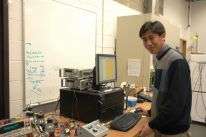
Zhiyong (Jason) Ren and his team with the University of Colorado Denver discovered, after six months from the initial hypothesis to completion, that they could produce hydrogen gas, which is collectable and storable, thus making improvements in the technology. The study, titled Concurrent Desalination and Hydrogen Generation Using Microbial Electrolysis and Desalination Cells, was published in Environmental Science & Technology on December 1 and is funded by the Office of Naval Research.
"Ships and their crews need energy generated on-site as well as fresh drinking water," said Ren. "Thus, the Navy is very interested in both low energy desalination and renewable energy production."
A recent study by Logan group at Penn State University also demonstrated similar findings in that the energy contained in hydrogen gas not only can offset the energy used for the desalination process but has surplus that can be used for downstream processing.
Next steps for Ren and his team will include using real wastewater to test the efficiency as well as optimizing the reactor configuration to improve system performance.
"This discovery is a milestone for our new research group," said Ren. "We are very excited about our findings and will continue working to improve the technology."
More information: Paper online: DOI: 10.1021/es1022202
Provided by University of Colorado Denver
-
Nuclear desalination
Nov 20, 2007 |
not rated yet |
0
-
Energy-efficient water purification
Jan 14, 2009 |
not rated yet |
0
-
Wastewater produces electricity and desalinates water
Aug 06, 2009 |
not rated yet |
0
-
Desalination can boost US water supplies, but environmental research needed
Apr 24, 2008 |
not rated yet |
0
-
New chlorine-tolerant, desalination membrane hopes to boost access to clean water
Jul 22, 2008 |
not rated yet |
0
-
Stars containing dark matter should look different from other stars
Feb 20, 2012 |
4.5 / 5 (17) |
11
-
Physicists discover evidence of rare hypernucleus, a component of strange matter
Feb 17, 2012 |
4.7 / 5 (38) |
22
-
Fast photon control brings quantum photonic technologies closer
Feb 13, 2012 |
5 / 5 (8) |
1
-
Engineers build first sub-10-nm carbon nanotube transistor
Feb 01, 2012 |
4.9 / 5 (36) |
32
-
Something old, something new: Evolution and the structural divergence of duplicate genes
Jan 31, 2012 |
4.6 / 5 (7) |
1
-
Calculating forces involved in seesaw motion
4 hours ago
-
Writing shear and moment equations for a simple beam problem?
5 hours ago
-
Furnace Shell Spray Cooling Design
21 hours ago
-
Ways to measure the speed of a golf ball?
Feb 21, 2012
-
Water Skin Effect in Plastic Pipe
Feb 21, 2012
-
Undergraduate Engineering Physics To Graduate Aerospace Engineering
Feb 21, 2012
- More from Physics Forums - General Engineering
More news stories
Stanford research team cracks animated NuCaptcha
(PhysOrg.com) -- The research team from Stanford University, led by Elie Bursztein, that previously had cracked regular CAPTCHAs and then audio CAPTCHAs, now has also successfully cracked the animated version called NuCapt ...
Tiny, implantable medical device can propel itself through bloodstream
Someday, your doctor may turn to you and say, "Take two surgeons and call me in the morning." If that day arrives, you may just have Ada Poon to thank.
17 hours ago |
5 / 5 (9) |
8
|
Italian engineer invents floating solar panels
Rays of the winter sun bounce off gleaming mirrors on the tiny lake of Colignola in Italy, where engineers have built a cost-effective prototype for floating, rotating solar panels.
Technology / Energy & Green Tech
21 hours ago |
4.7 / 5 (6) |
5
Microsoft hits Motorola, Google with EU complaint
Microsoft on Wednesday lodged a formal complaint with the European Union's competition regulator against Motorola Mobility and its soon-to-be owner Google, saying Motorola's aggressive enforcement of patent ...
17 hours ago |
2 / 5 (1) |
2
Calif. pledges better mobile privacy disclosures
(AP) -- Mobile applications seeking to collect personal information will have to forewarn users as part of an agreement reached in California.
9 hours ago |
not rated yet |
0
Researchers build first physical 'metatronic' circuit
(PhysOrg.com) -- The technological world of the 21st century owes a tremendous amount to advances in electrical engineering, specifically, the ability to finely control the flow of electrical charges using ...
Spitzer finds solid buckyballs in space
(PhysOrg.com) -- Astronomers using data from NASA's Spitzer Space Telescope have, for the first time, discovered buckyballs in a solid form in space. Prior to this discovery, the microscopic carbon spheres ...
Faster than light neutrinos? More like faulty wiring
You can shelf your designs for a warp drive engine (for now) and put the DeLorean back in the garage; it turns out neutrinos may not have broken any cosmic speed limits after all.
Physicists surprised by disappearing and reappearing superconductivity in iron selenium chalcogenides
Superconductivity is a rare physical state in which matter is able to conduct electricity -- maintain a flow of electrons -- without any resistance. This phenomenon can only be found in certain materials at low temperatures, ...
Going up: Japan builder eyes space elevator
A Japanese construction firm claimed Wednesday it could execute an out-of-this-world plan to put tourists in space within 40 years by building an elevator that stretches a quarter of the way to the moon.
Flesh-eating bacteria inspire superglue
(PhysOrg.com) -- A bio-inspired superglue has been developed by Oxford University researchers that cant be matched for sticking molecules together and not letting go.
Dec 03, 2010
Rank: 1.8 / 5 (4)
Dec 03, 2010
Rank: 1 / 5 (2)
Yes, but think of the energy...THE ENERGY!!!111
Dec 03, 2010
Rank: 1 / 5 (2)
Dec 03, 2010
Rank: 4.5 / 5 (2)
Dec 03, 2010
Rank: 2.3 / 5 (3)
And where would all that salt go from oceans, if this escape would happen? Again, if this would be reasonable risk, how much do you think there should be bacteria to do this to oceans? There is way too much of water in oceans for any problem like this. If you want to find real problems, just look at gulf of Mexico, where BP had some minor mishap last spring...
Dec 03, 2010
Rank: 4 / 5 (2)
Unless the bacteria have figures out a way to transmutate the NaCl I doubt that it will be a problem. Where will the salt go??
Dec 03, 2010
Rank: 4.9 / 5 (7)
Dec 04, 2010
Rank: 4.8 / 5 (4)
I think you have misunderstood how the cell functions.
High salinity actually inhibits the microbial action.
Dec 04, 2010
Rank: 1 / 5 (1)
Dec 04, 2010
Rank: 2 / 5 (2)
Dec 04, 2010
Rank: 4.3 / 5 (3)
Dec 05, 2010
Rank: 1 / 5 (1)
Most of it is.
Dec 05, 2010
Rank: 4 / 5 (1)
Have you only just noticed that?
Dec 06, 2010
Rank: not rated yet
1. desalinate salt water
2. produce hydrogen gas
3. "potentially" treat waste water
where as the current method of producing hydrogen through electrolysis PRODUCES waste water AND requires salt. So unless they are creating new microbes, & not just using existing ones in new ways, I have no problem with this tech.