Putting the dead to work
January 14, 2011
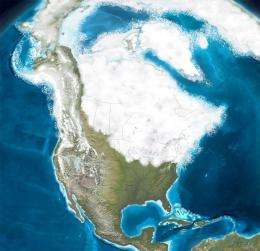
This map shows how North America appeared just over 12,000 years ago. During the Pleistocene, repeated glaciations occurred. Credit: Ron Blakey, NAU
Conservation paleobiologists -- scientists who use the fossil record to understand the evolutionary and ecological responses of present-day species to changes in their environment -- are putting the dead to work.
A new review of the research in this emerging field provides examples of how the fossil record can help assess environmental impacts, predict which species will be most vulnerable to environmental changes, and provide guidelines for restoration.
The literature review by conservation paleobiologists Gregory Dietl of the Paleontological Research Institution and Cornell University and Karl Flessa of the University of Arizona is published in the January, 2011, issue of the journal Trends in Ecology and Evolution.
"Conservation paleobiologists apply the data and tools of paleontology to today's problems in biodiversity conservation," says Dietl.
The primary sources of data are "geohistorical": the fossils, geochemistry and sediments of the geologic record.
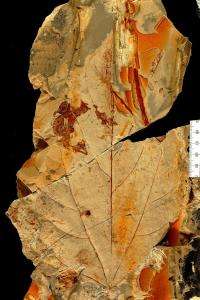
Fossil leaf from a plant that's likely a member of the family that includes poinsettias. Credit: Smithsonian National Museum of Natural History
"A conservation paleobiology perspective has the unique advantage of being able to identify phenomena beyond time scales of direct observation," Dietl says.Such data, says Flessa, "are crucial for documenting the species we have already lost--such as the extinct birds of the Hawaiian islands--and for developing more effective conservation policies in the face of an uncertain future."
Geohistorical records, the authors write, are critical to identifying where--and how--species survived long-ago periods of climate change.
"Historically, paleontologists have focused their efforts on understanding the deep-time geological record of ancient life on Earth, but these authors turn that focus 180 degrees," says H. Richard Lane, program director in NSF's Division of Earth Sciences, which funds Dietl's and Flessa's research.
"In putting the dead to work, they identify the significant impact knowledge of fossil life can have on interpreting modern biodiversity and ecological trends."
Ancient DNA, for example, has been used to show that the arctic fox (Alopex lagopus) was not able to move with shifting climates as its range contracted, eventually becoming extinct in Europe at the end of the Pleistocene.
However, the species persisted in regions of northeastern Siberia where the climate was still suitable for arctic foxes.
In another tale from the beyond, fossil evidence suggests that the birds of the Hawaiian Islands suffered large-scale extinctions around the time of the arrival of the Polynesians.

Corals and other fossils from long-ago seas tell scientists much about life on Earth today. Credit: Polish Academy of Sciences
Studies comparing the ecological characteristics of bird species before and after these extinctions reveal a strong bias against larger-bodied and flightless, ground-nesting species.The pattern suggests that hunting by humans played a role in the extinction of the flightless species.
By the 18th century, the time of the first Europeans' arrival in the islands, most large-bodied birds had already disappeared. European colonization of the islands led to a second wave of exctinctions.
Those birds that survived had traits that helped them weather two onslaughts.
In their review paper, Dietl and Flessa cite a study of the frequency in the fossil record of insect damage to flowering plant leaves in the Bighorn Basin of Wyoming dating from before, during and after the Paleocene-Eocene Thermal Maximum (PETM, some 55.8 million years ago).
The PETM, scientists believe, is one of the best deep-time analogs for current global climate change questions.
Results from the insect research suggest that herbivory intensified during the PETM global warming episode.
"This finding provides insights into how the human-induced rise in atmospheric carbon dioxide is likely to affect insect-plant interactions in the long run," the authors write, "which is difficult to predict from short-term studies that have highly species-specific responses."
The dead can help us even in remote places like the Galapagos Islands.
Scientists have used the fossil pollen and plant record there to show that at least six non-native or "doubtfully native" species were present before the arrival of humans.
This baseline information, says Dietl, "is crucial to a current conservation priority in the Galapagos: the removal of invasive species."
An important role of geohistorical data is to provide access to a wider range of past environmental conditions--alternative worlds of every imaginable circumstance.
Tales of the past that may lead to better conservation practices, crucial for life, not death, on Earth.
The dead, it turns out, do tell tales.
The National Science Foundation (NSF) funded the research.
-
Holes in Fossil Shells Show Effects of Competition and Evolution
Jan 04, 2005 |
not rated yet |
0
-
Caribbean coral reef protection efforts miss the mark
Jun 17, 2010 |
not rated yet |
0
-
Global bird conservation effort lifts off
Aug 13, 2007 |
not rated yet |
0
-
Threatened or invasive? Species' fates identified
Jun 13, 2008 |
not rated yet |
0
-
Researcher finds fossilized shell-breaking crab
Apr 17, 2008 |
not rated yet |
0
-
Stars containing dark matter should look different from other stars
Feb 20, 2012 |
4.5 / 5 (17) |
11
-
Physicists discover evidence of rare hypernucleus, a component of strange matter
Feb 17, 2012 |
4.7 / 5 (38) |
22
-
Fast photon control brings quantum photonic technologies closer
Feb 13, 2012 |
5 / 5 (8) |
1
-
Engineers build first sub-10-nm carbon nanotube transistor
Feb 01, 2012 |
4.9 / 5 (36) |
32
-
Something old, something new: Evolution and the structural divergence of duplicate genes
Jan 31, 2012 |
4.6 / 5 (7) |
1
-
Eye biology videos
4 hours ago
-
Flowering Plant Revived After 30,000 Years in Permafrost
Feb 21, 2012
-
Toba volcano eruptions - 1.000 - 10,000 breeding pairsunb
Feb 20, 2012
-
How is a specific gene removed from DNA
Feb 20, 2012
-
Reproduction and Human evolution
Feb 19, 2012
-
Viruses: Living or Non-living organisms
Feb 19, 2012
- More from Physics Forums - Biology
More news stories
Surprising diversity at a synapse hints at complex diversity of neural circuitry
A new study reveals a dazzling degree of biological diversity in an unexpected place a single neural connection in the body wall of flies.
11 hours ago |
5 / 5 (4) |
0
|
Men might not 'become extinct' after all: Theory of the 'rotting' Y chromosome dealt a fatal blow
If you were to discover that a fundamental component of human biology has survived virtually intact for the past 25 million years, you'd be quite confident in saying that it is here to stay.
14 hours ago |
5 / 5 (6) |
1
|
New family of legless amphibians found in India
Since before the age of dinosaurs it has burrowed unbothered beneath the monsoon-soaked soils of remote northeast India - unknown to science and mistaken by villagers as a deadly, miniature snake.
21 hours ago |
5 / 5 (9) |
3
Climate change affects bird migration timing in North America
Bird migration timing across North America has been affected by climate change, according to a study published Feb. 22 in the open access journal PLoS ONE.
10 hours ago |
4.5 / 5 (2) |
2
New iridescent lizard species found in Cambodia
A new species of lizard with striking iridescent rainbow skin, a long tail and very short legs has been discovered in the rainforest in northeast Cambodia, conservationists announced Wednesday.
10 hours ago |
not rated yet |
0
Researchers build first physical 'metatronic' circuit
(PhysOrg.com) -- The technological world of the 21st century owes a tremendous amount to advances in electrical engineering, specifically, the ability to finely control the flow of electrical charges using ...
Spitzer finds solid buckyballs in space
(PhysOrg.com) -- Astronomers using data from NASA's Spitzer Space Telescope have, for the first time, discovered buckyballs in a solid form in space. Prior to this discovery, the microscopic carbon spheres ...
Faster than light neutrinos? More like faulty wiring
You can shelf your designs for a warp drive engine (for now) and put the DeLorean back in the garage; it turns out neutrinos may not have broken any cosmic speed limits after all.
Physicists surprised by disappearing and reappearing superconductivity in iron selenium chalcogenides
Superconductivity is a rare physical state in which matter is able to conduct electricity -- maintain a flow of electrons -- without any resistance. This phenomenon can only be found in certain materials at low temperatures, ...
Stanford research team cracks animated NuCaptcha
(PhysOrg.com) -- The research team from Stanford University, led by Elie Bursztein, that previously had cracked regular CAPTCHAs and then audio CAPTCHAs, now has also successfully cracked the animated version called NuCapt ...
Going up: Japan builder eyes space elevator
A Japanese construction firm claimed Wednesday it could execute an out-of-this-world plan to put tourists in space within 40 years by building an elevator that stretches a quarter of the way to the moon.


Jan 14, 2011
Rank: not rated yet
Jan 14, 2011
Rank: 3.3 / 5 (3)
Jan 14, 2011
Rank: 1 / 5 (3)
Jan 14, 2011
Rank: 1 / 5 (3)
Jan 14, 2011
Rank: 5 / 5 (2)
I love that book. Just don't mention it to Ethelred ;)
Jan 14, 2011
Rank: 5 / 5 (2)
I've read two different translations and thoroughly enjoyed it both times.
Jan 16, 2011
Rank: not rated yet
I have read ONE book that was even partially in Russia. George McDonald Fraser's Flashman at the Charge. Which is about the Crimean War and the part in Russia is after Flashman is captured in the aftermath of the Charge of the Light Brigade.
"Big place ain't it." Is the best think Flashy had to say about the place. No I don't think one Flashman book is going to say all there is to say about a place that big. However EVERYTHING I have ever seen about it is that is a remarkably nasty place climate wise and that climate is bone deep in the Russian psyche. Hope for the best expect the worst is not realism in Russia. It is massive optimism, mostly because the Russians keep making it the worst.
More
Jan 16, 2011
Rank: not rated yet
Comes from reading Science Fiction and being an American I suppose. We expect things to get better. I remember reading Steinbeck's The Pearl. My teacher must have hated my review as much as I hated the story. I know he wrote other stuff. I liked Cannery Row but I simply am not going to read a bunch of Slit My Wrists and Dies stuff and Russia, the Rodina, is the Mother Land of Slit My Wrists and Die(that is MY name for the Berlin song Take My Breath Away that is a key song in Top Gun
More
Jan 16, 2011
Rank: not rated yet
Oh I just remembered that I read a SF book partially set in Russia. One of Harry Turtledove's turgid alternate histories. In retrospect I can't figure out how I managed to wade through the whole damned thing but I think I have simply gotten less tolerant of sort of writing. Maybe I simply didn't have anything else to read as I had bought the whole series before I started reading any of it and was seriously short on money at the time.
Ethelred