Dino-era sex riddle solved by new fossil find
January 20, 2011
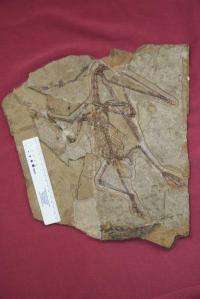
"Mrs. T" is a female Darwinopterus (wingspan 0.78 m) preserved together with her egg. Credit: Lu Junchang
(PhysOrg.com) -- The discovery of an ancient fossil, nicknamed 'Mrs T', has allowed scientists for the first time to sex pterodactyls flying reptiles that lived alongside dinosaurs between 220-65 million years ago.
Pterodactyls featured prominently in Spielberg's Jurassic Park III and are a classic feature of many dinosaur movies where they are often depicted as giant flying reptiles with a crest.
The discovery of a flying reptile fossilised together with an egg in Jurassic rocks (about 160 million years old) in China provides the first direct evidence for gender in these extinct fliers. This fossil shows that females were crestless, solving the long-standing problem of what some pterosaurs did with their spectacular head crests: showy displays by males.
The find was made by an international team of researchers from the Universities of Leicester, Lincoln and the Geological Institute, Beijing. Details of the unique new find are published today (January 21) in the journal Science.
David Unwin, a palaeobiologist in the Department of Museum Studies at the University of Leicester, was part of the research team that studied the fossil. He said:
"Pterosaurs, flying reptiles, also known as pterodactyls, dominated the skies in the Mesozoic Era, the age of dinosaurs, 220-65 million years ago. Many pterosaurs have head crests. In the most spectacular cases these can reach five times the height of the skull. Scientists have long suspected that these crests were used for some kind of display or signalling and may have been confined to males, while females were crestless. But, in the absence of any direct evidence for gender this idea remained speculative and crested and crestless forms were often separated into completely different species."
"The fossil we have discovered, an individual of Darwinopterus (a pterosaur first described by the same team of scientists in 2009) is preserved together with an egg showing that it must be female. This type of discovery, in which gender can be determined with certainty, is extremely rare in the fossil record, and the first to be reported for pterosaurs."
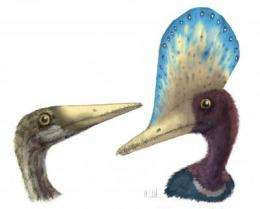
This graphic shows the sex-related features of Darwinopterus. The male (right) has a large head crest, but this is absent in the female (left). Credit: Mark Witton
The new discovery, christened "Mrs T" (a contraction of "Mrs Pterodactyl") by the research team, was made in Jurassic rocks of Liaoning Province in northeast China and seems to represent a tragic accident. The well developed shell shows that Mrs T was just about ready to lay her egg when she was killed in an accident that broke her left forearm, possibly the result of a storm, or perhaps even a volcanic eruption, which were common in this part of China around 160 million years old.
Dr Unwin said: "Mrs T shows two features that distinguish her from male individuals of Darwinopterus. She has relatively large hips, to accommodate the passage of eggs, but no head crest. Males, on the other hand, have relatively small hips and a well developed head crest. Presumably they used this crest to intimidate rivals, or to attract mates such as Mrs T.
"Mrs T is a once in ten lifetime's discovery. As long as the skull or hips are preserved we can now confidently identify males and females of Darwinopterus and, even more importantly, we can use this technique to sex other pterosaurs because they often show differences in head crests and hips just as in Darwinopterus".
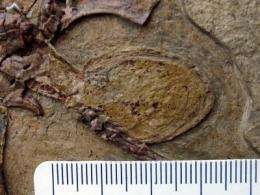
This is a close up of the egg (20 by 28 mm) preserved together with Mrs. T, a female Darwinopterus. Credit: Lu Junchang
Dr Unwin added: "Gender is one of the most fundamental of biological attributes, but extremely difficult to pinpoint with any certainty in the fossil record. Being able to sex pterosaurs is a major step forward. Finally, we have a good explanation for pterosaur head crests, a problem that has puzzled scientists for more than 100 years. Now, we can exploit our knowledge of pterosaur gender to research entirely new areas such as population structure and behaviour. We can also play matchmaker for pterosaurs bringing back together long separated males and females in the single species to which they both belong".Apart from gender the new find also has much to tell us about pterosaur reproduction. Said Dr Unwin: "Mrs T's egg is relatively small and had a soft shell. This is typical of reptiles, but completely different from birds which lay relatively large hard-shelled eggs. This discovery is not surprising though, because a small egg would require less investment in terms of materials and energy a distinct evolutionary advantage for active energetic fliers such as pterosaurs and perhaps an important factor in the evolution of gigantic species such as the 10 meter wingspan Quetzalcoatlus."
-
'Missing link' pterosaur found in China
Oct 13, 2009 |
not rated yet |
0
-
Air-filled bones helped prehistoric reptiles take first flight
Feb 18, 2009 |
not rated yet |
0
-
Scientists find 95-million-year-old pterosaur fossil in Morocco
May 26, 2010 |
not rated yet |
0
-
New species of flying reptile identified on B.C. coast
Jan 10, 2011 |
not rated yet |
0
-
Terrifying pterosaurs were fragile in flight
Nov 23, 2010 |
not rated yet |
0
-
Stars containing dark matter should look different from other stars
Feb 20, 2012 |
4.5 / 5 (17) |
11
-
Physicists discover evidence of rare hypernucleus, a component of strange matter
Feb 17, 2012 |
4.7 / 5 (38) |
22
-
Fast photon control brings quantum photonic technologies closer
Feb 13, 2012 |
5 / 5 (8) |
1
-
Engineers build first sub-10-nm carbon nanotube transistor
Feb 01, 2012 |
4.9 / 5 (36) |
32
-
Something old, something new: Evolution and the structural divergence of duplicate genes
Jan 31, 2012 |
4.6 / 5 (7) |
1
-
Eye biology videos
4 hours ago
-
Flowering Plant Revived After 30,000 Years in Permafrost
Feb 21, 2012
-
Toba volcano eruptions - 1.000 - 10,000 breeding pairsunb
Feb 20, 2012
-
How is a specific gene removed from DNA
Feb 20, 2012
-
Reproduction and Human evolution
Feb 19, 2012
-
Viruses: Living or Non-living organisms
Feb 19, 2012
- More from Physics Forums - Biology
More news stories
Global influence of U.S. Constitution on the decline, study reveals
The U.S. Constitution's global influence is on the decline, finds a new study by David S. Law, JD, PhD, professor of law at Washington University in St. Louis.
Other Sciences / Economics & Business
17 hours ago |
4.5 / 5 (2) |
8
Immigration chief seeks to reassure Silicon Valley
(AP) -- The Obama administration's top immigration official said Wednesday he wants to keep more foreign-born high-tech entrepreneurs in the U.S. But to make that happen, he said he needs those entrepreneurs to turn their ...
9 hours ago |
5 / 5 (2) |
0
What is the value of a green card? Researcher calculates increase in income
Just what does it mean to get a green card? To some applicants, about $1,000 each month.
Other Sciences / Economics & Business
16 hours ago |
not rated yet |
2
Increasingly, children's books are where the wild things aren't: study
Was your favorite childhood book crawling with wild animals and set in places like jungles or deep forests? Or did it take place inside a house or in a city, with few if any untamed creatures in sight?
Other Sciences / Social Sciences
11 hours ago |
4.8 / 5 (4) |
0
Ancient rock art found in Brazil
Researchers have discovered an extremely old anthropomorphic figure engraved in rock in Brazil, according to a report published Feb. 22 in the open access journal PLoS ONE.
Other Sciences / Archaeology & Fossils
9 hours ago |
4.5 / 5 (4) |
0
Researchers build first physical 'metatronic' circuit
(PhysOrg.com) -- The technological world of the 21st century owes a tremendous amount to advances in electrical engineering, specifically, the ability to finely control the flow of electrical charges using ...
Spitzer finds solid buckyballs in space
(PhysOrg.com) -- Astronomers using data from NASA's Spitzer Space Telescope have, for the first time, discovered buckyballs in a solid form in space. Prior to this discovery, the microscopic carbon spheres ...
Faster than light neutrinos? More like faulty wiring
You can shelf your designs for a warp drive engine (for now) and put the DeLorean back in the garage; it turns out neutrinos may not have broken any cosmic speed limits after all.
Physicists surprised by disappearing and reappearing superconductivity in iron selenium chalcogenides
Superconductivity is a rare physical state in which matter is able to conduct electricity -- maintain a flow of electrons -- without any resistance. This phenomenon can only be found in certain materials at low temperatures, ...
CT colonography shown to be comparable to standard colonoscopy
Computerized tomographic (CT) colonography (CTC), also known as virtual colonoscopy, is comparable to standard colonoscopy in its ability to accurately detect cancer and precancerous polyps in people ages 65 and older, according ...
Stanford research team cracks animated NuCaptcha
(PhysOrg.com) -- The research team from Stanford University, led by Elie Bursztein, that previously had cracked regular CAPTCHAs and then audio CAPTCHAs, now has also successfully cracked the animated version called NuCapt ...


Jan 21, 2011
Rank: not rated yet