Warming North Atlantic water tied to heating Arctic, according to new study
January 27, 2011
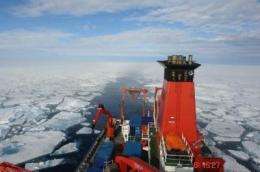
Photo of the German research vessel Maria S. Merian moving through sea ice in Fram Strait northwest of Svalbard. The research team discovered the water there was the warmest in at least 2,000 years, which has implications for a warming and melting Arctic. Credit: Credit: Nicolas van Nieuwenhove (IFM-GEOMAR, Kiel)
The temperatures of North Atlantic Ocean water flowing north into the Arctic Ocean adjacent to Greenland -- the warmest water in at least 2,000 years -- are likely related to the amplification of global warming in the Arctic, says a new international study involving the University of Colorado Boulder.
Led by Robert Spielhagen of the Academy of Sciences, Humanities and Literature in Mainz, Germany, the study showed that water from the Fram Strait that runs between Greenland and Svalbard -- an archipelago constituting the northernmost part of Norway -- has warmed roughly 3.5 degrees Fahrenheit in the past century. The Fram Strait water temperatures today are about 2.5 degrees F warmer than during the Medieval Warm Period, which heated the North Atlantic from roughly 900 to 1300 and affected the climate in Northern Europe and northern North America.
The team believes that the rapid warming of the Arctic and recent decrease in Arctic sea ice extent are tied to the enhanced heat transfer from the North Atlantic Ocean, said Spielhagen. According to CU-Boulder's National Snow and Ice Data Center, the total loss of Arctic sea ice extent from 1979 to 2009 was an area larger than the state of Alaska, and some scientists there believe the Arctic will become ice-free during the summers within the next several decades.
"Such a warming of the Atlantic water in the Fram Strait is significantly different from all climate variations in the last 2,000 years," said Spielhagen, also of the Leibniz Institute of Marine Sciences in Keil, Germany.
According to study co-author Thomas Marchitto, a fellow at CU-Boulder's Institute of Arctic and Alpine Research, the new observations are crucial for putting the current warming trend of the North Atlantic in the proper context.
"We know that the Arctic is the most sensitive region on the Earth when it comes to warming, but there has been some question about how unusual the current Arctic warming is compared to the natural variability of the last thousand years," said Marchitto, also an associate professor in CU-Boulder's geological sciences department. "We found that modern Fram Strait water temperatures are well outside the natural bounds."
A paper on the study will be published in the Jan. 28 issue of Science. The study was supported by the German Research Foundation; the Academy of Sciences, Humanities and Literature in Mainz, Germany; and the Norwegian Research Council.
Other study co-authors included Kirstin Werner and Evguenia Kandiano of the Leibniz Institute of Marine Sciences, Steffen Sorensen, Katarzyna Zamelczyk, Katrine Husum and Morten Hald from the University of Tromso in Norway and Gereon Budeus of the Alfred Wegener Institute of Polar and Marine Research in Bremerhaven, Germany.
Since continuous meteorological and oceanographic data for the Fram Strait reach back only 150 years, the team drilled ocean sediment cores dating back 2,000 years to determine past water temperatures. The researchers used microscopic, shelled protozoan organisms called foraminifera -- which prefer specific water temperatures at depths of roughly 150 to 650 feet -- as tiny thermometers.
In addition, the team used a second, independent method that involved analyzing the chemical composition of the foraminifera shells to reconstruct past water temperatures in the Fram Strait, said Marchitto.
The Fram Strait branch of the North Atlantic Current is the major carrier of oceanic heat to the Arctic Ocean. In the eastern part of the strait, relatively warm and salty water enters the Arctic. Fed by the Gulf Stream Current, the North Atlantic Current provides ice-free conditions adjacent to Svalbard even in winter, said Marchitto.
"Cold seawater is critical for the formation of sea ice, which helps to cool the planet by reflecting sunlight back to space," said Marchitto. "Sea ice also allows Arctic air temperatures to be very cold by forming an insulating blanket over the ocean. Warmer waters could lead to major sea ice loss and drastic changes for the Arctic."
The rate of Arctic sea ice decline appears to be accelerating due to positive feedbacks between the ice, the Arctic Ocean and the atmosphere, Marchitto said. As Arctic temperatures rise, summer ice cover declines, more solar heat is absorbed by the ocean and additional ice melts. Warmer water may delay freezing in the fall, leading to thinner ice cover in winter and spring, making the sea ice more vulnerable to melting during the next summer.
Air temperatures in Greenland have risen roughly 7 degrees F in the past several decades, thought to be due primarily to an increase in Earth's greenhouse gases, according to CU-Boulder scientists.
"We must assume that the accelerated decrease of the Arctic sea ice cover and the warming of the ocean and atmosphere of the Arctic measured in recent decades are in part related to an increased heat transfer from the Atlantic," said Spielhagen.
-
Higher Water Temperatures and Reduced Ice Cover In the Arctic Ocean
Aug 27, 2004 |
not rated yet |
0
-
Without its insulating ice cap, Arctic surface waters warm to as much as 5 C above average
Dec 12, 2007 |
not rated yet |
0
-
Understanding ocean climate
Dec 10, 2009 |
not rated yet |
0
-
Arctic Ocean waters warm suddenly
Oct 07, 2005 |
not rated yet |
0
-
NASA Sees Rapid Changes in Arctic Sea Ice
Sep 13, 2006 |
not rated yet |
0
-
Stars containing dark matter should look different from other stars
Feb 20, 2012 |
4.5 / 5 (17) |
11
-
Physicists discover evidence of rare hypernucleus, a component of strange matter
Feb 17, 2012 |
4.7 / 5 (38) |
22
-
Fast photon control brings quantum photonic technologies closer
Feb 13, 2012 |
5 / 5 (8) |
1
-
Engineers build first sub-10-nm carbon nanotube transistor
Feb 01, 2012 |
4.9 / 5 (36) |
32
-
Something old, something new: Evolution and the structural divergence of duplicate genes
Jan 31, 2012 |
4.6 / 5 (7) |
1
-
Is the Earth really going to die
14 hours ago
-
Do some geologists actually act a lot like Randy Marsh?
Feb 11, 2012
-
Discrepancy between oxygen and carbon-dioxide levels
Feb 09, 2012
-
where gems are found in the world
Feb 09, 2012
-
Wind Waves in Reservoir ~ Wind run-up and Wind set-up
Feb 08, 2012
-
Balance of oxygen in the atmosphere
Feb 01, 2012
- More from Physics Forums - Earth
More news stories
Spitzer finds solid buckyballs in space
(PhysOrg.com) -- Astronomers using data from NASA's Spitzer Space Telescope have, for the first time, discovered buckyballs in a solid form in space. Prior to this discovery, the microscopic carbon spheres ...
14 hours ago |
4.7 / 5 (12) |
8
|
Going up: Japan builder eyes space elevator
A Japanese construction firm claimed Wednesday it could execute an out-of-this-world plan to put tourists in space within 40 years by building an elevator that stretches a quarter of the way to the moon.
Space & Earth / Space Exploration
21 hours ago |
3.5 / 5 (13) |
26
ENASA satellite finds Earth's clouds are getting lower
(PhysOrg.com) -- Earth's clouds got a little lower -- about one percent on average -- during the first decade of this century, finds a new NASA-funded university study based on NASA satellite data. The results ...
Space & Earth / Earth Sciences
18 hours ago |
5 / 5 (8) |
13
|
Fresh scandal embroils US climate science debate
A fresh scandal over climate change has erupted in the United States after leaked documents appeared to show a right-wing funded campaign to influence how climate science is taught in schools.
10 hours ago |
4.1 / 5 (9) |
8
World's oceans get an acid bath
Among the repercussions of global climate change, the effect of ocean acidification on marine life is one of the least-understood variables.
17 hours ago |
4.3 / 5 (6) |
4
|
Researchers build first physical 'metatronic' circuit
(PhysOrg.com) -- The technological world of the 21st century owes a tremendous amount to advances in electrical engineering, specifically, the ability to finely control the flow of electrical charges using ...
Faster than light neutrinos? More like faulty wiring
You can shelf your designs for a warp drive engine (for now) and put the DeLorean back in the garage; it turns out neutrinos may not have broken any cosmic speed limits after all.
Physicists surprised by disappearing and reappearing superconductivity in iron selenium chalcogenides
Superconductivity is a rare physical state in which matter is able to conduct electricity -- maintain a flow of electrons -- without any resistance. This phenomenon can only be found in certain materials at low temperatures, ...
CT colonography shown to be comparable to standard colonoscopy
Computerized tomographic (CT) colonography (CTC), also known as virtual colonoscopy, is comparable to standard colonoscopy in its ability to accurately detect cancer and precancerous polyps in people ages 65 and older, according ...
Stanford research team cracks animated NuCaptcha
(PhysOrg.com) -- The research team from Stanford University, led by Elie Bursztein, that previously had cracked regular CAPTCHAs and then audio CAPTCHAs, now has also successfully cracked the animated version called NuCapt ...
Study: Virtual colonoscopy effective screening tool for adults over 65
Computed tomography (CT) colonography can be used as a primary screening tool for colorectal cancer in adults over the age of 65, according to a new study published online in the journal Radiology.
Jan 27, 2011
Rank: 2.1 / 5 (15)
Jan 27, 2011
Rank: 5 / 5 (4)
Jan 27, 2011
Rank: 3 / 5 (4)
Jan 27, 2011
Rank: 3.5 / 5 (13)
Jan 28, 2011
Rank: 2.3 / 5 (9)
Can you please expand on what you are trying to say when you said: "Worst, it is somehow a sort of conspiratorial effort of scientists colluding the powers to somehow enslave everyone."
I have no idea what you are trying to say in that sentence. Which scientists are you talking about and where does the enslavement come in?
Jan 28, 2011
Rank: not rated yet
Jan 28, 2011
Rank: not rated yet
Jan 28, 2011
Rank: 1 / 5 (1)
Jan 28, 2011
Rank: 4.5 / 5 (2)
I'm a bit skeptical of AGW myself -- I don't think the science is wrong, it's just that there's a tendency to exaggerate doomsday scenarios.
However, skepticism on the matter would be easier to maintain if the typical skepticism wasn't of the tune of: "It's an EVIL CONSPIRACY!!!!ONE!ELEVEN!" (Twhirling their mustaches and cackling: "Nyah-ah-aah!")
Jan 28, 2011
Rank: 5 / 5 (2)
The threat level is Likelihood X Impact.
Serious threats, even if the odds are fairly low are cause for concern, a subtlety seeming overlooked by the anti-AGW characters. It's fine to be skeptical, but how certain are you that we don't face an existential threat? 99%? A 1% chance that we destroy the ecology of the planet in the next 100 years would require mitigation.
Jan 28, 2011
Rank: 4.7 / 5 (3)
Not certain. However, it doesn't matter because I'm a nobody and what I think about it doesn't make any difference one way or another. The issue is purely academic because I don't run anything.
When somebody suggests to me that the fate of the world is resting, however obliquely, in my hands, all I can reply is: "ME? We are in REALLY big trouble."
Jan 28, 2011
Rank: 5 / 5 (2)
Ultimately we all share in the costs of academic research... so, yes, it's in all our hands. And yes, we may be in trouble ;-)
Jan 28, 2011
Rank: not rated yet
No worries matey. I really am not in charge of things.
And you won't disagree, will you? Because I know, whatever I say or whatever I think, I can drop dead for all you really care.
Jan 28, 2011
Rank: 5 / 5 (3)
If you look at the Greenland ice core proxy over at the NOAA site you'll see that natural variability can be extreme. Google the following and take the first link:
NOAA Paleoclimatology Program Alley 2000 Greenland Ice Core Data
It makes me cringe when I see editorial opinion mixed in with comments about hard science like they did in the article above. Just for fun, I like to copy these stories into Word and then cut out all of the opinion and see what's left.
What they say is possibly true, but it's unfair not to mention the relative likelyhood of other explainations.
Jan 28, 2011
Rank: 5 / 5 (1)
Actually, I will often write up notes from PHYSORG articles on various topics as fuel for my blog, and as far as "meat" goes they generally render to fairly small items. Sometimes they simply disappear.
PHYSORG is a collecting house for science articles from a wide range of sources. That is a very valuable function, but inescapably the writing quality is highly variable and the mean is not very high.
Jan 28, 2011
Rank: 4.3 / 5 (3)
Jan 29, 2011
Rank: 3 / 5 (2)
Thanks
Jan 30, 2011
Rank: 1 / 5 (1)
Jan 30, 2011
Rank: 2.6 / 5 (5)
Making assumptions like that could get you a job as a climatologist.
Let's see, two temperature proxies (from the same source material) that I am sure are well correlated with actual historical temperatures, show a long period of alleged stability and then the modern data from actual thermometers show a rapid increase. Sounds very much like a hockey stick shaped graph. Or should I say, a hockey stick *graft*. A scam does not become more credible through repetition.
Jan 30, 2011
Rank: 3.7 / 5 (3)
I used to be a GW skeptic, then a AGW skeptic, then a "warming catastrophe" skeptic, and now I just wish I could find a skeptical "scientist" whose anti-global warming arguments weren't so full of obvious holes. First it wasn't happening, then it was natural, then it would self regulate. More and more unanticipated positive feedback mechanisms are being uncovered.
But, then again, as a plant lover, I welcome our soon-to-be-warmer world.
Jan 31, 2011
Rank: not rated yet
I already provided my reference. Read my first comment and google my NOAA reference for the Greenland ice core temperature proxy. If you click on the graph it will open a larger version that you can see better.
Are you questioning that the past 2000 years are relatively cool compared to the past 10000 or are you questioning the 15 degree changes in decades? I can give other references to the 15 degree part. I think there are several citations in the IPCC 4th AR. I'll look them up if I HAVE to.
Keep in mind that I'm highly skeptical of paleo proxies though, and I take the above stuff with carefull consideration.
@MikeyK: ?? I don't post much on weekends, and like I said; I already gave my source.
Jan 31, 2011
Rank: not rated yet
Jan 31, 2011
Rank: 1 / 5 (1)
Jan 31, 2011
Rank: 1 / 5 (1)
To your point about the past 2,000 years probably being cooler than the past 10,000 years, I would agree with that. However the past few decades have probably been warmer than at any point in the last 10,000 years ( as you say old proxies have a large margin of error). How do you explain this recent rapid warming without any other driver changing as much as CO2?
Jan 31, 2011
Rank: not rated yet
Sun spot records are not the same as solar radiance. Recent evidence from our latest and greatest space observatories seems to indicate a disconnect there. I say wait and see on that one. The next 10-20 years should tell us a lot. You know the other issues with the CO2/Temp record, so I won't go into them again.
Well, the past 12k years represents the time span from the deepest part of the YD ice age to present, and a warming trend may be normal after an ice age ends. We can't know that for sure though. This could, after all, be human caused warming. The catch 22 is that we really won't be sure until we have a longer record, and then it could be too late. It's a gamble.
Feb 07, 2011
Rank: 1 / 5 (1)
Here is what I predict. Everything will pretty much follow VP Al Gore's predictions and everything will get worst.