Scientists construct synthetic proteins that sustain life
January 6, 2011 by Kitta MacPherson
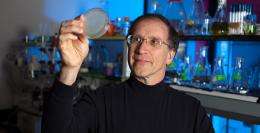
Michael Hecht, a professor of chemistry at Princeton University, has led a team of researchers who have for the first time constructed artificial proteins that enable the growth of living cells. The synthetic proteins were designed from scratch and expressed from artificial genes. He is holding samples of living bacteria containing the synthetic proteins. (Photo by Brian Wilson)
(PhysOrg.com) -- In a groundbreaking achievement that could help scientists "build" new biological systems, Princeton University scientists have constructed for the first time artificial proteins that enable the growth of living cells.
The team of researchers created genetic sequences never before seen in nature, and the scientists showed that they can produce substances that sustain life in cells almost as readily as proteins produced by nature's own toolkit.
"What we have here are molecular machines that function quite well within a living organism even though they were designed from scratch and expressed from artificial genes," said Michael Hecht, a professor of chemistry at Princeton, who led the research. "This tells us that the molecular parts kit for life need not be limited to parts -- genes and proteins -- that already exist in nature."
The work, Hecht said, represents a significant advance in synthetic biology, an emerging area of research in which scientists work to design and fabricate biological components and systems that do not already exist in the natural world. One of the field's goals is to develop an entirely artificial genome composed of unique patterns of chemicals.
"Our work suggests," Hecht said, "that the construction of artificial genomes capable of sustaining cell life may be within reach."
Nearly all previous work in synthetic biology has focused on reorganizing parts drawn from natural organisms. In contrast, Hecht said, the results described by the team show that biological functions can be provided by macromolecules that were not borrowed from nature, but designed in the laboratory.
Although scientists have shown previously that proteins can be designed to fold and, in some cases, catalyze reactions, the Princeton team's work represents a new frontier in creating these synthetic proteins.
The research, which Hecht conducted with three former Princeton students and a former postdoctoral fellow, is described in a report published online Jan. 4 in the journal Public Library of Science ONE.
Hecht and the students in his lab study the relationship between biological processes on the molecular scale and processes at work on a larger magnitude. For example, he is studying how the errant folding of proteins in the brain can lead to Alzheimer's disease, and is involved in a search for compounds to thwart that process. In work that relates to the new paper, Hecht and his students also are interested in learning what processes drive the routine folding of proteins on a basic level -- as proteins need to fold in order to function -- and why certain key sequences have evolved to be central to existence.
Proteins are the workhorses of organisms, produced from instructions encoded into cellular DNA. The identity of any given protein is dictated by a unique sequence of 20 chemicals known as amino acids. If the different amino acids can be viewed as letters of an alphabet, each protein sequence constitutes its own unique "sentence."
And, if a protein is 100 amino acids long (most proteins are even longer), there are an astronomically large number of possibilities of different protein sequences, Hecht said. At the heart of his team's research was to question how there are only about 100,000 different proteins produced in the human body, when there is a potential for so many more. They wondered, are these particular proteins somehow special? Or might others work equally well, even though evolution has not yet had a chance to sample them?
Hecht and his research group set about to create artificial proteins encoded by genetic sequences not seen in nature. They produced about 1 million amino acid sequences that were designed to fold into stable three-dimensional structures.
"What I believe is most intriguing about our work is that the information encoded in these artificial genes is completely novel -- it does not come from, nor is it significantly related to, information encoded by natural genes, and yet the end result is a living, functional microbe," said Michael Fisher, a co-author of the paper who earned his Ph.D. at Princeton in 2010 and is now a postdoctoral fellow at the University of California-Berkeley. "It is perhaps analogous to taking a sentence, coming up with brand new words, testing if any of our new words can take the place of any of the original words in the sentence, and finding that in some cases, the sentence retains virtually the same meaning while incorporating brand new words."
Once the team had created this new library of artificial proteins, they inserted those proteins into various mutant strains of bacteria in which certain natural genes previously had been deleted. The deleted natural genes are required for survival under a given set of conditions, including a limited food supply. Under these harsh conditions, the mutant strains of bacteria died -- unless they acquired a life-sustaining novel protein from Hecht's collection. This was significant because formation of a bacterial colony under these selective conditions could occur only if a protein in the collection had the capacity to sustain the growth of living cells.
In a series of experiments exploring the role of differing proteins, the scientists showed that several different strains of bacteria that should have died were rescued by novel proteins designed in the laboratory. "These artificial proteins bear no relation to any known biological sequences, yet they sustained life," Hecht said.
Added Kara McKinley, also a co-author and a 2010 Princeton graduate who is now a Ph.D. student at the Massachusetts Institute of Technology: "This is an exciting result, because it shows that unnatural proteins can sustain a natural system, and that such proteins can be found at relatively high frequency in a library designed only for structure."
More information: "De Novo Designed Proteins from a Library of Artificial Sequences Function in Escherichia Coli and Enable Cell Growth", Public Library of Science ONE, http://www.plosone … pone.0015364
Provided by Princeton University
-
Researchers create functioning artificial proteins using nature's rules
Sep 21, 2005 |
not rated yet |
0
-
Genetic Code 2.0: Novel artificial proteins for industry and science
Jun 29, 2010 |
not rated yet |
0
-
Comprehensive model is first to map protein folding at atomic level
Nov 06, 2006 |
not rated yet |
0
-
Research breakthrough for the protein factories of tomorrow
Sep 22, 2006 |
not rated yet |
0
-
Unfolding 'nature's origami'
Mar 02, 2009 |
not rated yet |
0
-
Stars containing dark matter should look different from other stars
Feb 20, 2012 |
4.5 / 5 (17) |
11
-
Physicists discover evidence of rare hypernucleus, a component of strange matter
Feb 17, 2012 |
4.7 / 5 (38) |
22
-
Fast photon control brings quantum photonic technologies closer
Feb 13, 2012 |
5 / 5 (8) |
1
-
Engineers build first sub-10-nm carbon nanotube transistor
Feb 01, 2012 |
4.9 / 5 (36) |
32
-
Something old, something new: Evolution and the structural divergence of duplicate genes
Jan 31, 2012 |
4.6 / 5 (7) |
1
-
Eye biology videos
4 hours ago
-
Flowering Plant Revived After 30,000 Years in Permafrost
Feb 21, 2012
-
Toba volcano eruptions - 1.000 - 10,000 breeding pairsunb
Feb 20, 2012
-
How is a specific gene removed from DNA
Feb 20, 2012
-
Reproduction and Human evolution
Feb 19, 2012
-
Viruses: Living or Non-living organisms
Feb 19, 2012
- More from Physics Forums - Biology
More news stories
Surprising diversity at a synapse hints at complex diversity of neural circuitry
A new study reveals a dazzling degree of biological diversity in an unexpected place a single neural connection in the body wall of flies.
10 hours ago |
5 / 5 (4) |
0
|
Men might not 'become extinct' after all: Theory of the 'rotting' Y chromosome dealt a fatal blow
If you were to discover that a fundamental component of human biology has survived virtually intact for the past 25 million years, you'd be quite confident in saying that it is here to stay.
13 hours ago |
5 / 5 (6) |
1
|
New family of legless amphibians found in India
Since before the age of dinosaurs it has burrowed unbothered beneath the monsoon-soaked soils of remote northeast India - unknown to science and mistaken by villagers as a deadly, miniature snake.
21 hours ago |
5 / 5 (8) |
3
Climate change affects bird migration timing in North America
Bird migration timing across North America has been affected by climate change, according to a study published Feb. 22 in the open access journal PLoS ONE.
9 hours ago |
4.5 / 5 (2) |
2
New iridescent lizard species found in Cambodia
A new species of lizard with striking iridescent rainbow skin, a long tail and very short legs has been discovered in the rainforest in northeast Cambodia, conservationists announced Wednesday.
10 hours ago |
not rated yet |
0
Researchers build first physical 'metatronic' circuit
(PhysOrg.com) -- The technological world of the 21st century owes a tremendous amount to advances in electrical engineering, specifically, the ability to finely control the flow of electrical charges using ...
Spitzer finds solid buckyballs in space
(PhysOrg.com) -- Astronomers using data from NASA's Spitzer Space Telescope have, for the first time, discovered buckyballs in a solid form in space. Prior to this discovery, the microscopic carbon spheres ...
Faster than light neutrinos? More like faulty wiring
You can shelf your designs for a warp drive engine (for now) and put the DeLorean back in the garage; it turns out neutrinos may not have broken any cosmic speed limits after all.
Physicists surprised by disappearing and reappearing superconductivity in iron selenium chalcogenides
Superconductivity is a rare physical state in which matter is able to conduct electricity -- maintain a flow of electrons -- without any resistance. This phenomenon can only be found in certain materials at low temperatures, ...
CT colonography shown to be comparable to standard colonoscopy
Computerized tomographic (CT) colonography (CTC), also known as virtual colonoscopy, is comparable to standard colonoscopy in its ability to accurately detect cancer and precancerous polyps in people ages 65 and older, according ...
Stanford research team cracks animated NuCaptcha
(PhysOrg.com) -- The research team from Stanford University, led by Elie Bursztein, that previously had cracked regular CAPTCHAs and then audio CAPTCHAs, now has also successfully cracked the animated version called NuCapt ...
Jan 06, 2011
Rank: 5 / 5 (10)
Jan 07, 2011
Rank: 1.4 / 5 (9)
Just a thought: your sentence is ambiguous - do you mean that if the cells are transported to another world, they'll survive the conditions there OR do you mean that because of the robustness, life's processes could have developed elsewhere other than on earth?
Jan 07, 2011
Rank: 5 / 5 (5)
Jan 07, 2011
Rank: 1 / 5 (14)
So here we have the doubly incredible miracle of evolution - so many possibilities and yet right here, currently we have a select 100k actual proteins that give us life - without having had the time to go thru the other 10exp80 Billion other combinations.
Basically, evolution has nothing to do with the existence of the DNA collection. That was created by the super intelligent person known as God.
Whilst it's laudable that human beings can now create such artificial proteins, the one concern I have is that we still do not understand the ramifications of that ability. What are the side-effects e.g. possibility of toxicity etc?
Jan 07, 2011
Rank: 5 / 5 (10)
Jan 07, 2011
Rank: 5 / 5 (11)
Why bother with other combinations if a set has already been found that works? Do you continue looking for your car keys after you've found them?
Pity it wasn't within his power to suppress the creation of willfully ignorant people.
That's why we have testing and experimentation. You know, the sort of thing that leads to actual answers? Well, maybe you don't know...
Jan 07, 2011
Rank: 5 / 5 (12)
I think you don't know how evolution is defined or how it works. It's a slow accretion process. The protein (or DNA sequence or organism) doesn't go through a _complete_ reshuffling in each cycle. It's only small parts which are then tested (by the environment) for fitness. That way the number of combinations is vastly reduced very quickly.
Oh, and please leave this god fiction out of it. This is a science site. (Unless, of course, you have scientific proof for it). claming something to be a fiction by resorting to a fictional explanation of your own isn't exactly...erm...a clever argumentative strategy.
Jan 07, 2011
Rank: 5 / 5 (8)
Nature gets opportunities for natural selection by chance, some get selected as they have a benefit, some get deselected as they are detrimental, and most changes have no effect.
but Nature cannot select by design as we can, it can take millenia for natural selection to determine if a protein is beneficial, and in many cases I suspect a protein was not immediately beneficial until a second protein evolved that happened to work with it in some beneficial manner.
What we CAN do more efficiently is model these proteins to understand their potential effects and interactions and for example design new drugs , better crops etc. I thinks that this work is a major breakthrough, and just goes to show how irrelevant 'GOD' is in the modern world of science.
If mankind can achieve such breakthroughs who needs a GOD to believe in.
Jan 07, 2011
Rank: not rated yet
1)the protein exist , but the natural exist too and doing all the job
2)the cell find a way to do the job by useing another synthetical path, which is again natural.
Jan 07, 2011
Rank: 4.5 / 5 (8)
Word salad.Prove it. I thought you maintained that only god could do it. Do I sense a backpedal?You could always engage in science and find out.
Jan 07, 2011
Rank: not rated yet
Jan 07, 2011
Rank: 3 / 5 (2)
I would say many of the natural laws we have discovered do a plenty good job of precluding any sort of divine entity, for example showing why the "omnis" attributed to such a being (omnipotence, omniscience, omnipresence) are impossible. This is just icing on the cake, in that it shows in addition to being impossible a divine creator is also not necessary.
Jan 07, 2011
Rank: 5 / 5 (1)
Jan 07, 2011
Rank: 2.4 / 5 (5)
Kevinrtrs - if a god or gods created the universe recently, it was created with a billions-of-years-deep history. So from your perspective true scientists are mere trying to understand the deep history that god created the universe with.
If God is omnipotent, God clearly COULD have created life with a deep evolutionary history, and when scientists study what you call God's work, that is what they find.
So who are you to insist that God can't have created life with an evolutionary history?
Jan 08, 2011
Rank: 5 / 5 (2)
it doesn`t need to. The onus of proof is on the one making an assertion (in this case "there is a god"). As long as that isn't even substantiated by a shred of evidence no proof to the contrary is necessary.
Or do you require proof that there are no unicorns? If you don't then why do you not believe in them?
Jan 08, 2011
Rank: 5 / 5 (3)
I think you should read what I said again. I made no such claim. Calling out logical fallacies by name is almost trite on here, but that's straw man if I've ever seen one. If it wasn't clear I meant only that this result shows a divine creator is not necessary.
Jan 08, 2011
Rank: 5 / 5 (3)
You are assuming that proteins need to be inside a cell to have any beneficial effect, this is clearly not true.
many protiens functio outside of cells to achieve extremely useful functions, for example enzymes that break down starches into sugars etc.
Designing proteins from scratch opens up a whole new world to chemical engineering that has no reliance on cells or life, for example in the efficient production of bio-fuels, or the direct synthesis of sugars from solar energy, these would be hugely beneficial to mankind and such enzymes are unlikely to be found in the natural environment as they would probably have no benefit to living organisms, or living organisms would not provide the mechanisms for natural selection of such proteins.
Jan 08, 2011
Rank: 5 / 5 (6)
Jan 08, 2011
Rank: 5 / 5 (3)
Precluding means "it cannot be", so I objected to your statement.
If you misused 'preclude' to mean "does not require", then I agree with what you MEANT to say.
To anyone who interpreted my comment as supporting either creationism or the existence of a god or gods, read again.
I want folks like Kevin and other YECs to realize that from THEIR point of view science is studying God's work. Even even a few of them do, there will be less nonsense and more science on these boards.
Jan 08, 2011
Rank: 5 / 5 (2)
For example, when someone says something like "nothing good has ever come from religion", I disagree. Agriculture comes from people offering plants to the gods - if you bury your best tubers as an offering, or seeds from your favorite plants, it is clear (from the perspective of that time), that the gods look favorably on this and return the favor.
Science is the study of how the universe works.
Religion is the certitude of a meaning underlying existence.
They are very different things, and if the creationsts stop trying to go against overwhelming evidence and scientists are careful not to make over-reaching statements, we will have more room for science on this board.
Jan 08, 2011
Rank: not rated yet
If someone wants to argue theology (or why and how it contradicts science) then there's plenty of religious sites out there where they can do that to their heart's content. There they will also not be molested by any scientifically inclined person.
Everybody wins.
Jan 08, 2011
Rank: 4.5 / 5 (2)
I generally try to refrain from posting - you and Skeptic and Ethelred and a few others generally say what I would have said.
But when I see supposed scientists forgetting that absence of evidence is not evidence of absence, I speak up.
I am not surprised when YECs forget that, but I expect more from scientists (being one myself).
Apparently you misinterpreted what I said as supporting the YECs, whereas I merely pointed out that a particular statement against the YECs was incorrect and left room for a counter attack.
As for unicorns, I don't believe in 'fairy' unicorns, but if you said that tracing 'unicorn' to 'monocerous' (one-horn, an old greek name for a rhinoceros) was PROOF unicorns don't exist, I'd disagree. Kevin doesn't know better, but a scientist should.
Jan 08, 2011
Rank: 4 / 5 (2)
There is, however, a difference between religious people slagging off science and scientists slagging off religion: Precedence of claims.
First claims must be supported first (in tis case the first claim is "there is a god"). As long as these claims are not supported adherence to them is _rightfully_ ridiculed .
This is type of behavior is not restricted religious matters. If someone were to make unsubstantiated scientific claims (as e.g. omatur is wont to do) they'd get the same treatment from me. i'd say 'put up or shut up' to such a person (which is exactly what the statement "there is no god" is).
Jan 08, 2011
Rank: 5 / 5 (3)
Many great science advances are made by people who have a theory first, with no evidence yet to support it over the established theory, and only afterward find evidence to support the new theory.
Ridicule should be reserved for when there is overwhelming evidence against something and people are pointedly ignoring the evidence (and even then it should be used judiciously, for ridicule is often both mean-spirited and counterproductive).
Now I'll agree that since the universe chugs along fine without needing a medlesome man-in-the-sky god, the chance of finding solid evidence for such a god is vanishingly small, but stretching that to say one discovery (or science in general) 'precludes' any god(s) is illogical.
(Probably Terrible_Bohr and dtxx simply misused 'preclude', but such carelessness in speech opens the door for YECs to make science sound wrong.)
Jan 09, 2011
Rank: not rated yet
Jan 10, 2011
Rank: 1 / 5 (1)
Jan 10, 2011
Rank: 1 / 5 (1)
Jan 10, 2011
Rank: 5 / 5 (2)
We have that. Matter is positive energy, gravity is NEGATIVE energy. So far they look close to a one to one ratio. There is reason to believe that they may be exactly one to one.
So why something instead of nothing? The laws of math and logic fit this Universe and many other conceivable Universes. Thus our Universe is possible without a Creator. This does not mean that it could not have been created but there is no requirement for a creator.
So why shouldn't it exist.
Ethelred
Jan 10, 2011
Rank: 5 / 5 (1)
You are using the same kind of anti-logic that many Creationists are fond of. False dichotomies. You act as if evidence against The Hairy Thunderer God, Jehovah of Genesis, is the only possible god. Just because YOU can't manage to think of other ways it does not mean that everyone else is.
The first imbecile that calls this a pro religion post gets a flock of ones. Its a pro LOGIC post.
Ethelred