Researchers print solar cells on toilet paper, other delicate materials (w/ Video)
January 4, 2011 by Lisa Zyga
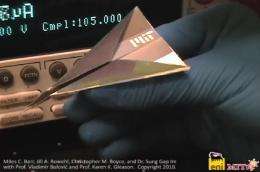
After printing solar cells on a piece of paper, researchers folded the paper into an airplane to demonstrate that it could still generate current. Image credit: Karen Gleason, MIT.
To demonstrate how a new fabrication technique can print solar cells on extremely thin, flexible materials, researchers from MIT have patterned solar cells onto ordinary toilet paper. While toilet paper may be an unlikely substrate for practical solar cell applications, it illustrates the versatility of the technique for low-cost printing on a wide variety of materials.
Karen Gleason, a chemical engineering professor at MIT, along with graduate student Miles Barr and others, showed that the technique could be used to print solar cells on a variety of delicate materials. One example is rice paper, which is used to make spring rolls in restaurants and usually dissolves in wet processes. Since the researchers technique is a dry, solvent-free process, the rice paper remains intact. The researchers also demonstrated the technique on plastic Saran wrap, which repels water and would normally be difficult to coat.
The new method, called oxidative chemical vapor deposition (oCVD), involves spraying a vapor of a monomer and an oxidizing agent onto a substrate. The monomer and oxidizing agent polymerize when they meet and form PEDOT plastic. The plastic itself is conductive, but the conductivity can be further increased up to 1,000 times by controlling the substrate temperature so that small nanopores form, which can be laced with highly conductive silver particles.
The printed solar cells can also withstand a great deal of bending and stretching with minimal effect on their properties. In tests, the researchers bent a printed plastic substrate to a radius of less than 5 mm more than 1,000 times, and found that its efficiency was still 99% of what is was before bending. The electrodes could also be bent and stretched, and still retained their conductivity. To further demonstrate the methods robustness, Barr folded a piece of paper printed with solar cells into a paper airplane, and showed that the device still generated a current.
MIT Professor Karen K. Gleason explains how graduate student Miles Barr folds a solar cell into a paper airplane. The research is part of the Eni-MIT Solar Frontiers Center. Video credit: MIT.
As the researchers noted, paper is not typically considered a good substrate for photovoltaics because its not transparent. However, the ability to print solar cells at low-cost on flexible, stretchable materials could be very useful for making solar cells more widespread. Since the technique can also be used to print other electronic devices besides solar cells, it could be used for novel applications such as printing electronics on fabric and other flexible displays.
More information: via: IEEE Spectrum
© 2010 PhysOrg.com
-
Xerox Develops Silver Ink for Cheap Printable Electronics
Oct 27, 2009 |
not rated yet |
0
-
Graphene organic photovoltaics, or, will joggers' t-shirts someday power their cell phones?
Jul 23, 2010 |
not rated yet |
0
-
Plastic electronics could slash the cost of solar panels
Mar 30, 2010 |
not rated yet |
0
-
New silver-based ink has applications in printed electronics
Feb 12, 2009 |
not rated yet |
0
-
UCLA engineers create new transparent electrodes for highly flexible electronics
Dec 20, 2010 |
not rated yet |
0
-
Stars containing dark matter should look different from other stars
Feb 20, 2012 |
4.5 / 5 (17) |
11
-
Physicists discover evidence of rare hypernucleus, a component of strange matter
Feb 17, 2012 |
4.7 / 5 (38) |
22
-
Fast photon control brings quantum photonic technologies closer
Feb 13, 2012 |
5 / 5 (8) |
1
-
Engineers build first sub-10-nm carbon nanotube transistor
Feb 01, 2012 |
4.9 / 5 (36) |
32
-
Something old, something new: Evolution and the structural divergence of duplicate genes
Jan 31, 2012 |
4.6 / 5 (7) |
1
-
Strength reduction factors for welded edge joints
4 hours ago
-
Specific heat of Al
Feb 21, 2012
-
Strongest steel?
Feb 19, 2012
-
stabilizing Zirconia
Feb 18, 2012
-
How to calculate strength of welds (welded joints)?
Feb 17, 2012
-
Polycarbonate fracture toughness????
Feb 16, 2012
- More from Physics Forums - Materials & Chemical Engineering
More news stories
New nanotechnology converts heat into power when it's needed most
Never get stranded with a dead cell phone again. A promising new technology called Power Felt, a thermoelectric device that converts body heat into an electrical current, soon could create enough juice to make another call ...
17 hours ago |
4 / 5 (8) |
6
|
New technique produces free-standing piezoelectric ferroelectric nanostructures from PZT material
(PhysOrg.com) -- Researchers have developed a soft template infiltration technique for fabricating free-standing piezoelectrically active ferroelectric nanotubes and other nanostructures from PZT ...
18 hours ago |
5 / 5 (5) |
4
|
Graphene is thinnest known anti-corrosion coating
New research has established the "miracle material" called graphene as the world's thinnest known coating for protecting metals against corrosion. Their study on this potential new use of graphene appears ...
Nanotechnology / Nanomaterials
14 hours ago |
4.6 / 5 (7) |
2
|
Researchers discover how different nanomaterial surfaces affect proteins
A new study led by nanotechnology and biotechnology experts at Rensselaer Polytechnic Institute is providing important details on how proteins in our bodies interact with nanomaterials. In their new study, published in the ...
Nanotechnology / Bio & Medicine
11 hours ago |
5 / 5 (2) |
1
|
A new twist on nanowires
Nanowires — microscopic fibers that can be “grown” in the lab — are a hot research topic today, with a variety of potential applications including light-emitting diodes (LEDs) and sensors. ...
20 hours ago |
4.8 / 5 (4) |
0
|
Researchers build first physical 'metatronic' circuit
(PhysOrg.com) -- The technological world of the 21st century owes a tremendous amount to advances in electrical engineering, specifically, the ability to finely control the flow of electrical charges using ...
Spitzer finds solid buckyballs in space
(PhysOrg.com) -- Astronomers using data from NASA's Spitzer Space Telescope have, for the first time, discovered buckyballs in a solid form in space. Prior to this discovery, the microscopic carbon spheres ...
Faster than light neutrinos? More like faulty wiring
You can shelf your designs for a warp drive engine (for now) and put the DeLorean back in the garage; it turns out neutrinos may not have broken any cosmic speed limits after all.
Physicists surprised by disappearing and reappearing superconductivity in iron selenium chalcogenides
Superconductivity is a rare physical state in which matter is able to conduct electricity -- maintain a flow of electrons -- without any resistance. This phenomenon can only be found in certain materials at low temperatures, ...
Stanford research team cracks animated NuCaptcha
(PhysOrg.com) -- The research team from Stanford University, led by Elie Bursztein, that previously had cracked regular CAPTCHAs and then audio CAPTCHAs, now has also successfully cracked the animated version called NuCapt ...
Going up: Japan builder eyes space elevator
A Japanese construction firm claimed Wednesday it could execute an out-of-this-world plan to put tourists in space within 40 years by building an elevator that stretches a quarter of the way to the moon.
Jan 04, 2011
Rank: 4.5 / 5 (2)
Jan 04, 2011
Rank: 4.9 / 5 (18)
Jan 04, 2011
Rank: 5 / 5 (3)
Jan 04, 2011
Rank: 4.3 / 5 (3)
If you did put it on something flexible you could wrap many structures like lamp posts and electrical poles (though I do wish people would bury the electrical lines more often). Solarizing (is that a word) things like street lights - even if they need to be hooked up to the grid for backup - could reduce the losses caused by transmission.
If they ever get wind power to become economically sensible (able to pay for itself without massive subsidies, solve maintenance and storage issues) they could wrap the turbine poles for some extra power. Since the wind turbines seem to have a beneficial effect on crops there would be an added insentive for farmers to use them.
Jan 04, 2011
Rank: 4 / 5 (1)
...or automobiles or geodesic domes as stated.
This could be extremely useful in hydroponic greenhouses, because in some locations they get too much sunlight and need screens. It would be nice to have the "screen" be build into some of the plastic in the form of these solar cells, and then use the electricity to power water pumps or something else.
Jan 04, 2011
Rank: 5 / 5 (1)
Jan 04, 2011
Rank: 5 / 5 (3)
Since the type they printed aren't see-through that would defeat the purpose of having windows, don't you think?
Think more about outside walls, shingles, ....
Jan 04, 2011
Rank: 3.5 / 5 (2)
Looks like just another PR release from the Toot to me.
Jan 04, 2011
Rank: 5 / 5 (1)
Seems that the trade off is: the more efficient something is at converting light to electricity, the more opaque it becomes...
Jan 04, 2011
Rank: 5 / 5 (2)
It's hard to say since their light source could be tuned perfectly to the wavelength that their cells respond to best, or they could have just used some typical light source that doesn't posses the wavelength needed to fully excite the cell. Also, without the voltage or resistance of the circuit known, we can't calculate the power being generated. Finally, I don't know exactly how much of the surface was actual working solar cell, so it's hard to calculate the per area power generated. But if you imagine multiple square meters of this stuff, it adds up pretty quickly.
Jan 05, 2011
Rank: not rated yet
Of course, because it needs to _capture_ the energy in order to convert it. Any photon that is captured does not pass through (and hence cannot be seen on the other side). Transparent solar cells would need to restrict themselves to the UV or IR parts of the spectrum (because we don't see these wavelengths we wouldn't notice when they're missing)
The most energy of our sun is, however, in the visible spectrum. (Naturally we evolved to make use of just this part because it allows us to see the most energy and hence gather the most information about our environment)