Research finds practicing retrieval is best tool for learning
January 21, 2011
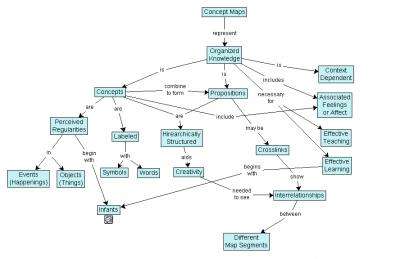
Elaborate study methods that use concept maps like this one require students to construct a diagram--typically using nodes or bubbles--that shows relationships among ideas, characteristics, materials, etc. Resent test results showed retrieval practice was superior to elaborative studying in all comparisons. Credit: Vicwood40, Creative Commons Attribution-Share Alike 3.0 Unported license
(PhysOrg.com) -- Put down those science text books and work at recalling information from memory. That's the shorthand take away message of new research from Purdue University that says practicing memory retrieval boosts science learning far better than elaborate study methods.
"Our view is that learning is not about studying or getting knowledge 'in memory,'" said Purdue psychology professor Jeffrey Karpicke, the lead investigator for the study that appears today in the journal Science. "Learning is about retrieving. So it is important to make retrieval practice an integral part of the learning process."
Educators traditionally rely on learning activities that encourage elaborate study routines and techniques focused on improving the encoding of information into memory. But, when students practice retrieval, they set aside the material they are trying to learn and instead practice calling it to mind.
The study, "Retrieval Practice Produces More Learning Than Elaborative Studying With Concept Mapping," tested both learning strategies alongside each other. The research was funded by the National Science Foundation's Division of Undergraduate Education.
"In prior research, we established that practicing retrieval is a powerful way to improve learning," said Karpicke. "Here we put retrieval practice to the test by comparing its effectiveness to an elaborative study method, specifically elaborative studying by creating concept maps."
Concept mapping requires students to construct a diagram--typically using nodes or bubbles--that shows relationships among ideas, characteristics or materials. These concepts are then written down as a way of encoding them in a person's memory.
The researchers say the practice is used extensively for learning about concepts in sciences such as biology, chemistry or physics.
In two studies, reported by Karpicke and his colleague, Purdue University psychology student Janell Blunt, a total of 200 students studied texts on topics from different science disciplines. One group engaged in elaborative study using concept maps while a second group practiced retrieval; they read the texts, then put them away and practiced freely recalling concepts from the text.
After an initial study period, both groups recalled about the same amount of information. But when the students returned to the lab a week later to assess their long-term learning, the group that studied by practicing retrieval showed a 50 percent improvement in long-term retention above the group that studied by creating concept maps.
This, despite the students own predictions about how much they would actually remember. "Students do not always know what methods will produce the best learning," said Karpicke in discussing whether students are good at judging the success of their study habits.
He found that when students have the material right in front of them, they think they know it better than they actually do. "It may be surprising to realize that there is such a disconnect between what students think will afford good learning and what is actually best. We, as educators, need to keep this in mind as we create learning tools and evaluate educational practices," he said.
The researchers showed retrieval practice was superior to elaborative studying in all comparisons.
"The final retention test was one of the most important features of our study, because we asked questions that tapped into meaningful learning," said Karpicke.
The students answered questions about the specific concepts they learned as well as inference questions asking them to draw connections between things that weren't explicitly stated in the material. On both measures of meaningful learning, practicing retrieval continued to produce better learning than elaborative studying.
Karpicke says there's nothing wrong with elaborative learning, but argues that a larger place needs to be found for retrieval practice. "Our challenge now is to find the most effective and feasible ways to use retrieval as a learning activity--but we know that it is indeed a powerful way to enhance conceptual learning about science."
-
Student self-testing earns high marks as study tool
Dec 10, 2009 |
not rated yet |
0
-
Do middle-school students understand how well they actually learn?
Nov 26, 2007 |
not rated yet |
0
-
Teamwork increases student learning and career success
Nov 02, 2007 |
not rated yet |
0
-
Research: College undergrads study ineffectively on computers
Aug 10, 2010 |
not rated yet |
0
-
Study: U.S. high school science labs poor
Aug 10, 2005 |
not rated yet |
0
-
Stars containing dark matter should look different from other stars
Feb 20, 2012 |
4.5 / 5 (17) |
11
-
Physicists discover evidence of rare hypernucleus, a component of strange matter
Feb 17, 2012 |
4.7 / 5 (38) |
22
-
Fast photon control brings quantum photonic technologies closer
Feb 13, 2012 |
5 / 5 (8) |
1
-
Engineers build first sub-10-nm carbon nanotube transistor
Feb 01, 2012 |
4.9 / 5 (36) |
32
-
Something old, something new: Evolution and the structural divergence of duplicate genes
Jan 31, 2012 |
4.6 / 5 (7) |
1
-
Bohr-Einstein debate: why did Bohr not simply say...
Feb 06, 2012
-
Best/Worst U.S. Presidents
Jan 31, 2012
- More from Physics Forums - History & Humanities
More news stories
Global influence of U.S. Constitution on the decline, study reveals
The U.S. Constitution's global influence is on the decline, finds a new study by David S. Law, JD, PhD, professor of law at Washington University in St. Louis.
Other Sciences / Economics & Business
18 hours ago |
4.5 / 5 (2) |
8
Immigration chief seeks to reassure Silicon Valley
(AP) -- The Obama administration's top immigration official said Wednesday he wants to keep more foreign-born high-tech entrepreneurs in the U.S. But to make that happen, he said he needs those entrepreneurs to turn their ...
9 hours ago |
5 / 5 (2) |
0
What is the value of a green card? Researcher calculates increase in income
Just what does it mean to get a green card? To some applicants, about $1,000 each month.
Other Sciences / Economics & Business
17 hours ago |
not rated yet |
2
Increasingly, children's books are where the wild things aren't: study
Was your favorite childhood book crawling with wild animals and set in places like jungles or deep forests? Or did it take place inside a house or in a city, with few if any untamed creatures in sight?
Other Sciences / Social Sciences
11 hours ago |
4.8 / 5 (4) |
0
Making the bones speak
In a narrow, modest laboratory in Michigan State Universitys Giltner Hall, students pore over African skeletons from the Middle Ages in an effort to make the bones speak.
Other Sciences / Archaeology & Fossils
18 hours ago |
not rated yet |
0
Researchers build first physical 'metatronic' circuit
(PhysOrg.com) -- The technological world of the 21st century owes a tremendous amount to advances in electrical engineering, specifically, the ability to finely control the flow of electrical charges using ...
Spitzer finds solid buckyballs in space
(PhysOrg.com) -- Astronomers using data from NASA's Spitzer Space Telescope have, for the first time, discovered buckyballs in a solid form in space. Prior to this discovery, the microscopic carbon spheres ...
Faster than light neutrinos? More like faulty wiring
You can shelf your designs for a warp drive engine (for now) and put the DeLorean back in the garage; it turns out neutrinos may not have broken any cosmic speed limits after all.
Physicists surprised by disappearing and reappearing superconductivity in iron selenium chalcogenides
Superconductivity is a rare physical state in which matter is able to conduct electricity -- maintain a flow of electrons -- without any resistance. This phenomenon can only be found in certain materials at low temperatures, ...
Stanford research team cracks animated NuCaptcha
(PhysOrg.com) -- The research team from Stanford University, led by Elie Bursztein, that previously had cracked regular CAPTCHAs and then audio CAPTCHAs, now has also successfully cracked the animated version called NuCapt ...
Going up: Japan builder eyes space elevator
A Japanese construction firm claimed Wednesday it could execute an out-of-this-world plan to put tourists in space within 40 years by building an elevator that stretches a quarter of the way to the moon.
Jan 21, 2011
Rank: 1 / 5 (2)
Jan 21, 2011
Rank: not rated yet
I think that Miller's Number is 7 + or - two chunks of information in the Short-Term memory.
Jan 21, 2011
Rank: not rated yet