Cosmic census finds crowd of planets in our galaxy
February 20, 2011 By SETH BORENSTEIN , AP Science Writer
Cosmic census finds crowd of planets in our galaxy (AP)

Enlarge

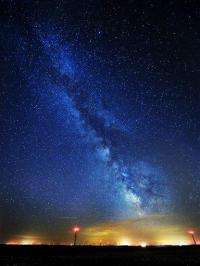
This Aug. 6, 2010 photo shows the Milky Way above wind turbines near Lake Benton and Hendricks, Minn. Scientists have estimated the first cosmic census of planets in our galaxy and the numbers are astronomical: at least 50 billion planets in the Milky Way. At least 500 million of those planets are in the not-too-hot, not-too-cold zone where life could exist, scientists announced Saturday, Feb. 19, 2011. The numbers were extrapolated from the early results of NASA's planet-hunting Kepler telescope. (AP Photo/The Star Tribune, David Brewster) ST. PAUL PIONEER PRESS OUT; MINNEAPOLIS-AREA TV OUT; MAGS OUT

(AP) -- Scientists have estimated the first cosmic census of planets in our galaxy and the numbers are astronomical: at least 50 billion planets in the Milky Way.

At least 500 million of those are in the not-too-hot, not-too-cold zone where life could exist. The numbers were extrapolated from the early results of NASA's planet-hunting Kepler telescope.

Kepler science chief William Borucki says scientists took the number of planets they found in the first year of searching a small part of the and then made an estimate on how likely stars are to have planets. Kepler spots planets as they pass between Earth and the star it orbits.

So far Kepler has found 1,235 candidate planets, with 54 in the Goldilocks zone, where life could possibly exist. Kepler's main mission is not to examine individual worlds, but give astronomers a sense of how many planets, especially potentially habitable ones, there are likely to be in our galaxy. They would use the one-four-hundredth of the night sky that Kepler is looking at and extrapolate from there.

Borucki and colleagues figured one of two stars has planets and one of 200 stars has planets in the , announcing these ratios Saturday at the American Association for the Advancement of Science annual conference in Washington. And that's a minimum because these stars can have more than one planet and Kepler has yet to get a long enough glimpse to see planets that are further out from the star, like Earth, Borucki said.

For example, if Kepler were 1,000 light years from Earth and looking at our sun and noticed Venus passing by, there's only a one-in-eight chance that Earth would also be seen, astronomers said.

To get the estimate for the total number of planets, scientists then took the frequency observed already and applied it to the number of stars in the Milky Way.

For many years scientists figured there were 100 billion stars in the Milky Way, but last year a Yale scientist figured the number was closer to 300 billion .

Either way it shows that Carl Sagan was right when he talked of billions and billions of worlds, said retired astronomer Steve Maran, who praised the research but wasn't part of it.

And that's just our galaxy. Scientists figure there are 100 billion .

Borucki said the new calculations lead to worlds of questions about life elsewhere in the cosmos. "The next question is why haven't they visited us?"

And the answer? "I don't know," Borucki said.

More information: Kepler site: http://kepler.nasa.gov/

©2010 The Associated Press. All rights reserved. This material may not be published, broadcast, rewritten or redistributed.

Filter


Move the slider to adjust rank threshold, so that you can hide some of the comments.


Display comments: newest first

Quantum_Conundrum
Feb 20, 2011

Rank: 1 / 5 (3)
Since the universe allegedly has a radius of 13.1 billion ly, then if you "over-estimate" the volume of a galaxy using the SPHERE formula, and using 60,000ly radius for galaxies, and leave plenty room in every direction, being an order of magnitude more empty space than occupied space, which is to say, an average of 1 galaxy per 9E17 cubic light years (600,000ly radius sphere), you actually find that the universe should contain about 10.4 TRILLION galaxies.

If we used Andromeda as a yardstick, then the midpoint between andromeda and milky way would be our "average radius" of space assigned to a single galaxy. This would be 1.1 million ly radius of space per galaxy.

Then even so, you would still get 1.689 TRILLION Galaxies.

Wouldn't expect a cosmologist to be able to do real math anyway.
omatumr
Feb 20, 2011

Rank: 1 / 5 (4)
Congratulations!

Stars circled by planets may be ordinary, not be "special."

The one here exploded 5 Gyr ago to eject all of the material now orbiting the Sun, and then reformed on the collapsed SN core:

youtube.com/watch?v=AQZe_Qk-q7M
Nik_2213
Feb 20, 2011

Rank: 5 / 5 (2)
Oh dear...

QC, did the star calculation distinguish between 'globular' and 'spiral' galaxies ??

Also, IIRC, O, helioseismology would reveal such a 'degenerate' core, surely ??
barakn
Feb 20, 2011

Rank: 5 / 5 (4)
Since the universe allegedly has a radius of 13.1 billion ly, then if you "over-estimate" the volume of a galaxy using the.. bla bla bla ...
Then even so, you would still get 1.689 TRILLION Galaxies.

Wouldn't expect a cosmologist to be able to do real math anyway.

Real math? Let's see how many stupid assumptions you made. First, you assumed the visible universe has a radius of 13.1 billion light years, based apparently on a false memory of the current consensus of the age at 13.75 billion years. However, this neglects the expansion of space. The radius of the universe is much larger than 13.75 billion light years. You also assume a constant density throughout time. Early on, the galaxies would have been closer together because expansion had yet to move them as far apart and gravity hadn't merged some together. (cont'd)
barakn
Feb 20, 2011

Rank: 5 / 5 (3)
You also assume a uniform distribution when in fact galaxies occur in the shape of filaments or membranes between enormous voids. To fudge your number you highballed your estimates of galaxy density - even your lower estimate is more typical of the local cluster of galaxies than of average space.

And of course there's the fact that you approached the problem backwards. The correct way of performing this calculation is to use observation, not by using made-up numbers. Simply perform a survey and count the number of galaxies in a few different direction, and then the total number comes from assuming a spherically symmetrical distribution (not a perfect assumption but far better than any of yours).
Snowboarder
Feb 21, 2011

Rank: 5 / 5 (2)
I believe the current estimate for the size of the visible universe is a sphere roughly 90 billion ly in diameter. Also Andromeda is moving towards us, so not really a fair measuring stick for average distance between galaxies. 3 to 5 billion years from now we'll probably collide.
d_robison
Feb 21, 2011

Rank: 5 / 5 (1)
You also assume a uniform distribution when in fact galaxies occur in the shape of filaments or membranes between enormous voids. To fudge your number you highballed your estimates of galaxy density - even your lower estimate is more typical of the local cluster of galaxies than of average space.

And of course there's the fact that you approached the problem backwards. The correct way of performing this calculation is to use observation, not by using made-up numbers. Simply perform a survey and count the number of galaxies in a few different direction, and then the total number comes from assuming a spherically symmetrical distribution (not a perfect assumption but far better than any of yours).


You forgot to mention that he assumes the universe is a perfect sphere, and that the edge of the visible universe is indeed the edge of our actual universe (not just that which is currently observable).
hush1
Mar 01, 2011

Rank: not rated yet
It is time for birth control.
For planets.
The Universe simply does not have the resources to support this.
Unsustainable.
Rank 5 /5 (14 votes)
Related Stories
Relevant PhysicsForums posts
  • Calculating the magnitude
    created2 hours ago
  • What is this spectrum I took?
    created13 hours ago
  • Orientation of Space
    created13 hours ago
  • Geologically Active Moon Now: NASA
    created20 hours ago
  • advice on building a science fair telescope
    createdFeb 22, 2012
  • Rise of the Sun
    createdFeb 22, 2012
  • More from Physics Forums - General Astronomy

More news stories

Spitzer finds solid buckyballs in space

(PhysOrg.com) -- Astronomers using data from NASA's Spitzer Space Telescope have, for the first time, discovered buckyballs in a solid form in space. Prior to this discovery, the microscopic carbon spheres ...

Space & Earth / Astronomy

created 14 hours ago | popularity 4.7 / 5 (12) | comments 8 | with audio podcast

Going up: Japan builder eyes space elevator

A Japanese construction firm claimed Wednesday it could execute an out-of-this-world plan to put tourists in space within 40 years by building an elevator that stretches a quarter of the way to the moon.

Space & Earth / Space Exploration

created 21 hours ago | popularity 3.5 / 5 (13) | comments 26

ENASA satellite finds Earth's clouds are getting lower

(PhysOrg.com) -- Earth's clouds got a little lower -- about one percent on average -- during the first decade of this century, finds a new NASA-funded university study based on NASA satellite data. The results ...

Space & Earth / Earth Sciences

created 18 hours ago | popularity 5 / 5 (8) | comments 13 | with audio podcast

Fresh scandal embroils US climate science debate

A fresh scandal over climate change has erupted in the United States after leaked documents appeared to show a right-wing funded campaign to influence how climate science is taught in schools.

Space & Earth / Environment

created 11 hours ago | popularity 4.1 / 5 (9) | comments 8

World's oceans get an acid bath

Among the repercussions of global climate change, the effect of ocean acidification on marine life is one of the least-understood variables.

Space & Earth / Environment

created 18 hours ago | popularity 4.3 / 5 (6) | comments 4 | with audio podcast


Researchers build first physical 'metatronic' circuit

(PhysOrg.com) -- The technological world of the 21st century owes a tremendous amount to advances in electrical engineering, specifically, the ability to finely control the flow of electrical charges using ...

Faster than light neutrinos? More like faulty wiring

You can shelf your designs for a warp drive engine (for now) and put the DeLorean back in the garage; it turns out neutrinos may not have broken any cosmic speed limits after all.

Physicists surprised by disappearing and reappearing superconductivity in iron selenium chalcogenides

Superconductivity is a rare physical state in which matter is able to conduct electricity -- maintain a flow of electrons -- without any resistance. This phenomenon can only be found in certain materials at low temperatures, ...

Stanford research team cracks animated NuCaptcha

(PhysOrg.com) -- The research team from Stanford University, led by Elie Bursztein, that previously had cracked regular CAPTCHAs and then audio CAPTCHAs, now has also successfully cracked the animated version called NuCapt ...

Flesh-eating bacteria inspire superglue

(PhysOrg.com) -- A bio-inspired superglue has been developed by Oxford University researchers that can’t be matched for sticking molecules together and not letting go.

Scientists create potent molecules aimed at treating muscular dystrophy

While RNA is an appealing drug target, small molecules that can actually affect its function have rarely been found. But now scientists from the Florida campus of The Scripps Research Institute have for the first time designed ...