Experts determine age of book 'nobody can read'
February 10, 2011 By Daniel Stolte
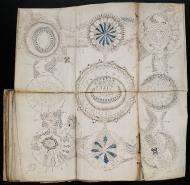
The Voynich manuscript's unintelligible writings and strange illustrations have defied every attempt at understanding their meaning.
(PhysOrg.com) -- While enthusiasts across the world pored over the Voynich manuscript, one of the most mysterious writings ever found penned by an unknown author in a language no one understands a research team at the UA solved one of its biggest mysteries: When was the book made?
University of Arizona researchers have cracked one of the puzzles surrounding what has been called "the world's most mysterious manuscript" the Voynich manuscript, a book filled with drawings and writings nobody has been able to make sense of to this day.
Using radiocarbon dating, a team led by Greg Hodgins in the UA's department of physics has found the manuscript's parchment pages date back to the early 15th century, making the book a century older than scholars had previously thought.
This tome makes the "DaVinci Code" look downright lackluster: Rows of text scrawled on visibly aged parchment, flowing around intricately drawn illustrations depicting plants, astronomical charts and human figures bathing in perhaps the fountain of youth. At first glance, the "Voynich manuscript" appears to be not unlike any other antique work of writing and drawing.
An alien language
But a second, closer look reveals that nothing here is what it seems. Alien characters, some resembling Latin letters, others unlike anything used in any known language, are arranged into what appear to be words and sentences, except they don't resemble anything written or read by human beings.
Hodgins, an assistant research scientist and assistant professor in the UA's department of physics with a joint appointment at the UA's School of Anthropology, is fascinated with the manuscript.
"Is it a code, a cipher of some kind? People are doing statistical analysis of letter use and word use the tools that have been used for code breaking. But they still haven't figured it out."
A chemist and archaeological scientist by training, Hodgins works for the NSF Arizona Accelerator Mass Spectrometry, or AMS, Laboratory, which is shared between physics and geosciences. His team was able to nail down the time when the Voynich manuscript was made.
Currently owned by the Beinecke Rare Book and Manuscript Library of Yale University, the manuscript was discovered in the Villa Mondragone near Rome in 1912 by antique book dealer Wilfrid Voynich while sifting through a chest of books offered for sale by the Society of Jesus. Voynich dedicated the remainder of his life to unveiling the mystery of the book's origin and deciphering its meanings. He died 18 years later, without having wrestled any its secrets from the book.
Fast-forward to 2009: In the basement underneath the UA's Physics and Atmospheric Sciences building, Hodgins and a crew of scientists, engineers and technicians stare at a computer monitor displaying graphs and lines. The humming sound of machinery fills the room and provides a backdrop drone for the rhythmic hissing of vacuum pumps.
Stainless steel pipes, alternating with heavy-bodied vacuum chambers, run along the walls.
This is the heart of the NSF-Arizona AMS Laboratory: an accelerator mass spectrometer capable of sniffing out traces of carbon-14 atoms that are present in samples, giving scientists clues about the age of those samples.
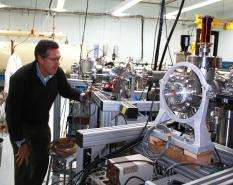
Greg Hodgins checks on the accelerator mass spectrometer, which narrowed the age of the book down to 1404 to 1438, in the early Renaissance. Credit: Daniel Stolte/UANews
Radiocarbon dating: looking back in timeCarbon-14 is a rare form of carbon, a so-called radioisotope, that occurs naturally in the Earth's environment. In the natural environment, there is only one carbon-14 atom per trillion non-radioactive or "stable" carbon isotopes, mostly carbon-12, but with small amounts of carbon-13. Carbon-14 is found in the atmosphere within carbon dioxide gas.
Plants produce their tissues by taking up carbon dioxide from the atmosphere, and so accumulate carbon-14 during life. Animals in turn accumulate carbon-14 in their tissues by eating plants, or eating other organisms that consume plants.
When a plant or animal dies, the level of carbon-14 in it remains drops at a predictable rate, and so can be used to calculate the amount of time that has passed since death.
What is true of plants and animals is also true of products made from them. Because the parchment pages of the Voynich Manuscript were made from animal skin, they can be radiocarbon-dated.
Pointing to the front end of the mass spectrometer, Hodgins explains the principle behind it. A tiny sample of carbon extracted from the manuscript is introduced into the "ion source" of the mass spectrometer.
"This causes the atoms in the sample to be ionized," he explained, "meaning they now have an electric charge and can be propelled by electric and magnetic fields."
Ejected from the ion source, the carbon ions are formed into a beam that races through the instrument at a fraction of the speed of light. Focusing the beam with magnetic lenses and filters, the mass spectrometer then splits it up into several beams, each containing only one isotope species of a certain mass.
"Carbon-14 is heavier than the other carbon isotopes," Hodgins said. "This way, we can single out this isotope and determine how much of it is present in the sample. From that, we calculate its age."
Dissecting a century-old book
To obtain the sample from the manuscript, Hodgins traveled to Yale University, where conservators had previously identified pages that had not been rebound or repaired and were the best to sample.
"I sat down with the Voynich manuscript on a desk in front of me, and delicately dissected a piece of parchment from the edge of a page with a scalpel," Hodgins says.
He cut four samples from four pages, each measuring about 1 by 6 millimeters (ca. 1/16 by 1 inch) and brought them back to the laboratory in Tucson, where they were thoroughly cleaned.
"Because we were sampling from the page margins, we expected there are a lot of finger oils adsorbed over time," Hodgins explains. "Plus, if the book was re-bound at any point, the sampling spots on these pages may actually not have been on the edge but on the spine, meaning they may have had adhesives on them."
"The modern methods we use to date the material are so sensitive that traces of modern contamination would be enough to throw things off."
Next, the sample was combusted, stripping the material of any unwanted compounds and leaving behind only its carbon content as a small dusting of graphite at the bottom of the vial.
"In radiocarbon dating, there is this whole system of many people working at it," he said. "It takes many skills to produce a date. From start to finish, there is archaeological expertise; there is biochemical and chemical expertise; we need physicists, engineers and statisticians. It's one of the joys of working in this place that we all work together toward this common goal."
The UA's team was able to push back the presumed age of the Voynich manuscript by 100 years, a discovery that killed some of the previously held hypotheses about its origins and history.
Elsewhere, experts analyzed the inks and paints that makes up the manuscript's strange writings and images.
"It would be great if we could directly radiocarbon date the inks, but it is actually really difficult to do. First, they are on a surface only in trace amounts" Hodgins said. "The carbon content is usually extremely low. Moreover, sampling ink free of carbon from the parchment on which it sits is currently beyond our abilities. Finally, some inks are not carbon based, but are derived from ground minerals. They're inorganic, so they don't contain any carbon."
"It was found that the colors are consistent with the Renaissance palette the colors that were available at the time. But it doesn't really tell us one way or the other, there is nothing suspicious there."
While Hodgins is quick to point out that anything beyond the dating aspect is outside his expertise, he admits he is just as fascinated with the book as everybody else who has tried to unveil its history and meaning.
"The text shows strange characteristics like repetitive word use or the exchange of one letter in a sequence," he says. "Oddities like that make it really hard to understand the meaning."
"There are types of ciphers that embed meaning within gibberish. So it is possible that most of it does mean nothing. There is an old cipher method where you have a sheet of paper with strategically placed holes in it. And when those holes are laid on top of the writing, you read the letters in those holes."
"Who knows what's being written about in this manuscript, but it appears to be dealing with a range of topics that might relate to alchemy. Secrecy is sometimes associated with alchemy, and so it would be consistent with that tradition if the knowledge contained in the book was encoded. What we have are the drawings. Just look at those drawings: Are they botanical? Are they marine organisms? Are they astrological? Nobody knows."
"I find this manuscript is absolutely fascinating as a window into a very interesting mind. Piecing these things together was fantastic. It's a great puzzle that no one has cracked, and who doesn't love a puzzle?"
More information: http://voynichcent … com/gallery/
-
Pieces of rare biblical manuscript reunited
Feb 26, 2010 |
not rated yet |
0
-
World's oldest surviving Bible published online
Jul 06, 2009 |
not rated yet |
0
-
Scientists produce archaeological 'time machine'
Feb 11, 2010 |
not rated yet |
0
-
New laser spectrometer opens the way for more effective carbon trading, drug development and carbon dating
Jul 01, 2008 |
not rated yet |
0
-
New tooth enamel dating technique could help identify disaster victims
Sep 15, 2005 |
not rated yet |
0
-
Stars containing dark matter should look different from other stars
Feb 20, 2012 |
4.5 / 5 (17) |
11
-
Physicists discover evidence of rare hypernucleus, a component of strange matter
Feb 17, 2012 |
4.7 / 5 (38) |
22
-
Fast photon control brings quantum photonic technologies closer
Feb 13, 2012 |
5 / 5 (8) |
1
-
Engineers build first sub-10-nm carbon nanotube transistor
Feb 01, 2012 |
4.9 / 5 (36) |
32
-
Something old, something new: Evolution and the structural divergence of duplicate genes
Jan 31, 2012 |
4.6 / 5 (7) |
1
-
Eye biology videos
4 hours ago
-
Flowering Plant Revived After 30,000 Years in Permafrost
Feb 21, 2012
-
Toba volcano eruptions - 1.000 - 10,000 breeding pairsunb
Feb 20, 2012
-
How is a specific gene removed from DNA
Feb 20, 2012
-
Reproduction and Human evolution
Feb 19, 2012
-
Viruses: Living or Non-living organisms
Feb 19, 2012
- More from Physics Forums - Biology
More news stories
Global influence of U.S. Constitution on the decline, study reveals
The U.S. Constitution's global influence is on the decline, finds a new study by David S. Law, JD, PhD, professor of law at Washington University in St. Louis.
Other Sciences / Economics & Business
18 hours ago |
4.5 / 5 (2) |
8
Immigration chief seeks to reassure Silicon Valley
(AP) -- The Obama administration's top immigration official said Wednesday he wants to keep more foreign-born high-tech entrepreneurs in the U.S. But to make that happen, he said he needs those entrepreneurs to turn their ...
9 hours ago |
5 / 5 (2) |
0
What is the value of a green card? Researcher calculates increase in income
Just what does it mean to get a green card? To some applicants, about $1,000 each month.
Other Sciences / Economics & Business
17 hours ago |
not rated yet |
2
Increasingly, children's books are where the wild things aren't: study
Was your favorite childhood book crawling with wild animals and set in places like jungles or deep forests? Or did it take place inside a house or in a city, with few if any untamed creatures in sight?
Other Sciences / Social Sciences
11 hours ago |
4.8 / 5 (4) |
0
Making the bones speak
In a narrow, modest laboratory in Michigan State Universitys Giltner Hall, students pore over African skeletons from the Middle Ages in an effort to make the bones speak.
Other Sciences / Archaeology & Fossils
18 hours ago |
not rated yet |
0
Researchers build first physical 'metatronic' circuit
(PhysOrg.com) -- The technological world of the 21st century owes a tremendous amount to advances in electrical engineering, specifically, the ability to finely control the flow of electrical charges using ...
Spitzer finds solid buckyballs in space
(PhysOrg.com) -- Astronomers using data from NASA's Spitzer Space Telescope have, for the first time, discovered buckyballs in a solid form in space. Prior to this discovery, the microscopic carbon spheres ...
Faster than light neutrinos? More like faulty wiring
You can shelf your designs for a warp drive engine (for now) and put the DeLorean back in the garage; it turns out neutrinos may not have broken any cosmic speed limits after all.
Physicists surprised by disappearing and reappearing superconductivity in iron selenium chalcogenides
Superconductivity is a rare physical state in which matter is able to conduct electricity -- maintain a flow of electrons -- without any resistance. This phenomenon can only be found in certain materials at low temperatures, ...
Stanford research team cracks animated NuCaptcha
(PhysOrg.com) -- The research team from Stanford University, led by Elie Bursztein, that previously had cracked regular CAPTCHAs and then audio CAPTCHAs, now has also successfully cracked the animated version called NuCapt ...
Going up: Japan builder eyes space elevator
A Japanese construction firm claimed Wednesday it could execute an out-of-this-world plan to put tourists in space within 40 years by building an elevator that stretches a quarter of the way to the moon.
Feb 10, 2011
Rank: 2.9 / 5 (15)
Feb 10, 2011
Rank: 4.4 / 5 (8)
"[A] century older" was good enough.
Feb 10, 2011
Rank: 5 / 5 (3)
This story is over a year old. News story from 12/09: bit.ly/8m71Y2
Feb 10, 2011
Rank: 5 / 5 (6)
If it was found in Rome, but written, say in France, couldn't there be some pollen, charcoal, oil, sea salt or something that would provide a rough path of where it's been?
...of course it would seem so easy watching enough CSI...
Feb 10, 2011
Rank: 4.3 / 5 (6)
Feb 10, 2011
Rank: 3 / 5 (2)
Seems like a lot of trouble for a Victorian-era hoaxster to go to. Much easier to get some paper and "age" it with acid or something.
Feb 10, 2011
Rank: 4.7 / 5 (15)
1 inch is 25.4 mm. That means 1 mm is ~1/25 of an inch, while 6 mm is 6/25...
Feb 10, 2011
Rank: 5 / 5 (4)
Not really. It's a pretty common technique to cut up old manuscripts, scrape off the existing text, then put some faked writing or drawing on it and pass it off as ancient.
Feb 10, 2011
Rank: 4.2 / 5 (6)
There was more to the dating process than just what was mentioned here. They took minute samples of the dyes involved and tested to make sure they were correct to the period technology and it was.
This book also has several large foldouts which can be a few pages across. It would have been relatively expensive to make, and the experts estimated it would have taken 2 years for making the caligraphy and the art in the book.
When I watched this show I realized that there may not be a way to decypher the text, because it could be in a code, not just a simple cypher. The cryptographer would be trying to read something in an unknown ancient dialect of an unknown language in an unknown cypher/code system.
It could even be a true "code language" made up by some linquistic genius like Tolkien, except 600 years ago.
Feb 10, 2011
Rank: 4.9 / 5 (7)
Most paper from the Victorian era was recycled manuscripts from prior eras. usually when dating a document the ink provides a more precise date due to this practice.
Feb 10, 2011
Rank: 5 / 5 (15)
That's not saying much.
Feb 10, 2011
Rank: 3.9 / 5 (8)
A modern person could put some nonsensical gibberish formed into words and put it onto one of those special long lasting gold plated DVDs, along with some weird, random pictures, and then bury it deep in the ground in an air tight box.
Future generations will be searching for its meaning for hundreds of years later, in the hope that it's a code that tells us something profound, but really it's the work of some nutter.
Feb 10, 2011
Rank: 5 / 5 (3)
Really interesting article. en.wikipedia.org/wiki/Voynich_manuscript
Feb 10, 2011
Rank: 5 / 5 (5)
Feb 10, 2011
Rank: 5 / 5 (3)
Feb 10, 2011
Rank: 5 / 5 (3)
Feb 10, 2011
Rank: 3.5 / 5 (2)
Feb 10, 2011
Rank: 3 / 5 (3)
As far as I know, it changes depending on season and the amount of cosmic/sun radiation hitting the earth.
Feb 10, 2011
Rank: 4.4 / 5 (7)
C14 doesn't change with seasons. C14 is produced by cosmic ray debris (neutrons) colliding with nitrogen atoms in the atmosphere. It does not depend on solar radiation.
The cosmic ray flux is approximately constant over long time spans, and C14 in the atmosphere has reasonably long life, so that fast fluctuations get smoothed out.
There can be regional variations in C14, but at least for the last few thousand years one can construct local calibration curves, based on measurements of C14 abundance in annual sediment layers, glacier layers, or tree rings -- for which date can be established independently of C14 by simple counting.
Feb 10, 2011
Rank: 5 / 5 (1)
Feb 10, 2011
Rank: not rated yet
Feb 10, 2011
Rank: 4 / 5 (6)
its a construction to appear as mysterious and mind stumping as possible. what an illiterate would make copying and making up pseudo letters and sort of remembered letters from other stuff.
the next question is... what use would that be?
well, to a mostly illiterate culture, one could claim to be able to read it. since its not in a real language, a person who can read, cant claim that they know it says something else.
hasnt anyone here ever seen two kids and one claim a dictionary or book has the info they want and reads something out loud and closes it? (its in older movies as well)
that the literate can sway the illiterate with claims of validity from books at a time when books were expensive, and pulp fictions and such were rare if not invented yet.
one could travel and pretend to have knowledge, or sit tight and work a town. given sanctity of written words and gall, the sky is the limit...
Feb 10, 2011
Rank: 4.5 / 5 (2)
the images and things have to not look like anything in any other book or else its not mystical or important, its a copy or a bunch of copies (again protection from being found)
print is expensive, and written word even today holds sway. illiterate population with enough literates to make life difficult
befuddling a judge trying to judge a language that can be claimed to be from anywhere the judge hasn't been or seen.
we have lots of old books, but the idea that we found the tool of a scam of the times seems to have slipped everyones minds.
iconographic all over the world is the wizard, or spell caster, or diviner, with their mystical book!!! from walt disney to the romani.
the period its from was a period of alchemy and mystic scamming of royals was common as a way of life.
its a mcguffin, a prop
for all the worlds a stage and some of us are more actors than others
Feb 10, 2011
Rank: 4.3 / 5 (7)
So you're saying this was another bible?
Feb 10, 2011
Rank: 5 / 5 (2)
Feb 10, 2011
Rank: 4.4 / 5 (5)
Not quite. Frequency analysis of the letters and words shows that it's organized, not random
Feb 11, 2011
Rank: not rated yet
Feb 11, 2011
Rank: 5 / 5 (7)
Feb 11, 2011
Rank: 1 / 5 (1)
Feb 11, 2011
Rank: 5 / 5 (1)
Feb 11, 2011
Rank: 2 / 5 (1)
Feb 11, 2011
Rank: 4.9 / 5 (7)
The plants are the most important; the words are written around the plants. i.e. a reference book.
The People have red spots on their hands & face, indicating treatments for ailments.
The jars contained the "healing potions" were used to impress his rich clientele and likely aromatic.
The swirling patterns are energy that must be cleansed and channeled to cure the patient.
The written language IS gibberish. The limited characters and routine star placement seem to have meaning, but mean nothing.
The plant drawings are fictional. I'm sure he had an amazing story who could tell you about how he came across each of these plants.
The animals ingesting the plants were "clues" to the amazing curative powers of the different plants.
The lack of corrections indicate this is a "final" version - Not a notebook - A fake herbal encyclopedia and prop for the salesman.
Feb 11, 2011
Rank: 5 / 5 (2)
That's because it hasn't. Voynich spent his life trying to prove Bacon wrote it, but there's little to no evidence for it. Since Bacon died over 100 years before the earliest dating of the vellum, he couldn't have been the author.
Feb 11, 2011
Rank: 5 / 5 (5)
Even with the dating of the parchment of the Voynich MSS at @ 100 yrs earlier than previously believed, it is still too late of a time period to be Roger Bacon, however it still leaves it in the same ballpark of Francis Bacon. Considering that there is significant evidence to show that it was penned by a young child of a wealthy family, there remains an argument for it being the work of Francis Bacon, although it is more likely that it was something that found it's way into his possession rather than being a product of his own hand.
Dating this to the Renaissance puts it into a whole different light, considering the works of Marsilio Ficino.
Feb 11, 2011
Rank: 5 / 5 (3)
Feb 11, 2011
Rank: 5 / 5 (1)
Fascinating, and he seems to fit. I think Agrippa might be a possibility too.
Feb 11, 2011
Rank: not rated yet
The writing lacks any emotion.
There is not enough context for there to be a code. The person was right handed, young 12-18(steady hand, low detial), unedumacated but was around people that were. Likely the person did not take credit that wrote it knowing it was jibberish, but sold it as an "unknown" book after writing it, to make money to get an education or buy food.
Feb 11, 2011
Rank: 5 / 5 (3)
Har har. An unexpectred laugh was just the lubricant for this somewhat dry topic. Thanks for that.
Feb 11, 2011
Rank: 2 / 5 (1)
Feb 12, 2011
Rank: 1 / 5 (2)
Feb 12, 2011
Rank: 3 / 5 (3)
Feb 12, 2011
Rank: 5 / 5 (1)
Feb 12, 2011
Rank: 1 / 5 (4)
also, by holding something that makes a connection
to an object of your random choice, eg. a photo,
a sword or even 'ye olde book', they describe all.
science may wish to consider matching results from
a few neat folks who regularly use Psychometry and
why not a few dowsers as well ;-))
some may roll their eyes and say 'bull shit' and
that is the expected reaction from most. composite of readings might provide the author's name, dates,
an address, secret code, intended use, owners +++. do good.
Feb 12, 2011
Rank: 1.8 / 5 (5)
Feb 12, 2011
Rank: 1 / 5 (1)
Feb 12, 2011
Rank: not rated yet
Feb 12, 2011
Rank: 1.7 / 5 (6)
Uh huh...
You uh...been around for "long time spans" to actually observe this, or is this yet another "scientific" theory incorrectly presented as a "fact"?
Feb 12, 2011
Rank: not rated yet
Feb 12, 2011
Rank: 5 / 5 (3)
It has been analyzed and does have a clear structure, but those who think "hoax" suspect the text may have been generated using a table of phonetic elements and a set of masks or "grilles" that could be overlaid on it and rotated to give more orderly structures of words than would have been generated by simply selecting the phonetic elements haphazardly.
Feb 12, 2011
Rank: 5 / 5 (4)
I must have impossibly misread them. Which picture are you talking about exactly? The closest I've seen are some pictures with circular motifs, including concentric circles or circles with radial, flower petal-like arrangements, but nothing like a galactic spiral.
Or neither of the two.
You're off your meds. I suppose Erich von Däniken uncovered even more ancient signs of alien visitation? I think hoodedkingcobra has it just about right.
Feb 13, 2011
Rank: not rated yet
Feb 13, 2011
Rank: not rated yet
Feb 13, 2011
Rank: not rated yet
Feb 14, 2011
Rank: 1 / 5 (2)
Remember the Ming era Vase a week ago that turned up in new condition in England?
Feb 14, 2011
Rank: not rated yet
Feb 14, 2011
Rank: 3 / 5 (2)
Feb 14, 2011
Rank: 1 / 5 (1)
Feb 14, 2011
Rank: not rated yet
Feb 14, 2011
Rank: 5 / 5 (3)
Feb 14, 2011
Rank: not rated yet
Feb 14, 2011
Rank: not rated yet
I don't suppose you mean St Ivvvvvvvvvvves in France?
Feb 14, 2011
Rank: 5 / 5 (2)
"Is there a Historian in the house? Alchemists of that time period coded things in exactly this way, including personal alphabets, writing backwards, using symbols. I'd love to have a good look at this manuscript."
Free versions of the Voynich manuscript (at a decent resolution) are readily available. A 55MB Pdf file of the manuscript for download is available here:
h
ttp://www.4shared.com/document/4igxXdj7/06391_The_Voynich_Manuscript.html
(If you haven't seen the full work by all means check it out. Quite a fascinating document.)
Feb 15, 2011
Rank: 1 / 5 (1)
Feb 19, 2011
Rank: not rated yet
Anyway its an intereting old book, is it a hoax or is it a real book with meaning for the time? Impossable really to say but its certainly a nice work of art tho.