New insights on the origin of the Rocky Mountains
February 28, 2011
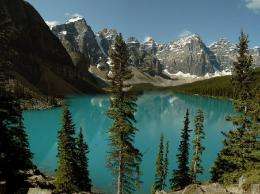
Image: Wikipedia.
(PhysOrg.com) -- The formation of the Rocky Mountains in Colorado has always puzzled scientists. Some 600 miles inland and far removed from the nearest tectonic plate, the only comparable inland mountain range is the Himalaya, which scientists deduced were formed by the collision of the Indian plate with the Eurasian plate.
"But there really was no India slamming into North America," said Craig Jones, a research fellow of the Cooperative Institute for Research in Environmental Sciences (CIRES) and a professor of geological sciences at the University of Colorado at Boulder. "Just how the Rockies have formed is an enigma."
But now scientists have further insight into the solution of this mystery. Jones and his team of researchers have proposed a new model of the mountains' creation and published their results in the February edition of the journal Geosphere. Not only could their research explain the origin of the Rockies, it could also elucidate other geological phenomena: why a swath of gold, silver and other precious metal deposits stretches across Colorado, and why a marine basin deepened in the states of Colorado and Wyoming just before the Rockies rose. The sediments of this marine basin are the Pierre Shale, a layer of dark-gray shale lying along the Front Range of Colorado.
"Pierre Shale has this nasty tendency to bow up people's basements," Jones said. "Why more than a mile of this stuff was dumped into this area has been puzzling."
Previously scientists believed that the oceanic plate subducting - moving under - North America rose to rub against the continent's bottom all the way from the ocean to Colorado. The theory was this action pushed the landmass into mountains much like a rug piles up underfoot, said Jones. But the hypothesis just doesn't explain the facts, he said. "That model predicted removal of material that is still found to lie underneath California and Arizona," he said. "That in and of itself was unsatisfying."
The new model hinges on an unusually thick lithosphere the stiff part of the Earth's surface that make up the tectonic plates under Wyoming. The protrusion of this keel into more fluid mantle flowing below, created a suction that pulled down Southern Wyoming and Colorado and formed a basin, Jones said. This basin, or hole, in which Pierre Shale built up, amplified mountain-building forces far inland and forced the formation of the Rockies, he said. "A huge basin develops and all of a sudden these mountains come rocketing out of it," Jones said. "We end up with the counter-intuitive visage of mountains rising up out of a hole. "
The hypothesis, if confirmed, could not only unravel the geological origin of the Rockies, but could also illuminate the mechanisms that have led to mountain ranges worldwide. "We are adding a new collection of processes that can control how mountain belts develop that previously haven't really been appreciated," Jones said. "Considering these processes might explain other puzzling mountain belts."
Coauthors on the study include Lang Farmer of CIRES and the University of Colorado, Shijie Zhong of the University of Colorado, and Brad Sageman of the Department of Earth and Planetary Sciences, Northwestern University. The study was supported by the National Science Foundation and is published online in the journal Geosphere.
More information: Hydrodynamic mechanism for the Laramide orogeny, http://geosphere.g … 183.abstract
-
Australian discovery solves mystery of the Andes
Mar 14, 2007 |
not rated yet |
0
-
Tree-ring data gives history of droughts
Aug 21, 2005 |
not rated yet |
0
-
Unseen Colorado Mountain Aquifers Throw Water on 'Teflon Basin' Myth
May 30, 2005 |
not rated yet |
0
-
New information about how Himalayas were formed
Aug 05, 2010 |
not rated yet |
0
-
Geophysicists image rock layers under Himalaya
Jun 29, 2005 |
not rated yet |
0
-
Stars containing dark matter should look different from other stars
Feb 20, 2012 |
4.5 / 5 (17) |
11
-
Physicists discover evidence of rare hypernucleus, a component of strange matter
Feb 17, 2012 |
4.7 / 5 (38) |
22
-
Fast photon control brings quantum photonic technologies closer
Feb 13, 2012 |
5 / 5 (8) |
1
-
Engineers build first sub-10-nm carbon nanotube transistor
Feb 01, 2012 |
4.9 / 5 (36) |
32
-
Something old, something new: Evolution and the structural divergence of duplicate genes
Jan 31, 2012 |
4.6 / 5 (7) |
1
-
Is the Earth really going to die
13 hours ago
-
Do some geologists actually act a lot like Randy Marsh?
Feb 11, 2012
-
Discrepancy between oxygen and carbon-dioxide levels
Feb 09, 2012
-
where gems are found in the world
Feb 09, 2012
-
Wind Waves in Reservoir ~ Wind run-up and Wind set-up
Feb 08, 2012
-
Balance of oxygen in the atmosphere
Feb 01, 2012
- More from Physics Forums - Earth
More news stories
Spitzer finds solid buckyballs in space
(PhysOrg.com) -- Astronomers using data from NASA's Spitzer Space Telescope have, for the first time, discovered buckyballs in a solid form in space. Prior to this discovery, the microscopic carbon spheres ...
13 hours ago |
4.7 / 5 (12) |
8
|
Going up: Japan builder eyes space elevator
A Japanese construction firm claimed Wednesday it could execute an out-of-this-world plan to put tourists in space within 40 years by building an elevator that stretches a quarter of the way to the moon.
Space & Earth / Space Exploration
20 hours ago |
3.5 / 5 (13) |
26
ENASA satellite finds Earth's clouds are getting lower
(PhysOrg.com) -- Earth's clouds got a little lower -- about one percent on average -- during the first decade of this century, finds a new NASA-funded university study based on NASA satellite data. The results ...
Space & Earth / Earth Sciences
17 hours ago |
5 / 5 (8) |
12
|
Fresh scandal embroils US climate science debate
A fresh scandal over climate change has erupted in the United States after leaked documents appeared to show a right-wing funded campaign to influence how climate science is taught in schools.
10 hours ago |
4.1 / 5 (9) |
8
World's oceans get an acid bath
Among the repercussions of global climate change, the effect of ocean acidification on marine life is one of the least-understood variables.
17 hours ago |
4.3 / 5 (6) |
4
|
Researchers build first physical 'metatronic' circuit
(PhysOrg.com) -- The technological world of the 21st century owes a tremendous amount to advances in electrical engineering, specifically, the ability to finely control the flow of electrical charges using ...
Faster than light neutrinos? More like faulty wiring
You can shelf your designs for a warp drive engine (for now) and put the DeLorean back in the garage; it turns out neutrinos may not have broken any cosmic speed limits after all.
CT colonography shown to be comparable to standard colonoscopy
Computerized tomographic (CT) colonography (CTC), also known as virtual colonoscopy, is comparable to standard colonoscopy in its ability to accurately detect cancer and precancerous polyps in people ages 65 and older, according ...
Physicists surprised by disappearing and reappearing superconductivity in iron selenium chalcogenides
Superconductivity is a rare physical state in which matter is able to conduct electricity -- maintain a flow of electrons -- without any resistance. This phenomenon can only be found in certain materials at low temperatures, ...
Study: Virtual colonoscopy effective screening tool for adults over 65
Computed tomography (CT) colonography can be used as a primary screening tool for colorectal cancer in adults over the age of 65, according to a new study published online in the journal Radiology.
Stanford research team cracks animated NuCaptcha
(PhysOrg.com) -- The research team from Stanford University, led by Elie Bursztein, that previously had cracked regular CAPTCHAs and then audio CAPTCHAs, now has also successfully cracked the animated version called NuCapt ...
Mar 01, 2011
Rank: not rated yet
Mar 06, 2011
Rank: not rated yet