Scientists bioengineer a protein to fight leukemia
February 18, 2011
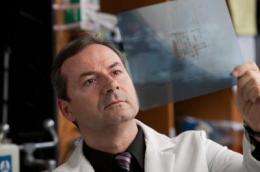
This is Fatih Uckun, M.D., Ph.D., of the Saban Research Institute of Children's Hospital Los Angeles. Credit: Photo courtesy of Children's Hospital Los Angeles
Scientists at the Children's Center for Cancer and Blood Diseases and The Saban Research Institute of Children's Hospital Los Angeles today announced a breakthrough discovery in understanding how the body fights leukemia. They have identified a protein called CD19-ligand (CD19-L) located on the surface of certain white blood cells that facilitates the recognition and destruction of leukemia cells by the immune system. This work represents the first report of a bioengineered version of CD19-L, a recombinant human biotherapeutic agent, targeting CD19-positive leukemic stem cells.
B-lineage acute lymphoblastic leukemia (ALL) is the most common cancer occurring in children and adolescents. Despite having received intensive chemotherapy, some patients have recurring disease. For these individuals, the prospect of long-term survival is poor.
"We need new anti-leukemia therapies capable of killing chemotherapy-resistant leukemia cells in patients with relapsed ALL. These are the cells that are the most difficult to treat. The challenge is to kill these cells while leaving healthy cells intact," said Fatih Uckun, MD, PhD, first author on the paper that has been published in the British Journal of Haematology. Dr. Uckun is also a professor of Pediatrics at the University of Southern California Keck School of Medicine and a member of the Developmental Therapeutics Program at the Norris Comprehensive Cancer Center.
Lymphocytes are a type of white blood cell involved in immune function and are categorized as either B-cells or T-cells. This newly discovered element, CD19-L, is expressed on the surface of T-lymphocytes and allows them to selectively bind to the CD19 receptor on the surface of B-lineage leukemia cells, and most importantly on leukemic stem cells responsible for the survival and expansion of the leukemia cell population. Once the CD19-L binds to leukemia cells, cell death occurs. Although CD19 is abundantly expressed on leukemia cells from B-lineage ALL patients, it is absent on red cells, T-cells, and normal bone marrow stem cells, making it specific, and therefore, a good therapeutic target.
Dr. Uckun and colleagues have bioengineered and prepared a highly purified liquid formulation of the human CD19-L protein. This recombinant protein not only shows selective binding to leukemia cells but also causes their rapid destruction within 24 hours. Perhaps most importantly, CD19-L killed even those leukemia cells that were highly resistant to both standard chemotherapy drugs as well as radiation.
CD19-L is the first CD19-specific recombinant human protein with potent anti-leukemic activity against B-lineage ALL, the most common form of childhood cancer and the second most common form of acute leukemia in adults. The identification of CD19-L may lead to therapeutic innovation for childhood leukemia by allowing a selective destruction of leukemic stem cells. According to Dr. Uckun, the next step will be to carefully evaluate this new agent for clinical potential against leukemia and to confirm in preclinical studies that leukemic cell destruction can be achieved at non-toxic dose levels.
"The CD19-ligand offers a previously unrecognized defense system against leukemia and opens a new range of therapeutic opportunities for the treatment of leukemia," said Stuart Siegel, MD, director of the Center for Cancer and Blood Diseases at Childrens' Hospital Los Angeles.
More information: Recombinant human CD19-ligand protein as a potent anti-leukaemic agent. Uckun FM, Sun L, Qazi S, Ma H, Ozer Z. Br J Haematol. 2011. doi:10.1111/j.1365-2141.2011.08583.x. [Epub ahead of print]
Provided by Children's Hospital Los Angeles
-
Researcher discovers way to overcome radiation resistance in leukemia
Sep 30, 2010 |
not rated yet |
0
-
Gene therapy protocol activates immune system in patients with leukemia
Feb 11, 2008 |
not rated yet |
0
-
T vs. B: Re-engineered human T cells effectively target and kill cancerous B cells
Sep 18, 2007 |
not rated yet |
0
-
Study: How some cancers become leukemia
Jul 17, 2006 |
not rated yet |
0
-
Leukemia stem cells have more in common with embryonic stem cells than adult stem cells
Feb 05, 2009 |
not rated yet |
0
-
Stars containing dark matter should look different from other stars
Feb 20, 2012 |
4.5 / 5 (17) |
11
-
Physicists discover evidence of rare hypernucleus, a component of strange matter
Feb 17, 2012 |
4.7 / 5 (38) |
22
-
Fast photon control brings quantum photonic technologies closer
Feb 13, 2012 |
5 / 5 (8) |
1
-
Engineers build first sub-10-nm carbon nanotube transistor
Feb 01, 2012 |
4.9 / 5 (36) |
32
-
Something old, something new: Evolution and the structural divergence of duplicate genes
Jan 31, 2012 |
4.6 / 5 (7) |
1
-
stomach not emptying
Feb 16, 2012
-
White reflections in photos in one eye
Feb 15, 2012
-
Is Everyday Technology Killing Us?
Feb 08, 2012
-
Exercise and weight loss
Feb 08, 2012
-
Why do we have head aches? Our brains can't feel anything.
Feb 07, 2012
-
"The end of diseases" by David Agus, interview from Daily Show with Jon Stewart
Feb 04, 2012
- More from Physics Forums - Medical Sciences
More news stories
What can animals' survival instincts tell us about understanding human emotion?
Can animals' survival instincts shed additional light on what we know about human emotion? New York University neuroscientist Joseph LeDoux poses this question in outlining a pioneering theory, drawn from two decades of research, ...
Medicine & Health / Neuroscience
14 hours ago |
5 / 5 (3) |
4
|
CT colonography shown to be comparable to standard colonoscopy
Computerized tomographic (CT) colonography (CTC), also known as virtual colonoscopy, is comparable to standard colonoscopy in its ability to accurately detect cancer and precancerous polyps in people ages 65 and older, according ...
3 hours ago |
not rated yet |
0
Study: Virtual colonoscopy effective screening tool for adults over 65
Computed tomography (CT) colonography can be used as a primary screening tool for colorectal cancer in adults over the age of 65, according to a new study published online in the journal Radiology.
3 hours ago |
not rated yet |
0
Injectable gel could repair tissue damaged by heart attack
(Medical Xpress) -- University of California, San Diego researchers have developed a new injectable hydrogel that could be an effective and safe treatment for tissue damage caused by heart attacks.
Medicine & Health / Cardiology
18 hours ago |
4.7 / 5 (6) |
3
|
Mini molecules could help fight battle of aortic bulge
When aortic walls buckle, the body's main blood pipe forms an ever-growing bulge. To thwart a deadly rupture, a team of Stanford University School of Medicine researchers has found two tiny molecules that may be able to orchestrate ...
Medicine & Health / Cardiology
13 hours ago |
5 / 5 (1) |
0
|
Researchers build first physical 'metatronic' circuit
(PhysOrg.com) -- The technological world of the 21st century owes a tremendous amount to advances in electrical engineering, specifically, the ability to finely control the flow of electrical charges using ...
Spitzer finds solid buckyballs in space
(PhysOrg.com) -- Astronomers using data from NASA's Spitzer Space Telescope have, for the first time, discovered buckyballs in a solid form in space. Prior to this discovery, the microscopic carbon spheres ...
Faster than light neutrinos? More like faulty wiring
You can shelf your designs for a warp drive engine (for now) and put the DeLorean back in the garage; it turns out neutrinos may not have broken any cosmic speed limits after all.
Physicists surprised by disappearing and reappearing superconductivity in iron selenium chalcogenides
Superconductivity is a rare physical state in which matter is able to conduct electricity -- maintain a flow of electrons -- without any resistance. This phenomenon can only be found in certain materials at low temperatures, ...
Stanford research team cracks animated NuCaptcha
(PhysOrg.com) -- The research team from Stanford University, led by Elie Bursztein, that previously had cracked regular CAPTCHAs and then audio CAPTCHAs, now has also successfully cracked the animated version called NuCapt ...
Going up: Japan builder eyes space elevator
A Japanese construction firm claimed Wednesday it could execute an out-of-this-world plan to put tourists in space within 40 years by building an elevator that stretches a quarter of the way to the moon.
Feb 18, 2011
Rank: 5 / 5 (1)