Solar cells can be made thinner and lighter with the help of aluminum particles
February 9, 2011
Solar cells can be made thinner and lighter with the help of aluminum particles

Enlarge

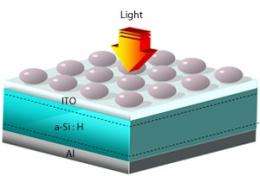
Schematic illustration of a silicon solar cell (a-Si:H) sandwiched between aluminum (Al) and transparent indium tin oxide (ITO) electrical contacts. Aluminum nanoparticles on the top (gray) enhance the absorption of light.

Solar cells are a key technology in the drive toward cleaner energy production. Unfortunately, solar technology is not yet economically competitive and the cost of solar cells needs to be brought down. One way to overcome this problem is to reduce the amount of expensive semiconductor material used, but thin-film solar cells tend to have lower performance compared with conventional solar cells.

Yuriy Akimov and Wee Shing Koh at the A*STAR Institute of High Performance Computing (Singapore) have now improved the light of thin-film solar cells by depositing particles on the cell surface.

Metallic can direct light better into the solar cell and prevent light from escaping. In conventional ‘thick-film’ solar cells, the nanoparticles would have little effect because all the light is absorbed by the film due to its thickness. For thin films, however, the nanoparticles can make a big difference. Their scattering increases the duration the light stays in the film, bringing the total absorption of light up to a level comparable with that for conventional solar cells. ”The strategy allows us to reduce the production costs of solar cells by several times and makes photovoltaics more competitive with respect to other forms of power generation,” says Akimov.

The researchers modeled the light absorption efficiency of solar cells for various nanoparticle materials and sizes. In particular, they compared the properties of silver versus aluminum nanoparticles. In most studies on the subject, silver particles have been preferred. These have optical resonances in the visible part of the spectrum that are even better at focusing the light into the solar cell. Unfortunately, there is a tradeoff: the optical resonances also cause the absorption of light by the nanoparticles, which means the solar cell is less efficient.

In the case of silver, this resonance is right in the key part of the solar spectrum, so that light absorption is considerable. But not so for aluminum nanoparticles, where these resonances are outside the important part of the solar spectrum. Furthermore, the aluminum particles handle oxidation well and their properties change little with variations in shape and size. And more importantly, their scattering properties are robust in comparison with silver nanoparticles. “We found that nanoparticles made of aluminum perform better than those made of other metals in enhancing light trapping in thin-film solar cells,” says Akimov. “We believe aluminum particles can help make thin-film commercially viable.”

More information: [1] Akimov, Y.A. & Koh, W.S. Design of plasmonic nanoparticles for efficient subwavelength light trapping in thin-film solar cells. Plasmonics. Published online: 22 Oct 2010 DOI:10.1007/s11468-010-9181-4
[2] Akimov, Y A. & Koh, W.S. Resonant and nonresonant plasmonic nanoparticle enhancement for thin-film silicon solar cells. Nanotechnology 21, 235201 (2010).

Provided by Agency for Science, Technology and Research (A*STAR)

4.3 /5 (3 votes)  

Filter


Move the slider to adjust rank threshold, so that you can hide some of the comments.


Display comments: newest first

dirk_bruere
Feb 10, 2011

Rank: not rated yet
Everything except the numbers...
Rank 4.3 /5 (3 votes)
Relevant PhysicsForums posts
  • Strength reduction factors for welded edge joints
    created4 hours ago
  • Specific heat of Al
    createdFeb 21, 2012
  • Strongest steel?
    createdFeb 19, 2012
  • stabilizing Zirconia
    createdFeb 18, 2012
  • How to calculate strength of welds (welded joints)?
    createdFeb 17, 2012
  • Polycarbonate fracture toughness????
    createdFeb 16, 2012
  • More from Physics Forums - Materials & Chemical Engineering

More news stories

New nanotechnology converts heat into power when it's needed most

Never get stranded with a dead cell phone again. A promising new technology called Power Felt, a thermoelectric device that converts body heat into an electrical current, soon could create enough juice to make another call ...

Nanotechnology / Nanophysics

created 18 hours ago | popularity 4 / 5 (8) | comments 6 | with audio podcast

New technique produces free-standing piezoelectric ferroelectric nanostructures from PZT material

(PhysOrg.com) -- Researchers have developed a “soft template infiltration” technique for fabricating free-standing piezoelectrically active ferroelectric nanotubes and other nanostructures from PZT ...

Nanotechnology / Nanophysics

created 18 hours ago | popularity 5 / 5 (5) | comments 4 | with audio podcast

Graphene is thinnest known anti-corrosion coating

New research has established the "miracle material" called graphene as the world's thinnest known coating for protecting metals against corrosion. Their study on this potential new use of graphene appears ...

Nanotechnology / Nanomaterials

created 14 hours ago | popularity 4.6 / 5 (7) | comments 2 | with audio podcast

Researchers discover how different nanomaterial surfaces affect proteins

A new study led by nanotechnology and biotechnology experts at Rensselaer Polytechnic Institute is providing important details on how proteins in our bodies interact with nanomaterials. In their new study, published in the ...

Nanotechnology / Bio & Medicine

created 11 hours ago | popularity 5 / 5 (2) | comments 1 | with audio podcast

A new twist on nanowires

Nanowires — microscopic fibers that can be “grown” in the lab — are a hot research topic today, with a variety of potential applications including light-emitting diodes (LEDs) and sensors. ...

Nanotechnology / Nanophysics

created 20 hours ago | popularity 4.8 / 5 (4) | comments 0 | with audio podcast


Researchers build first physical 'metatronic' circuit

(PhysOrg.com) -- The technological world of the 21st century owes a tremendous amount to advances in electrical engineering, specifically, the ability to finely control the flow of electrical charges using ...

Spitzer finds solid buckyballs in space

(PhysOrg.com) -- Astronomers using data from NASA's Spitzer Space Telescope have, for the first time, discovered buckyballs in a solid form in space. Prior to this discovery, the microscopic carbon spheres ...

Faster than light neutrinos? More like faulty wiring

You can shelf your designs for a warp drive engine (for now) and put the DeLorean back in the garage; it turns out neutrinos may not have broken any cosmic speed limits after all.

Physicists surprised by disappearing and reappearing superconductivity in iron selenium chalcogenides

Superconductivity is a rare physical state in which matter is able to conduct electricity -- maintain a flow of electrons -- without any resistance. This phenomenon can only be found in certain materials at low temperatures, ...

Stanford research team cracks animated NuCaptcha

(PhysOrg.com) -- The research team from Stanford University, led by Elie Bursztein, that previously had cracked regular CAPTCHAs and then audio CAPTCHAs, now has also successfully cracked the animated version called NuCapt ...

Going up: Japan builder eyes space elevator

A Japanese construction firm claimed Wednesday it could execute an out-of-this-world plan to put tourists in space within 40 years by building an elevator that stretches a quarter of the way to the moon.