Jumping spiders that love smelly socks could help fight malaria
February 17, 2011 by Lin Edwards
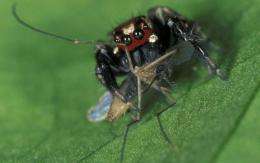
Evarcha culicivora. Credit: Robert Jackson/ University of Canterbury.
(PhysOrg.com) -- Researchers in New Zealand have found that a type of jumping spider prefers the odor of smelly socks to clean ones. The spider is the only predator known to feed indirectly on vertebrate blood by eating the mosquitoes that have fed on the vertebrates, including humans.
The spider (Evarcha culicivora), which is also known as the vampire spider, is a native of East Africa and is known to go into a kind of feeding frenzy when it smells blood, killing up to 20 female blood-filled Anopheles mosquitoes (the type that carry malaria) in a single session, but not necessarily eating them all immediately.
Dr Fiona Cross and Professor Robert Jackson of the University of Canterbury in New Zealand thought the jumping spider could be a useful tool in the fight against malaria if people were encouraged to have them living in their homes, and even before carrying out their research suspected the spiders might be attracted to human odors because they are commonly found in tall grass next to human dwellings.
Cross and Jackon devised an "olfactometer" to test their suspicions. They placed each spider into a small holding chamber connected to an exit chamber and pumped air into the holding chamber from one of two boxes. One of the boxes contained a clean sock, and the other contained a smelly sock that had been worn for 12 hours. The spider was free to move into the exit chamber at any time, and this chamber had normal, unscented air.
The results of the experiment were that the spiders stayed in the holding chamber 15 to 30 minutes longer if their air was laden with the scent of smelly socks than if the air carried the clean sock smell. The behavior was seen in all 109 spiders tested, regardless of their age or gender.
Dr Cross said the discovery ties in with some of the spiders behavior patterns, and it is the first time a spiders attraction to human odors has been demonstrated. She said since the spider lives in areas where malaria is rife it makes sense to learn as much as possible about it, especially ways in which people can lure the spiders into living in their houses without attracting more mosquitoes at the same time. She said the spider will never be the magic bullet that wipes out malaria, but it could be helpful and it is freely available in the environment.
In 2003 Professor Jackson discovered the spider and showed that it preys on mosquitoes responsible for malaria, especially females engorged after a blood meal. He also showed the spiders can recognize the mosquitoes both from their appearance and their smell, which was unexpected in a jumping spider known more for its excellent eyesight. Jackson then teamed with Cross and in 2009 they showed the spider becomes irresistible to the opposite sex when they have eaten a meal of blood-filled spiders.
The paper is published in the journal Biology Letters.
More information: Olfaction-based anthropophily in a mosquito-specialist predator, by Fiona R. Cross, Biology Letters, Published online before print February 16, 2011, doi:10.1098/rsbl.2010.1233
© 2010 PhysOrg.com
-
Mosquitoes supply spider with blood
Oct 11, 2005 |
not rated yet |
0
-
New spider is tracked in California
Jan 26, 2006 |
not rated yet |
0
-
Study: Crickets 'forewarn' unborn babies about spiders
Feb 17, 2010 |
not rated yet |
0
-
Spider-eating wasp moves into Britain
May 10, 2006 |
not rated yet |
0
-
Scientists breed goats that produce spider silk
May 31, 2010 |
not rated yet |
0
-
Stars containing dark matter should look different from other stars
Feb 20, 2012 |
4.5 / 5 (17) |
11
-
Physicists discover evidence of rare hypernucleus, a component of strange matter
Feb 17, 2012 |
4.7 / 5 (38) |
22
-
Fast photon control brings quantum photonic technologies closer
Feb 13, 2012 |
5 / 5 (8) |
1
-
Engineers build first sub-10-nm carbon nanotube transistor
Feb 01, 2012 |
4.9 / 5 (36) |
32
-
Something old, something new: Evolution and the structural divergence of duplicate genes
Jan 31, 2012 |
4.6 / 5 (7) |
1
-
Eye biology videos
4 hours ago
-
Flowering Plant Revived After 30,000 Years in Permafrost
Feb 21, 2012
-
Toba volcano eruptions - 1.000 - 10,000 breeding pairsunb
Feb 20, 2012
-
How is a specific gene removed from DNA
Feb 20, 2012
-
Reproduction and Human evolution
Feb 19, 2012
-
Viruses: Living or Non-living organisms
Feb 19, 2012
- More from Physics Forums - Biology
More news stories
Surprising diversity at a synapse hints at complex diversity of neural circuitry
A new study reveals a dazzling degree of biological diversity in an unexpected place a single neural connection in the body wall of flies.
10 hours ago |
5 / 5 (4) |
0
|
Men might not 'become extinct' after all: Theory of the 'rotting' Y chromosome dealt a fatal blow
If you were to discover that a fundamental component of human biology has survived virtually intact for the past 25 million years, you'd be quite confident in saying that it is here to stay.
13 hours ago |
5 / 5 (6) |
1
|
New family of legless amphibians found in India
Since before the age of dinosaurs it has burrowed unbothered beneath the monsoon-soaked soils of remote northeast India - unknown to science and mistaken by villagers as a deadly, miniature snake.
21 hours ago |
5 / 5 (8) |
3
Climate change affects bird migration timing in North America
Bird migration timing across North America has been affected by climate change, according to a study published Feb. 22 in the open access journal PLoS ONE.
9 hours ago |
4.5 / 5 (2) |
2
New iridescent lizard species found in Cambodia
A new species of lizard with striking iridescent rainbow skin, a long tail and very short legs has been discovered in the rainforest in northeast Cambodia, conservationists announced Wednesday.
10 hours ago |
not rated yet |
0
Researchers build first physical 'metatronic' circuit
(PhysOrg.com) -- The technological world of the 21st century owes a tremendous amount to advances in electrical engineering, specifically, the ability to finely control the flow of electrical charges using ...
Spitzer finds solid buckyballs in space
(PhysOrg.com) -- Astronomers using data from NASA's Spitzer Space Telescope have, for the first time, discovered buckyballs in a solid form in space. Prior to this discovery, the microscopic carbon spheres ...
Faster than light neutrinos? More like faulty wiring
You can shelf your designs for a warp drive engine (for now) and put the DeLorean back in the garage; it turns out neutrinos may not have broken any cosmic speed limits after all.
Physicists surprised by disappearing and reappearing superconductivity in iron selenium chalcogenides
Superconductivity is a rare physical state in which matter is able to conduct electricity -- maintain a flow of electrons -- without any resistance. This phenomenon can only be found in certain materials at low temperatures, ...
CT colonography shown to be comparable to standard colonoscopy
Computerized tomographic (CT) colonography (CTC), also known as virtual colonoscopy, is comparable to standard colonoscopy in its ability to accurately detect cancer and precancerous polyps in people ages 65 and older, according ...
Stanford research team cracks animated NuCaptcha
(PhysOrg.com) -- The research team from Stanford University, led by Elie Bursztein, that previously had cracked regular CAPTCHAs and then audio CAPTCHAs, now has also successfully cracked the animated version called NuCapt ...
Feb 17, 2011
Rank: 5 / 5 (2)
Shouldn't that be "blood-filled mosquitoes"?
Feb 17, 2011
Rank: 5 / 5 (1)
Feb 17, 2011
Rank: not rated yet
Feb 17, 2011
Rank: not rated yet
Feb 18, 2011
Rank: not rated yet