Tech therapy for smartphone-stressed mobile operators
February 15, 2011 by Richard Lein
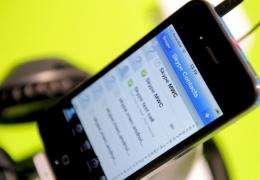
A smartphone showing a Skype application at the 3GSM World congress in Barcelona, on February 14, 2011. It is not an easy time for mobile operators -- smartphones have touched off a data traffic explosion without revenues to match, but a little tech-therapy is at hand at the mobile phone industry's annual get-together in Barcelona this week.
It is not an easy time for mobile operators -- smartphones have touched off a data traffic explosion without revenues to match, but a little tech-therapy is at hand.
At the mobile phone industry's annual get-together in Barcelona this week dozens of companies were offering technical fixes to help mobile operators ride the data wave instead of being drowned in a traffic tsunami.
The challenge mobile operators face is formidable.
Sales of smartphones have rocketed over the past few years with nearly half a billion of them now out there, and with each generating up to 24 times as much data traffic as a regular mobile phone the volume of network traffic has exploded.
The network firm Cisco is forecasting it to grow 26-fold by 2015.
Yet operators have had trouble making much money out of data, with many initially offering "all-you-can-eat" plans for a fixed price to encourage take up of the service.
The costs for mobile operators to expand their networks to keep up with data traffic growth through 2014 are estimated at 86 billion euros ($116 billion) by A.T. Kearney consulting firm and, at current trends, they will end up 21 billion euros short.
Content providers currently pay little to support the networks, but having them share more of the burden has become embroiled in the politically-sensitive "net neutrality" debate.
So mobile operators have only the option of "turning to the end user" to find the needed resources, according to Jean-Sebastien Grail, an analyst and Booz&Co consultancy.
Many operators have already ended their unlimited data plans, but this risks stunting the development of the market, and it is not easy for operators to put smartphone users on data diets, as T-Mobil learned in Britain last month.
It initially announced it was slashing monthly data allowances by at least half, only to have customer anger force it to say a day later that the change would not apply to current subscriptions.
But technical advancements to networks could help operators get more out of their networks and open up new revenue streams, and is a major focus for companies at the Mobile World Congress in Barcelona.
Network equipment manufacturer Nokia Siemens Networks is showing off technology which it says will allow operators to connect five times as many smartphones to their networks by making more efficient use of available transmission space.
A number of companies are offering technology to help make networks smarter.

Microsoft chief executive Steve Ballmer speaks during the 3GSM World congress in Barcelona, February 14, 2011. It is not an easy time for mobile operators -- smartphones have touched off a data traffic explosion without revenues to match, but a little tech-therapy is at hand.
"Intelligent networks would discriminate between traffic, allowing operators to give priority to certain kinds of traffic, and the possibility to charge higher prices to some customers who are willing to pay for priority service, such as gamers or companies," said Sonny Waheed of network optimisation technology company Tellabs.Other companies are focussing on improving transmission of bandwidth-hogging video, which is already the most popular mobile application and which Cisco expects to account for two-thirds of traffic by 2015.
"From a technology perspective there are a number of steps that can be taken to enhance the way video is carried and reduce the overall burden" on networks, said Paul Gainham of Juniper Networks, which is offering video optimisation technology this year at the MWC.
Israeli firm Flash Networks says its technology lets operators determine which traffic is flowing through its networks and optimise its flow through congested cells.
"With a variety of tools we can optimise traffic without compromising user experience," said Flash Networks' Merav Bahat.
The technology allows data traffic savings of 40 percent for video, and provides at least 20 percent operating cost savings for operators, she said.
The analysis of traffic and patterns allows the storing of popular videos near users, meaning quicker starts and less freezing during viewing.
With 50 percent faster downloads "you end up with more satisfied and loyal customers" said Bahat.
Better knowledge of customer traffic also gives operators the chance to insert themselves again into mobile browsing by offering a more personalised experience, and if they can direct traffic to commercial websites they can earn fees from businesses, she said.
(c) 2011 AFP
-
Could smartphones go stupid?
Feb 11, 2011 |
not rated yet |
0
-
Smartphones to run operators into the red in 3 years
Feb 03, 2011 |
not rated yet |
0
-
Rising to the challenge of managing bandwidth
Mar 29, 2006 |
not rated yet |
0
-
YouTube is top website with smartphone users
Feb 08, 2011 |
not rated yet |
0
-
4G wireless technology slowly starts out in Scandinavia
May 17, 2010 |
not rated yet |
0
-
Stars containing dark matter should look different from other stars
Feb 20, 2012 |
4.5 / 5 (17) |
11
-
Physicists discover evidence of rare hypernucleus, a component of strange matter
Feb 17, 2012 |
4.7 / 5 (38) |
22
-
Fast photon control brings quantum photonic technologies closer
Feb 13, 2012 |
5 / 5 (8) |
1
-
Engineers build first sub-10-nm carbon nanotube transistor
Feb 01, 2012 |
4.9 / 5 (36) |
32
-
Something old, something new: Evolution and the structural divergence of duplicate genes
Jan 31, 2012 |
4.6 / 5 (7) |
1
-
Calculating forces involved in seesaw motion
4 hours ago
-
Writing shear and moment equations for a simple beam problem?
5 hours ago
-
Furnace Shell Spray Cooling Design
21 hours ago
-
Ways to measure the speed of a golf ball?
Feb 21, 2012
-
Water Skin Effect in Plastic Pipe
Feb 21, 2012
-
Undergraduate Engineering Physics To Graduate Aerospace Engineering
Feb 21, 2012
- More from Physics Forums - General Engineering
More news stories
Stanford research team cracks animated NuCaptcha
(PhysOrg.com) -- The research team from Stanford University, led by Elie Bursztein, that previously had cracked regular CAPTCHAs and then audio CAPTCHAs, now has also successfully cracked the animated version called NuCapt ...
Tiny, implantable medical device can propel itself through bloodstream
Someday, your doctor may turn to you and say, "Take two surgeons and call me in the morning." If that day arrives, you may just have Ada Poon to thank.
18 hours ago |
5 / 5 (9) |
8
|
Italian engineer invents floating solar panels
Rays of the winter sun bounce off gleaming mirrors on the tiny lake of Colignola in Italy, where engineers have built a cost-effective prototype for floating, rotating solar panels.
Technology / Energy & Green Tech
22 hours ago |
4.7 / 5 (6) |
5
Microsoft hits Motorola, Google with EU complaint
Microsoft on Wednesday lodged a formal complaint with the European Union's competition regulator against Motorola Mobility and its soon-to-be owner Google, saying Motorola's aggressive enforcement of patent ...
17 hours ago |
2 / 5 (1) |
2
Calif. pledges better mobile privacy disclosures
(AP) -- Mobile applications seeking to collect personal information will have to forewarn users as part of an agreement reached in California.
10 hours ago |
not rated yet |
0
Researchers build first physical 'metatronic' circuit
(PhysOrg.com) -- The technological world of the 21st century owes a tremendous amount to advances in electrical engineering, specifically, the ability to finely control the flow of electrical charges using ...
Spitzer finds solid buckyballs in space
(PhysOrg.com) -- Astronomers using data from NASA's Spitzer Space Telescope have, for the first time, discovered buckyballs in a solid form in space. Prior to this discovery, the microscopic carbon spheres ...
Faster than light neutrinos? More like faulty wiring
You can shelf your designs for a warp drive engine (for now) and put the DeLorean back in the garage; it turns out neutrinos may not have broken any cosmic speed limits after all.
Physicists surprised by disappearing and reappearing superconductivity in iron selenium chalcogenides
Superconductivity is a rare physical state in which matter is able to conduct electricity -- maintain a flow of electrons -- without any resistance. This phenomenon can only be found in certain materials at low temperatures, ...
Going up: Japan builder eyes space elevator
A Japanese construction firm claimed Wednesday it could execute an out-of-this-world plan to put tourists in space within 40 years by building an elevator that stretches a quarter of the way to the moon.
Flesh-eating bacteria inspire superglue
(PhysOrg.com) -- A bio-inspired superglue has been developed by Oxford University researchers that cant be matched for sticking molecules together and not letting go.
