Building biological computers
March 7, 2011
Building biological computers

Enlarge

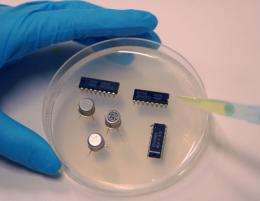
Genetically modified cells can be made to communicate with each other as if they were electronic circuits. Using yeast cells, a group of researchers in Gothenburg has taken a groundbreaking step towards being able to build complex systems in the future where the body’s own cells help to keep us healthy. The study was presented recently in an article in the scientific journal Nature. Credit: University of Gothenburg

New research shows that genetically modified cells can be made to communicate with each other as if they were electronic circuits. The study is a groundbreaking step toward building complex systems where the body's own cells can help to keep us healthy.

Genetically modified cells can be made to communicate with each other as if they were . Using , a group of researchers at the University of Gothenburg, Sweden, has taken a groundbreaking step towards being able to build in the future where the body's own cells help to keep us healthy. The study was presented recently in an article in the scientific journal Nature.

"Even though engineered cells can't do the same job as a real computer, our study paves the way for building complex constructions from these cells," says Kentaro Furukawa at the University of Gothenburg's Department of Cell- and Molecular Biology, one of the researchers behind the study. "In the future we expect that it will be possible to use similar cell-to-cell communication systems in the human body to detect changes in the state of health, to help fight illness at an early stage, or to act as to detect pollutants in connection with our ability to break down toxic substances in the environment."

Combining biology and technology

Synthetic biology is a relatively new area of research. One application is the design of that are not found in nature. For example, researchers have successfully constructed a number of different artificial connections within genetically modified cells, such as circuit breakers, oscillators and sensors.

Some of these artificial networks could be used for industrial or medical applications. Despite the huge potential for these artificial connections, there have been many technical limitations to date, mainly because the artificial systems in individual cells rarely work as expected, which has a major impact on the results.

Biotechnology challenges the world of computers

Using yeast cells, the research team at the University of Gothenburg has now produced synthetic circuits based on gene-regulated communication between cells. The yeast cells have been modified genetically so that they sense their surroundings on the basis of set criteria and then send signals to other yeast cells by secreting molecules. The various cells can thus be combined like bricks of Lego to produce more complicated circuits. Using a construction of yeast cells with different genetic modifications, it is possible to carry out more complicated "electronic" functions than would be the case with just one type of cells.

Provided by Astrobio.net (news : web)

4.7 /5 (11 votes)  

Filter


Move the slider to adjust rank threshold, so that you can hide some of the comments.


Display comments: newest first

Eoprime
Mar 07, 2011

Rank: not rated yet
Seems to be the week of 'Lets recycle news', this one was first published 14.12.10 http*LINKAGE*physorg.com/news/2010-12-door-biological.html

Hoped for an update on the story, sounds interesting overall.
Rank 4.7 /5 (11 votes)
Related Stories
Relevant PhysicsForums posts
  • Eye biology videos
    created4 hours ago
  • Flowering Plant Revived After 30,000 Years in Permafrost
    createdFeb 21, 2012
  • Toba volcano eruptions - 1.000 - 10,000 breeding pairsunb
    createdFeb 20, 2012
  • How is a specific gene removed from DNA
    createdFeb 20, 2012
  • Reproduction and Human evolution
    createdFeb 19, 2012
  • Viruses: Living or Non-living organisms
    createdFeb 19, 2012
  • More from Physics Forums - Biology

More news stories

Surprising diversity at a synapse hints at complex diversity of neural circuitry

A new study reveals a dazzling degree of biological diversity in an unexpected place – a single neural connection in the body wall of flies.

Biology / Other

created 11 hours ago | popularity 5 / 5 (4) | comments 0 | with audio podcast

Men might not 'become extinct' after all: Theory of the 'rotting' Y chromosome dealt a fatal blow

If you were to discover that a fundamental component of human biology has survived virtually intact for the past 25 million years, you'd be quite confident in saying that it is here to stay.

Biology / Biotechnology

created 14 hours ago | popularity 5 / 5 (6) | comments 1 | with audio podcast

New family of legless amphibians found in India

Since before the age of dinosaurs it has burrowed unbothered beneath the monsoon-soaked soils of remote northeast India - unknown to science and mistaken by villagers as a deadly, miniature snake.

Biology / Plants & Animals

created 21 hours ago | popularity 5 / 5 (9) | comments 3

Climate change affects bird migration timing in North America

Bird migration timing across North America has been affected by climate change, according to a study published Feb. 22 in the open access journal PLoS ONE.

Biology / Ecology

created 10 hours ago | popularity 4.5 / 5 (2) | comments 2

New iridescent lizard species found in Cambodia

A new species of lizard with striking iridescent rainbow skin, a long tail and very short legs has been discovered in the rainforest in northeast Cambodia, conservationists announced Wednesday.

Biology / Plants & Animals

created 10 hours ago | popularity not rated yet | comments 0


Researchers build first physical 'metatronic' circuit

(PhysOrg.com) -- The technological world of the 21st century owes a tremendous amount to advances in electrical engineering, specifically, the ability to finely control the flow of electrical charges using ...

Spitzer finds solid buckyballs in space

(PhysOrg.com) -- Astronomers using data from NASA's Spitzer Space Telescope have, for the first time, discovered buckyballs in a solid form in space. Prior to this discovery, the microscopic carbon spheres ...

Faster than light neutrinos? More like faulty wiring

You can shelf your designs for a warp drive engine (for now) and put the DeLorean back in the garage; it turns out neutrinos may not have broken any cosmic speed limits after all.

Physicists surprised by disappearing and reappearing superconductivity in iron selenium chalcogenides

Superconductivity is a rare physical state in which matter is able to conduct electricity -- maintain a flow of electrons -- without any resistance. This phenomenon can only be found in certain materials at low temperatures, ...

Stanford research team cracks animated NuCaptcha

(PhysOrg.com) -- The research team from Stanford University, led by Elie Bursztein, that previously had cracked regular CAPTCHAs and then audio CAPTCHAs, now has also successfully cracked the animated version called NuCapt ...

Going up: Japan builder eyes space elevator

A Japanese construction firm claimed Wednesday it could execute an out-of-this-world plan to put tourists in space within 40 years by building an elevator that stretches a quarter of the way to the moon.