How much can a cell uptake?
March 2, 2011
How much can a cell uptake?

Enlarge

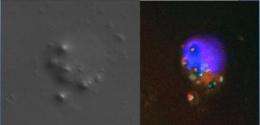
Immunological research at the University of Haifa, Israel, has made a new breakthrough, revealing a critical component in the "decision-making" process of white blood cells that play a role in the healing process from bacterial inflammation. "The process that we have discovered can assist in the development of drugs that are based on the natural processes that take place in the human body, unlike most of the existing drugs that attempt to curb inflammation by artificial means," explains Dr. Amiram Ariel of the Department of Biology at the University of Haifa, who headed the study. The research and its results have been published in the scientific journal European Journal of Immunology. This new study, conducted by Dr. Ariel alongside a team of students led by Dr. Sagie Schif-Zuck, set out to probe the critical stage of the healing process, when the macrophages decide to relocate and adjust their healing activities, moving from local rehabilitation of the damaged tissue to shut down of systemic immune responses at organs of the immune system. Credit: Courtesy of the University of Haifa

Immunological research at the University of Haifa, Israel, has made a new breakthrough, revealing a critical component in the "decision-making" process of white blood cells that play a role in the healing process from bacterial inflammation. "The process that we have discovered can assist in the development of drugs that are based on the natural processes that take place in the human body, unlike most of the existing drugs that attempt to curb inflammation by artificial means," explains Dr. Amiram Ariel of the Department of Biology at the University of Haifa, who headed the study. The research and its results have been published in the scientific journal European Journal of Immunology.

Bacterial forms in the body when bacteria (pathogens) penetrate body tissue. In response, specific types of () begin to fight the invaders, to destroy and remove them from the tissue. In normal conditions, inflammation is terminated once the cells have managed to eradicate the bacteria and then undergo programmed . At that point, another type of white blood cells come on stage – macrophages – whose job it is to take up the dead cells (the neutrophils) and to restore the tissue to its normal functioning state. While the macrophages feast on their cell meal, they gain the ability to begin the tissue's rehabilitation process. However, at one point they abandon the tissue and make their way over to immune system organs, via the lymphatic system, where they deliver the "back to routine" message to the rest of the immune system. This message is important for the body's return to normal functioning. Until now, however, the when and how that directs macrophages' leaving the inflamed tissue remained unknown.

Dr. Ariel explains that even when the body manages to cope with the bacterial invaders, there is also the danger of "excessive" healing that will result in fibrosis and scar formation. This happens when the system reels out of control and "over-heals" the previously infected area. Fibrosis can lead to malfunctioning of the healing tissue, tissue death and sometimes even mortality. To understand why this happens, it is important to identify and understand the way macrophages' govern the .

The current study, conducted by Dr. Ariel alongside a team of students led by Dr. Sagie Schif-Zuck, set out to probe the critical stage of the healing process, when the macrophages decide to relocate and adjust their healing activities, moving from local rehabilitation of the damaged tissue to shut down of systemic immune responses at organs of the immune system.
How much can a cell uptake?
Enlarge

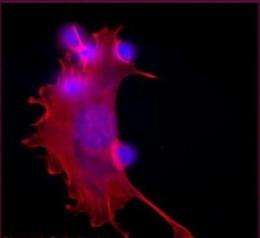
A breakthrough research in immunology, conducted by Dr. Amiram Ariel of the University of Haifa alongside a team of students led by Dr. Sagie Schif-Zuck, set out to probe the critical stage of the inflammation healing process, when the macrophages decide to relocate and adjust their healing activities, moving from local rehabilitation of the damaged tissue to shut down of systemic immune responses at organs of the immune system. Credit: Image from: Henson, P. (2007),

The researchers discovered that the macrophages have a fascinating "uptake threshold" of seven cells. After engulfing seven neutrophils they are "licensed" to leave the tissue and continue with their remote tasks. The research also found that these cells are sensitive to the tissue's healing pace, so that when the tissue is healing quicker, they are permitted to leave earlier, and when the tissue is finding it harder to repair itself, they hang around longer, even after reaching the uptake threshold of seven cells. The researchers also discovered substances that "inform" the cells on the tissue's rate of repair, and found that by injecting these substances, the macrophages' transition to immune organs is accelerated while new macrophages are recruited to further treat the damaged tissue and continue the healing process. In addition, the study revealed that as they leave the tissue, the macrophages undergo molecular changes necessary to carry out their new functions in the lymphatic system.

"Our new study has found a major event in the inflammatory healing process that is responsible for the transition of macrophages from local rehabilitation of the damaged tissue to its consequent role in promoting the immune system's return to routine. The findings from our study can assist in the development of biological drugs that are based on the body's natural processes and biomolecules. Today, most drugs are designed to block particular pathways in the inflammatory process, which is also a "fight back" strategy found in and viruses; but in many cases, the body relates to such a drug as a type of 'bacterial invasion', finds ways to circumvent it and produces an alternative immunological response to the blocked one. By harnessing the natural healing process that we have discovered, the body will be able to naturally complete and terminate all the inflammatory processes, and will be able to avoid the deficiencies of existing anti-inflammatory treatments," Dr. Ariel concludes.

Provided by University of Haifa (news : web)


Rank 5 /5 (1 vote)
Relevant PhysicsForums posts
  • stomach not emptying
    createdFeb 16, 2012
  • White reflections in photos in one eye
    createdFeb 15, 2012
  • Is Everyday Technology Killing Us?
    createdFeb 08, 2012
  • Exercise and weight loss
    createdFeb 08, 2012
  • Why do we have head aches? Our brains can't feel anything.
    createdFeb 07, 2012
  • "The end of diseases" by David Agus, interview from Daily Show with Jon Stewart
    createdFeb 04, 2012
  • More from Physics Forums - Medical Sciences

More news stories

CT colonography shown to be comparable to standard colonoscopy

Computerized tomographic (CT) colonography (CTC), also known as virtual colonoscopy, is comparable to standard colonoscopy in its ability to accurately detect cancer and precancerous polyps in people ages 65 and older, according ...

Medicine & Health / Cancer

created 3 hours ago | popularity not rated yet | comments 0

What can animals' survival instincts tell us about understanding human emotion?

Can animals' survival instincts shed additional light on what we know about human emotion? New York University neuroscientist Joseph LeDoux poses this question in outlining a pioneering theory, drawn from two decades of research, ...

Medicine & Health / Neuroscience

created 14 hours ago | popularity 5 / 5 (3) | comments 4 | with audio podcast

Study: Virtual colonoscopy effective screening tool for adults over 65

Computed tomography (CT) colonography can be used as a primary screening tool for colorectal cancer in adults over the age of 65, according to a new study published online in the journal Radiology.

Medicine & Health / Other

created 3 hours ago | popularity not rated yet | comments 0

Injectable gel could repair tissue damaged by heart attack

(Medical Xpress) -- University of California, San Diego researchers have developed a new injectable hydrogel that could be an effective and safe treatment for tissue damage caused by heart attacks.

Medicine & Health / Cardiology

created 17 hours ago | popularity 4.7 / 5 (6) | comments 3 | with audio podcast

Mini molecules could help fight battle of aortic bulge

When aortic walls buckle, the body's main blood pipe forms an ever-growing bulge. To thwart a deadly rupture, a team of Stanford University School of Medicine researchers has found two tiny molecules that may be able to orchestrate ...

Medicine & Health / Cardiology

created 13 hours ago | popularity 5 / 5 (1) | comments 0 | with audio podcast


Researchers build first physical 'metatronic' circuit

(PhysOrg.com) -- The technological world of the 21st century owes a tremendous amount to advances in electrical engineering, specifically, the ability to finely control the flow of electrical charges using ...

Spitzer finds solid buckyballs in space

(PhysOrg.com) -- Astronomers using data from NASA's Spitzer Space Telescope have, for the first time, discovered buckyballs in a solid form in space. Prior to this discovery, the microscopic carbon spheres ...

Faster than light neutrinos? More like faulty wiring

You can shelf your designs for a warp drive engine (for now) and put the DeLorean back in the garage; it turns out neutrinos may not have broken any cosmic speed limits after all.

Physicists surprised by disappearing and reappearing superconductivity in iron selenium chalcogenides

Superconductivity is a rare physical state in which matter is able to conduct electricity -- maintain a flow of electrons -- without any resistance. This phenomenon can only be found in certain materials at low temperatures, ...

Stanford research team cracks animated NuCaptcha

(PhysOrg.com) -- The research team from Stanford University, led by Elie Bursztein, that previously had cracked regular CAPTCHAs and then audio CAPTCHAs, now has also successfully cracked the animated version called NuCapt ...

Going up: Japan builder eyes space elevator

A Japanese construction firm claimed Wednesday it could execute an out-of-this-world plan to put tourists in space within 40 years by building an elevator that stretches a quarter of the way to the moon.