Hubble rules out one alternative to dark energy
March 14, 2011
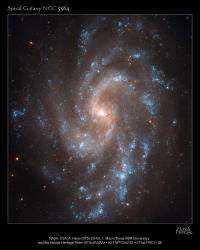
The brilliant, blue glow of young stars trace the graceful spiral arms of galaxy NGC 5584 in this Hubble Space Telescope image. Thin, dark dust lanes appear to be flowing from the yellowish core, where older stars reside. The reddish dots sprinkled throughout the image are largely background galaxies. Credit: NASA, ESA, A. Riess (STScI/JHU), L. Macri (Texas A&M University), and Hubble Heritage Team (STScI/AURA)
(PhysOrg.com) -- Astronomers using NASA's Hubble Space Telescope have ruled out an alternate theory on the nature of dark energy after recalculating the expansion rate of the universe to unprecedented accuracy.
The universe appears to be expanding at an increasing rate. Some believe that is because the universe is filled with a dark energy that works in the opposite way of gravity. One alternative to that hypothesis is that an enormous bubble of relatively empty space eight billion light-years across surrounds our galactic neighborhood. If we lived near the center of this void, observations of galaxies being pushed away from each other at accelerating speeds would be an illusion.
This hypothesis has been invalidated because astronomers have refined their understanding of the universe's present expansion rate. Adam Riess of the Space Telescope Science Institute (STScI) and Johns Hopkins University in Baltimore, Md., led the research. The Hubble observations were conducted by the SHOES (Supernova Ho for the Equation of State) team that works to refine the accuracy of the Hubble constant to a precision that allows for a better characterization of dark energy's behavior. The observations helped determine a figure for the universe's current expansion rate to an uncertainty of just 3.3 percent. The new measurement reduces the error margin by 30 percent over Hubble's previous best measurement of 2009. Riess' results appear in the April 1 issue of The Astrophysical Journal.
The value for the expansion rate is 73.8 kilometers per second per megaparsec. It means that for every additional million parsecs (3.26 million light-years) a galaxy is from Earth, the galaxy appears to be traveling 73.8 kilometers per second faster away from us.
Every decrease in uncertainty of the universe's expansion rate helps solidify our understanding of its cosmic ingredients. Knowing the precise value of the universe's expansion rate further restricts the range of dark energy's strength and helps astronomers tighten up their estimates of other cosmic properties, including the universe's shape and its roster of neutrinos, or ghostly particles, that filled the early universe.
"We are using the new camera on Hubble like a policeman's radar gun to catch the universe speeding," Riess said. "It looks more like it's dark energy that's pressing on the gas pedal."
Bursting the Bubble
Dark energy is one of the greatest cosmological mysteries in modern physics. Even Albert Einstein conceived of a repulsive force, called the cosmological constant, which would counter gravity and keep the universe stable. He abandoned the idea when astronomer Edwin Hubble discovered in 1929 that the universe is expanding. Observational evidence for dark energy didn't come along until 1998, when two teams of researchers (one led by Riess) discovered it.
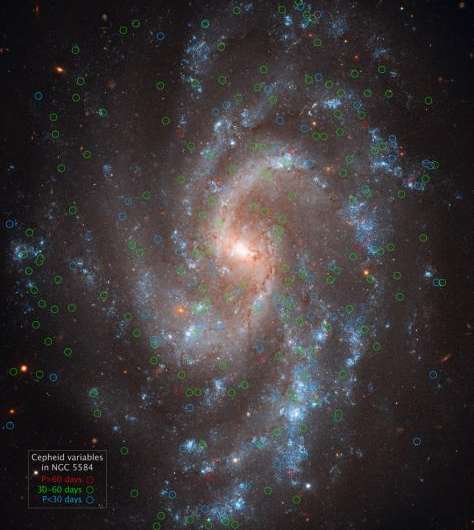
Cepheids in Spiral Galaxy NGC 5584. This illustration shows the location of Cepheid variables found in the spiral galaxy NGC 5584. Ultraviolet, visible, and infrared data taken with Hubble's Wide Field Camera 3 in 2010 reveals Cepheids of varying periods. Those stars with periods of less than 30 days and between 30 and 60 days are marked with blue and green circles, respectively. A small number of Cepheids, with periods larger than 60 days, are marked in red. Credit: NASA, ESA, A. Riess (STScI/JHU), and L. Macri (Texas A&M University)
The idea of dark energy was so far-fetched, many scientists began contemplating other strange interpretations, including the cosmic bubble theory. In this theory, the lower-density bubble would expand faster than the more massive universe around it. To an observer inside the bubble, it would appear that a dark-energy-like force was pushing the entire universe apart. The bubble hypothesis requires that the universe's expansion rate be much slower than astronomers have calculated, about 60 to 65 kilometers per second per megaparsec. By reducing the uncertainty of the Hubble constant's value to 3.3 percent, Riess reports that his team has eliminated beyond all reasonable doubt the possibility of that lower number."The hardest part of the bubble theory to accept was that it required us to live very near the center of such an empty region of space," explained Lucas Macri, of Texas A&M University in College Station, a key collaborator of Riess. "This has about a one in a million chance of occurring. But since we know that something weird is making the universe accelerate, it's better to let the data be our guide."
Using stars as "cosmic yardsticks" measuring the universe's expansion rate is a tricky business. Riess' team first had to determine accurate distances to galaxies near and far from Earth. The team compared those distances with the speed at which the galaxies are apparently receding because of the expansion of space. They used those two values to calculate the Hubble constant, the number that relates the speed at which a galaxy appears to recede to its distance from the Milky Way. Because astronomers cannot physically measure the distances to galaxies, researchers had to find stars or other objects that serve as reliable cosmic yardsticks. These are objects with an intrinsic brightness, brightness that hasn't been dimmed by distance, an atmosphere, or stellar dust, that is known. Their distances, therefore, can be inferred by comparing their true brightness with their apparent brightness as seen from Earth.
Among the most reliable of these cosmic yardsticks for relatively shorter distances are Cepheid variables, pulsating stars that dim and fade at rates that correspond to their intrinsic luminosity. But Cepheids are too dim to be found in very distant galaxies. To calculate longer distances, Riess' team chose a special class of exploding stars called Type Ia supernovae. These stellar explosions all flare with similar luminosity and are brilliant enough to be seen far across the universe. By comparing the apparent brightness of Type la supernovae and pulsating Cepheid stars, the astronomers could measure accurately their intrinsic brightness and therefore calculate distances to Type Ia supernovae in far-flung galaxies.
Using the sharpness of the new Wide Field Camera 3 (WFC3) to study more stars in visible and near-infrared light, scientists eliminated systematic errors introduced by comparing measurements from different telescopes.
"WFC3 is the best camera ever flown on Hubble for making these measurements, improving the precision of prior measurements in a small fraction of the time it previously took," said Macri.
Using one instrument to measure the Hubble constant is like measuring a hallway with a tape measure instead of by laying a ruler from end to end. By avoiding the need to pick up the ruler and lay it back down, you can prevent mistakes. "The camera on Hubble, WFC3, is the best ever flown on Hubble for making these measurements, improving the precision of prior measurements in a small fraction of the time it previously took," Riess said.
The astronomer hopes that Hubble will continue to be used in this way to reduce the uncertainty in the Hubble constant even more, and thus refine the measured properties of dark energy. He suggests the present uncertainty could be cut in two before Hubble gives way to improvements out of Hubble's reach but within the scope of the James Webb Space Telescope, an infrared observatory scheduled to launch later this decade.
Chasing a runaway universe, Riess has been pursing dark energy for 13 years. He co-discovered the existence of dark energy by finding that distant Type Ia supernovae were dimmer than expected, which meant they were farther away than anticipated. The only way for that to happen, Riess realized, was if the expansion of the universe had sped up some time in the past.
Until that discovery, astronomers had generally believed that the cosmic expansion was gradually slowing down, due to the gravitational tugs that individual galaxies exert on one another. But the results implied that some mysterious force was acting against the pull of gravity, shoving galaxies away from each other at ever-increasing speeds.
Riess decided that one of the best ways to tighten the constraints on dark energy is to determine an accurate value for the Hubble constant, which he has been doing with the Hubble Space Telescope. That measurement, combined with others from NASA's Wilkinson Microwave Anisotropy Probe (WMAP), traces the universe's behavior from nearly the dawn of time to the present age. (WMAP showed the universe as it appeared shortly after the Big Bang, before stars and galaxies formed.)
Riess is just one of many astronomers who, over the past 80 years, have been measuring and re-measuring the Hubble constant. The Hubble telescope has played a major role in helping astronomers precisely measure the universe, expansion. Before Hubble was launched in 1990, the estimates for the Hubble constant varied by a factor of two. In 1999, the Hubble Space Telescope Key Project on the Extragalactic Distance Scale refined the value of the Hubble constant to an error of about 10 percent.
-
Refined Hubble Constant narrows explanations for dark energy
May 07, 2009 |
not rated yet |
0
-
Zeroing in on Hubble's constant
Jan 05, 2009 |
not rated yet |
0
-
Hubble Snaps Images of a Pinwheel-Shaped Galaxy
Feb 07, 2006 |
not rated yet |
0
-
'Big baby' galaxy found in newborn Universe
Sep 28, 2005 |
not rated yet |
0
-
Hubble's Deepest View of Universe Unveils Never-Before-Seen Galaxies (w/ Video)
Dec 08, 2009 |
not rated yet |
0
-
Stars containing dark matter should look different from other stars
Feb 20, 2012 |
4.5 / 5 (17) |
11
-
Physicists discover evidence of rare hypernucleus, a component of strange matter
Feb 17, 2012 |
4.7 / 5 (38) |
22
-
Fast photon control brings quantum photonic technologies closer
Feb 13, 2012 |
5 / 5 (8) |
1
-
Engineers build first sub-10-nm carbon nanotube transistor
Feb 01, 2012 |
4.9 / 5 (36) |
32
-
Something old, something new: Evolution and the structural divergence of duplicate genes
Jan 31, 2012 |
4.6 / 5 (7) |
1
-
Calculating the magnitude
2 hours ago
-
What is this spectrum I took?
12 hours ago
-
Orientation of Space
12 hours ago
-
Geologically Active Moon Now: NASA
19 hours ago
-
advice on building a science fair telescope
Feb 22, 2012
-
Rise of the Sun
Feb 22, 2012
- More from Physics Forums - General Astronomy
More news stories
Spitzer finds solid buckyballs in space
(PhysOrg.com) -- Astronomers using data from NASA's Spitzer Space Telescope have, for the first time, discovered buckyballs in a solid form in space. Prior to this discovery, the microscopic carbon spheres ...
14 hours ago |
4.7 / 5 (12) |
8
|
Going up: Japan builder eyes space elevator
A Japanese construction firm claimed Wednesday it could execute an out-of-this-world plan to put tourists in space within 40 years by building an elevator that stretches a quarter of the way to the moon.
Space & Earth / Space Exploration
21 hours ago |
3.5 / 5 (13) |
26
ENASA satellite finds Earth's clouds are getting lower
(PhysOrg.com) -- Earth's clouds got a little lower -- about one percent on average -- during the first decade of this century, finds a new NASA-funded university study based on NASA satellite data. The results ...
Space & Earth / Earth Sciences
18 hours ago |
5 / 5 (8) |
13
|
Fresh scandal embroils US climate science debate
A fresh scandal over climate change has erupted in the United States after leaked documents appeared to show a right-wing funded campaign to influence how climate science is taught in schools.
10 hours ago |
4.1 / 5 (9) |
8
World's oceans get an acid bath
Among the repercussions of global climate change, the effect of ocean acidification on marine life is one of the least-understood variables.
17 hours ago |
4.3 / 5 (6) |
4
|
Researchers build first physical 'metatronic' circuit
(PhysOrg.com) -- The technological world of the 21st century owes a tremendous amount to advances in electrical engineering, specifically, the ability to finely control the flow of electrical charges using ...
Faster than light neutrinos? More like faulty wiring
You can shelf your designs for a warp drive engine (for now) and put the DeLorean back in the garage; it turns out neutrinos may not have broken any cosmic speed limits after all.
Physicists surprised by disappearing and reappearing superconductivity in iron selenium chalcogenides
Superconductivity is a rare physical state in which matter is able to conduct electricity -- maintain a flow of electrons -- without any resistance. This phenomenon can only be found in certain materials at low temperatures, ...
CT colonography shown to be comparable to standard colonoscopy
Computerized tomographic (CT) colonography (CTC), also known as virtual colonoscopy, is comparable to standard colonoscopy in its ability to accurately detect cancer and precancerous polyps in people ages 65 and older, according ...
Stanford research team cracks animated NuCaptcha
(PhysOrg.com) -- The research team from Stanford University, led by Elie Bursztein, that previously had cracked regular CAPTCHAs and then audio CAPTCHAs, now has also successfully cracked the animated version called NuCapt ...
Study: Virtual colonoscopy effective screening tool for adults over 65
Computed tomography (CT) colonography can be used as a primary screening tool for colorectal cancer in adults over the age of 65, according to a new study published online in the journal Radiology.

Mar 14, 2011
Rank: 3.5 / 5 (4)
Sigh. Again, I still don't understand what empty space actually 'is'. Did inter-galactic space get 'made' in the BB? Is there a difference between inter-galactic space, and 'space' outside the universe?
Mar 14, 2011
Rank: 2.4 / 5 (5)
There is no such thing as empty space. At least not within our universe. What you perceive as nothing is actually everything in harmony. Matter is just, in layman's terms, the separation (or disharmony) of vacuum.
If you'd use a microscope capable of observing infinitesimal objects you'd observe what would seemingly be intense chaos in vacuum.
Mar 14, 2011
Rank: 1.3 / 5 (6)
Mar 14, 2011
Rank: 4.3 / 5 (8)
Our observations of other galaxies are red shifted suggesting they are accelerating away from us / each other. Dark Energy or a repulsive force is the prevailing theory to explain this. Another thought was that this red shift was a result of relativistic effects of Earth being near the center of a "void bubble" in the universe, but this research shows that ain't so. Score for the Copernican principle! Earth is still just an insignificant Pale Blue Dot.
Mar 14, 2011
Rank: 3.9 / 5 (9)
Hmmmm. The only problem is the many orders of magnitude that quantum calculations give for the vacuum energy suggests that maybe this interpretation of the vacuum is incorrect. We don't know what dark energy is, just like dark matter. Dark means we don't know. We see the effects of something and can make some predictions, but we still search for an explanation.
Mar 14, 2011
Rank: 4.6 / 5 (7)
Good questions. I second them. Here is a stab from clueless me.
(1)If empty space = vacuum, I don't think we know yet what it is, hence Dark Energy. If empty space is something else???
(2)Space-time "started" with the BB. Before the BB just "wasn't". There is no space outside the universe. Are there other universes? Maybe, but my understanding is that you couldn't travel to them by "conventional" means. i.e. you can't fly out of our universe, through some void, to another one. The space-time we exist in is our universe, there is no "outside".
Somebody tear me up.
Mar 14, 2011
Rank: 5 / 5 (2)
Mar 14, 2011
Rank: 1.5 / 5 (11)
To give you a simple example: we "measure a river and by our measurement it is 600,000km long then we see a boat crossing it in less than a second so we have to redefine relativity...
The point is the river measurement was wrong and we don't need to redefine anything.
I am happy that HST is now fini tuning its measurements to allow to get rid of this clumsy dark "stuff"!
Mar 14, 2011
Rank: 2.4 / 5 (5)
Mar 14, 2011
Rank: 2 / 5 (6)
Question: "Is the entire universe and everything in it expanding?" If so, "Is local space also expanding, down to the subatomic level?"
It's mind-boggling to me that the particles within my body may also be spreading apart at the same rate as the entire universe. Too small to measure perhaps, but I'm part of the inflationary process.
Mar 14, 2011
Rank: 2 / 5 (5)
It follows like night follows day that if space is expanding at a constant rate therefore universe will expand at accelerating rate.
That will happen simply because as space expands there is more of to expand.
Of course we are by no means certain that space is in fact expanding but if it is then it would have to accelerate.
Mar 14, 2011
Rank: 1.8 / 5 (5)
Mar 15, 2011
Rank: 1 / 5 (4)
The homogeneity of this reasoning can be seen in the inverse nature of space-time deformation as in regions of black holes where the increased gravity component intensifies positive collapse of the space time components asymptotically towards infinite potential or singularity
Mar 15, 2011
Rank: 1 / 5 (3)
Mar 15, 2011
Rank: 5 / 5 (1)
Mar 15, 2011
Rank: 1 / 5 (1)
- there is no such thing as "empty space"
Mar 15, 2011
Rank: 5 / 5 (8)
I wasn't referring to dark energy or dark matter. I was referring to such things as virtual particles that constantly pop in and out of existence. Particles and antiparticles that appear out of vacuum. You don't need dark energy or dark matter to show that vacuum isn't "empty". All you need is a vacuum chamber and two metal plates to demonstrate the casimir effect.
Mar 15, 2011
Rank: 3.3 / 5 (6)
You may believe, but science will never be able to tell you whether you are right or wrong.
Otoh, IF there is a falsifiable way to hypothesize "other universes" THEN it doesn't make sense to call them "other universes" as then they are part of _the_ universe.
Mar 15, 2011
Rank: 3.8 / 5 (4)
Mar 15, 2011
Rank: 4.5 / 5 (10)
Spacetime isn't expanding at every point, certainly not at the subatomic level. It doesn't occur at local scales, and by local, I mean within galaxies and galaxy clusters. At these scales, gravity plays a dominant role, keeping everything in place. It's only at much larger scales that the effects of expansion become evident.
Mar 15, 2011
Rank: 1 / 5 (3)
If Spirit of Cosmology studies needs to be sustained, one has to be open minded. Cosmology Structures-new modeling- my paper-Carnegie Centennial Symposioum 3-Jan 2003, Cosmology Definition provide ample scope to understand the Cosmic Function of the Universe- See Invisible-Visible matrix concept as well
COSMOLOGY-KNOWLEDGE EXPANSION
http://groups.goo...s?hl=en-
East west effective Interaction helps in Time.
Time is the essence as Cosmic Events move faster than our concepts-to allow correction. Best of Brains Trust for Cosmology Research form the essence
Vidyardhi Nanduri
Mar 15, 2011
Rank: 2.8 / 5 (4)
Mar 15, 2011
Rank: 4.6 / 5 (8)
No, it's not possible. Even if there was the same amount of normal, but hidden, matter out there (there isn't), it would still be way too small an amount to account for observations. And it's not just the quantity of matter, but its distribution and interaction with normal matter which points to dark matter being of non-baryonic type.
Through gravitational effects on normal (luminous) matter, including gravitational lensing effects and computer modelling of the early universe.
Mar 15, 2011
Rank: 4 / 5 (1)
I don't recall anything about what space is, if anything. I get the virtual particle thing, DM, and DE. I'm not talking about any of that. They say space was created in the BB. Then what is it?
Why couldn't you hypothetically travel to the edge of this verse and beyond? I'm proposing a thought experiment here, not saying we could accomplish this. I get the logistical problems of travel that far, and that there might not be an 'edge' or 'end' of this verse.
If there is no difference between inter-verse (or outer-verse, if this is the only universe) space and inter-galactic space, then why can't our verse merely be 'flowing' into the void, in all directions, creating a redshift?
Mar 15, 2011
Rank: 4.6 / 5 (10)
"I'm not getting fat, I'm just redshifting!"
Mar 15, 2011
Rank: not rated yet
These also are good questions. Our brains evolved in the course of dealing with things on the scale of our workaday world. The further we get from our normal scale of things the more we can be misled by our preconceptions.
I recently read an article in Scientific American magazine that explained how quantum mechanics is being derived geometrically from conceptions of loops of 'fibres' which surround every point of space-time. The fibres may be looped and twisted around other fibres in systematic and characteristic ways. Interactions amongst the many superimposing loops is what we call particles. cont ...
Mar 15, 2011
Rank: not rated yet
I found that article very helpful, in so far as I understood it; but I am not a mathematician and not the foggiest idea what "Lie groups" are.
In my simple minded way I consider that what we call space-time is not something ultimate in itself - except for us who live within it. I think space-time is better thought of as the infinitely in-folded and seething boundary "surface" of different existences. The ancient East Asian idea of Yin & Yang is something like this, but then I think there must be at least three fundamental existences [and the ancients who thought like this ended up with a "Holy Trinity".]
If there are many different existences, as I conceive them, and each only has an interface with some but not all of the others, such that we could represent these boundaries as the overlapping areas in Venn diagrams, this could be a very feasible way of accounting for the existence and evolution of space time and its particle and wavecals.
Mar 15, 2011
Rank: 5 / 5 (1)
@bluehigh: Didn't I say there wasn't anything as "empty space" in my first post? I admit I confused things by then equating it to the vacuum, but that was more of a deflection to indicate that the vacuum is as empty as we get and if that isn't your empty space then "???"
@Skultch: In our space-time (universe), there is no limit to travel beyond ,I think answers your question. My understanding is that you can't get beyond our universe in any x, y, or z direction. Before the BB Space-time just wasn't. When you get the into the theory of branes and such interacting, then we get into an area I don't fully grasp with respect to whether "travel" between them is possible. Maybe the universe is in a giant Higgs bubble and you can move to different bubbles with varying strength Higgs fields, but that is just speculative babble.
@A_Paradox: Sounds like LQG but you went mystic on us
Mar 15, 2011
Rank: 5 / 5 (3)
Mar 15, 2011
Rank: 1 / 5 (2)
Mar 15, 2011
Rank: 5 / 5 (3)
Doesn't M-Theory suggest that the ends of strings conveying the electromagnetic force have to be bound at the ends to branes? I am doing my best to remember what I read while at work, but I think the Theory forbids interaction between branes by means outside of gravitation. I don't think you could travel between them.
Hopefully, someone will come along and add to my fragmentary knowledge on this topic.
Mar 16, 2011
Rank: 4 / 5 (4)
That's right. According to M-theory only gravitons may travel between p-branes. There is however research based on M-theory that suggests other particles may as well behave as such, but these are mere extensions of the M-theory rather than the theory itself.
Mar 16, 2011
Rank: not rated yet
Not really. It's just that trying to understand the "ultimate" nature of existence is intrinsically paradoxical; one has to stop somewhere, at least for a given moment. I tend towards a kind of logical minimalism: there is that which is. Reflection leads to the recognition that "nothing" or "nothingness" are just as paradoxical as anything else, and don't help much except in a rough and ready workaday sense. What seems to count is that there is difference - that which exists yet is different from that which is not the same. It sounds completely asinine yet it has to be. Which is what makes me think of "existences". They exist but are different. I think this strongly implies boundaries and that the world we recognise is actually the evolution of the boundaries where existences meet but do not merge.
I am not a Platonist like the mathematical ontologists who believe that numbers are the ultimate reality.
Mar 16, 2011
Rank: 3.7 / 5 (3)
Dark Energy occurs everywhere, cursory examination appears to reveal that Dark energy is the functional balance to gravity within false vaccuum.
Mar 16, 2011
Rank: 3.7 / 5 (3)
You are a sharp person Skeptic Heretic and have a better way with words when stating your case, though you can be a little too MACHO or RAMBO at times.
Mar 16, 2011
Rank: 5 / 5 (2)
I don't understand. Are you trying to say that you don't believe in mathematics?
Mar 16, 2011
Rank: 1 / 5 (10)
The universe is fragmenting because:
a.) The energy source is neutron repulsion
b.) Neutron repulsion causes neutron-emission
c.) Neutron-decay spontaneously occurs ~10 minutes after neutron-emission
d.) The volume expands by a factor of ~1,000,000,000,000,000 in neutron decay
e.) Neutron =>H+ + e- => Hydrogen atom; V(finial)/V(initial) ~ 1,000,000,000,000,000
See: "Neutron Repulsion"
The APEIRON Journal
in press (2011), 19 pages
http://arxiv.org/...2.1499v1
With kind regards,
Oliver K. Manuel
Mar 16, 2011
Rank: 4.2 / 5 (5)
You're welcome to call me on it when I make such a mistake. If you're correct when doing so I'll always provide credit based on relevant observation. Backhanded praise will alway receive vitriol however.
Mar 16, 2011
Rank: 5 / 5 (4)
Mar 16, 2011
Rank: 1 / 5 (5)
Thanks for your comments.
I am an experimentalist, not a theoretician.
1. The volume of the hydrogen atom is ~ 1,000,000,000,000,000 times greater than the volume of the neutron.
2. The density of the neutron is ~ 1,000,000,000,000,000 times greater than the density of the hydrogen atom.
3. I know absolutely nothing about the expansion of space-time.
The paper, "Neutron Repulsion," is based on experimental data rather than exotic theoretical ideas about expansion of space time [The APEIRON Journal, in press (2011), 19 page]
http://arxiv.org/...2.1499v1
Mar 17, 2011
Rank: 1 / 5 (7)
Mar 17, 2011
Rank: 5 / 5 (3)
On a different note:The "o" in "Ho" is supposed to be a subscript 0 according to the HubbleSite NewsCenter. H_0 is the symbol for the hubble "constant" to which the above article refers. Though I suppose as written the team name garners more attention.
Mar 17, 2011
Rank: 2.6 / 5 (5)
Redshift is therefore not by means of motion, so that neither exists a dark energy.
There is therefore not an expansion of the universe.
When did science people the courage to recognize this?
Mar 17, 2011
Rank: 3.5 / 5 (4)
@SH:To clarify, on small scales do the other four forces "counteract" DE? I have always struggled with this since I would think an experimental result in static space would have observational differences even at small scales with one in an expanding space. We just need somebody clever enough to design the experiment.
@omatumr: This article IS about spacetime expansion and Dark Energy. That IS clear and YOU posted here. You claim your theory explains all, then you proceed to tell us you don't know what you are talking about? Just stop.
I spoke too soon on the cranks I guess. frajo, your point is still valid though.
Mar 17, 2011
Rank: 2.3 / 5 (6)
Mar 17, 2011
Rank: 5 / 5 (2)
Mar 17, 2011
Rank: 4 / 5 (5)
Mar 17, 2011
Rank: not rated yet
Mar 17, 2011
Rank: 1 / 5 (1)
Mar 17, 2011
Rank: 2.3 / 5 (3)
Neutron repulsion [1] triggers the nuclear reactions that generate luminosity and H and He as waste products in the Sun and in other stars:
a.) Neutron star =(neutron-emission)=> Neutron
b.) Neutron =(neutron-decay)=> Hydrogen (H)
c.) Hydrogen =(H-fusion)=> Helium (He)
d.) H/He = 10 in waste products (photosphere) released to interstellar space
e.) H/He = 10 in interstellar space
Remarkable coincidence?
Or confirmation of neutron repulsion [1]?
[1] "Neutron Repulsion"
The APEIRON Journal
in press (2011), 19 pages
http://arxiv.org/...2.1499v1
Mar 17, 2011
Rank: 5 / 5 (3)
I try not to post comments with questions that already have an obvious answer. Your response to my "clever experimenter" point seems pretty obvious. Shame on me. Regarding your next two statements:
I was under the same impression, but would add that this is all theory with little or no true observational basis to support these explanations of the Casimir effect and DE. Just our current best guess. (and again, I hadn't put them together in my dense skull until you pointed out the obvious)*smacks head*
@omatumr: Again, not relevant to the DE or expansion discussion insofar as I can tell.
Mar 17, 2011
Rank: 4.5 / 5 (8)
The link between DE & CE is not clear as yet, but I suspect they are not related.
The CE arises when the degrees of freedom of a field are restricted by geometry, such as two closely spaced plates. The pressure between the plates is negative, which is also a key property of DE. However, reasons for doubt include the following.
Casimir energy sometimes exhibits positive pressure, depending on the geometry of the boundaries (unlike DE). Related, Casimir energy depends on the physical (plate) boundaries, whereas the universe has no physical edges (as far as we can see).
The Casimir force degrades quickly with distance, while DE increases with distance. Also, DE is most likely a scalar field, while Casimir energy is a property of the EM field, which is vector.
Mar 17, 2011
Rank: 4.3 / 5 (6)
Mar 17, 2011
Rank: 4.3 / 5 (6)
Yes, of course. That is why I expressed my opinion as a doubt, rather than an absolute rejection of the idea. I do look forward to further research into the nature of the vacuum.
Mar 17, 2011
Rank: 2 / 5 (1)
Wrong on both assumptions. Nothing to do with God and this article presents some evidence that the void theory may be invalid, however just because the authors say its ruled out does not make it so.
Mar 17, 2011
Rank: 1 / 5 (1)
He points to a study published in November in the Journal of Cosmology and Astroparticle Physics, which tested a variety of void models against astronomical data. Some of them allow local expansion rates as high as the new Hubble value by positing a "void within a void", where the density of matter is not constant within the void itself, but drops off steeply towards its centre.
Mar 17, 2011
Rank: 3 / 5 (2)
Mar 17, 2011
Rank: 3 / 5 (2)
Mar 17, 2011
Rank: 1.8 / 5 (5)
Were these effects considered and ruled out before proposing Dark Energy?
If not, why not?
Mar 17, 2011
Rank: 3 / 5 (6)
I'm sure they were (see my previous post for some objections). On the whole, physicists would rather not have to resort to a new, mysterious and unforeseen force to explain observations if existing theory can do the job.
Mar 17, 2011
Rank: 2.5 / 5 (6)
Mar 18, 2011
Rank: 1 / 5 (3)
Mar 18, 2011
Rank: 4 / 5 (2)
DamienS: CE and DE are theorized by several to be linked. There are multiple papers discussing brane theory with "folded" dimensions being tied to CE and DE. Also, the paper published this month, Setare & Sheykhi arXiv:1103.1067v1, demonstrates that CE is consistent with the second law of thermodynamics in a universe with DE and DM. My understanding is that the mechanism that produced CE in confined spaces is theorized to be similar to the DE mechanism. I'd guess CE is richer with attractiveness and repulsiveness given the scale, whereas in large scales of DE the repulsiveness apparently dominates. Blind conjecture based on math I've read and don't fully understand.
Mar 18, 2011
Rank: 5 / 5 (2)
Mar 18, 2011
Rank: 1.6 / 5 (7)
It matters not that in your mind "DE is only barely less explainable than gravity."
Neutron Repulsion (NR) has been experimentally verified.
The Casimir Effect (CE) has been experimentally verified.
Dark Energy (DE) has not been experimentally verified.
Were NR and CE ruled out before proposing DE?
If not, why not?
Mar 18, 2011
Rank: 1 / 5 (1)
I wonder if MOND and MOG are actually related to the neutron repulsion you keep on talking about?
Mar 18, 2011
Rank: 5 / 5 (3)
Come again? Respectfully, you seem to miss the point. How does NR or CE explain the apparent accelerating expansion of the universe / redshift that we observe? CE is only experimentally observable on the very smallest scales. Because of its nature, both repulsive and attractive depending on the experiment, it isn't even in the running as the agent of expansion of space/time.
Your first post on this article starts with "Alternative to Dark Energy". I haven't seen you support this, or even provide an inkling to how NR would do this. Back when I was reading the links you post, I confess to giving up on them long ago, I don't remember anything linking NR to space time expansion either.
More..
Mar 18, 2011
Rank: not rated yet
TM: MOG theorizes a phion particle that creates a fifth force that counteracts gravity. I believe the scale it works on would be larger, like gravity, than the scales for Dr. Manuel's NR theory. I would think the same would be true for MOND(scale, not the phion).
Mar 18, 2011
Rank: 1 / 5 (4)
Mar 18, 2011
Rank: not rated yet
TM: With these scales in mind, assuming my understanding above is correct, gravity on universal scales isn't really the relevant point. The relevant point is the scale at which the force becomes "dominant". Again to my understanding, Per Dr. Manuel's theory, Neutron repulsion provides an energy source, like the strong force and nuclear fusion, that would fuel the sun. So its "dominance" would be in the atomic nucleus and would not be relevant to scales as large as even a golf ball, let alone galactic scales. That NR could provide a large portion of the sun's energy, much as the strong force does in the standard stellar models, isn't the disputed part of his theory. The part most disputed, I believe, is his solar composition and development theory.
Mar 18, 2011
Rank: 1 / 5 (4)
Thanks for doing the research on "neutron repulsion." Omatumr was the first insistent person to mention the subject and thought he may have been onto something that could be used in galactic scales, because I know it will not work on universal scales like DE.
I wonder what happen to Omatumr on this tread?
Mar 18, 2011
Rank: 1.7 / 5 (6)
Still here.
On the very smallest scale, in the centers of stars and galaxies, neutron repulsion triggers the following reactions
a.) Neutron emission from the core.
b.) Neutron decay to Hydrogen.
c.) H-fusion to Helium.
http://arxiv.org/...2.1499v1
The volume of the individual particles themselves only increase by about a factor of ~1,000,000,000,000,000.
But the waste products, with H/He ~ 10, travel to the top of the photosphere and then pour out into the interstellar medium, where
The "distance between interstellar atoms is roughly 100 million times larger than the atoms themselves" [Astronomy: the Evolving Universe by Michael ZeilikSee page 306, Section 14.2 The Interstellar Medium: Gas].
Mar 18, 2011
Rank: 3.4 / 5 (5)
Mar 19, 2011
Rank: 1.5 / 5 (8)
Neutron repulsion had not been recognized in 1977, nor the high abundance of iron (Fe) in the interior of the Sun.
It appears that you have understood nothing that we published in that time period:
1. "Elemental and isotopic inhomogeneities in noble gases: The case for local synthesis of the chemical elements", Trans. Missouri Acad. Sci. 9, 104 122 (1975).
2. "Strange xenon, extinct superheavy elements and the solar neutrino puzzle", Science 195, 208-209 (1977).
3. "Isotopes of tellurium, xenon and krypton in the Allende meteorite retain record of nucleosynthesis", Nature 277, 615-620 (1979)
4. "Noble gas anomalies and synthesis of the chemical elements", Meteoritics 15, 117-138 (1980)
5. "Heterogeneity of isotopic and elemental compositions in meteorites: Evidence of local synthesis of the elements ", Geokhimiya (12) 1776-1801 (1981)
Mar 19, 2011
Rank: 1.5 / 5 (8)
Everything non-understandable is a black or dark for the mainstream scientists.
Before the Andromeda and Milky Way collision in the cyclic and infinite universe the centre of the Milky Way repeats a Hydrogen model.
http://www.youtub...vk2wDYwc
The recycled matter of the Andromeda and Milky Way will produce two precursor stars of the new embryonic spiral galaxies.
Of course space is an amazing cyclic and infinite medium. It has no alternative.
We can receive the red-shifted Suns spectrum.
http://www.cosmog...er-7.htm
Thus BBT is an impressive falsification.
Mar 19, 2011
Rank: 1.3 / 5 (7)
In view of confusion, below is an outline of major conclusions over my 50 year career as a research scientist:
1. Observations (1960-1975): Origin of Solar System
2. Conclusion (1975): The Sun Gave Birth to the Solar System
3. Video Summary: youtube.com/watch?v=AQZe_Qk-q7
1. Observations (1969-1983): Composition of Sun
2. Conclusion (1983): Interior of Sun is mostly iron (Fe)
3. Video Summary: youtube.com/watch?v=yLjQSSHIe6k
1. Observations (1939-2001): Source of Solar Energy
2. Conclusion (2001): Neutron Repulsion Powers the Sun
3. Video Summary: youtube.com/watch?v=sXNyLYSiPO0
Mar 20, 2011
Rank: not rated yet
Mar 20, 2011
Rank: 5 / 5 (2)
Mar 20, 2011
Rank: 1.3 / 5 (7)
Dynamic competition between the attractive force of gravity and repulsive forces between neutrons sustains life, the Sun, and the cosmos itself as ever-changing "living" systems.
a.) Gravity produces a gravitational barrier to the escape of neutrons from neutron stars.
b.) Neutron repulsion energizes neutrons, that "bounce around" inside the gravitational barrier.
c.) On each encounter there is a finite probability that the excited neutron will leak through the gravitational barrier, neutron-emission.
d.) The volume of individual fundamental particles increases by a factor of 10^15 in neutron decay.
e.) The separation increases by a factor of 10^10 when hydrogen moves to the interstellar medium.
The net volume increase is 10^25 !
10,000,000,000,000,000,000,000,000 !
Mar 20, 2011
Rank: 2 / 5 (4)
Mar 20, 2011
Rank: 5 / 5 (3)
zapote:The only reason the Electromagnetic force is weak over large scales is that the average charge of matter is zero. If this were not the case (if all charged matter had the same sign of charge), large conglomerations of matter would never have formed, so no atoms much less planets, black holes, or galaxies.
Mar 20, 2011
Rank: not rated yet
Mar 20, 2011
Rank: 1.7 / 5 (6)
e.) The separation increases by a factor of 10^8 (100 million*) when hydrogen moves to the interstellar medium.
The net volume increase is 10^23 !
100,000,000,000,000,000,000,000 !
*The "distance between interstellar atoms is roughly 100 million times larger than the atoms themselves" [Astronomy: the Evolving Universe by Michael Zeilik, See page 306, Section 14.2 The Interstellar Medium: Gas].
Mar 20, 2011
Rank: 5 / 5 (7)
Here's a simple experiment to try at home. Get a piece of paper, hold it against your fridge and then place a fridge magnet on to it - let go. The puny little fridge magnet stays affixed to the fridge easily overcoming the force of gravity generated by the whole planet!
Even your muscles can withstand the force of the entire planet, allowing you to move, run and jump around all day long. That's how weak gravity is.
Mar 20, 2011
Rank: 1.3 / 5 (6)
Its not gravity that is a weak force but the majority of the universe's artifacts exhibit low levels of gravity due to their structure, a black hole that could be created at the LHC would be very tiny but still have the same gravitational field strength at the event horizon as one of its bigger cousins.
@Lomed although its true the other forces contributed alot to the formation and make up of matter, I think in terms of the universe's macro structure Gravitation is the Governor
Mar 21, 2011
Rank: 2 / 5 (4)
I couldnt care less about what theories are dispensed with until, we know for sure the exact amount and whether its continuing to expand or decreasing in its rate of expansion its pointless speculating.
Mar 21, 2011
Rank: not rated yet
Mar 24, 2011
Rank: 1 / 5 (3)
Neutron repulsion appears to explain the expansion of the universe and the accelerating expansion rate observed with the Hubble telescope - without fudge factors.
science.nasa.gov/astrophysics/focus-areas/what-is-dark-energy/
Dynamic competition between attractive forces of gravity and repulsive forces between neutrons powers the Sun and the cosmos [http://arxiv.org/...2.1499v1].
Nuclear evolution is NOT in the direction of fusion (as imagined in standard cosmology models), but in the reverse direction of fragmentation and dissociation.
The universe expands because the volume of individual particles increases by a factor of ~10^23 when neutrons from compact neutron cores become interstellar hydrogen in the process that sustains life, the Sun and the dynamic cosmos.
With kind regards,
Oliver K. Manuel
Mar 24, 2011
Rank: not rated yet
Mar 25, 2011
Rank: 1 / 5 (4)
Thanks for your excellent comment.
Neutron repulsion is the greatest known source of nuclear energy. It causes
1.) Neutron emission from the cores of stars like the Sun, and
2.) Fragmentation of galactic centers to produce cores of stars.
Neutron emission is like water evaporation. It ONLY occurs from the surface.
When massive neutron stars at the cores of galaxies fragment into smaller neutron stars at the cores of stars, the surface area of neutron stars increases. Like a sprinkler squirts water into droplets and increases evaporation.
That is why the rate of acceleration increased.
Mar 25, 2011
Rank: 5 / 5 (1)
Mar 25, 2011
Rank: 1 / 5 (4)
Just as opposing forces cause a nucleus of uranium to be alive. It may emit an alpha particle, it may fission, it may do neither.
If only one force totally controlled, there would be no dynamic changes in you, or me, in the Sun, or in the cosmos.
That is why the universe is "alive."
You will not find the answer in simplistic "either/or" thinking.
With kind regards,
Oliver K. Manuel