Miniature lasers could help launch new age of the Internet
March 15, 2011
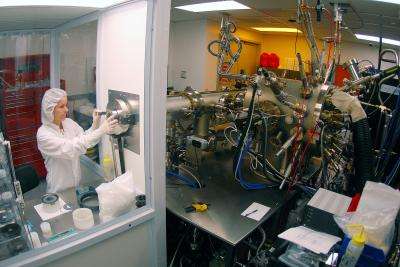
Sabine Freisem, a senior research scientist who has been collaborating with Deppe for the past eight years, works on lasers in their UCF lab. Credit: UCF
A new laser device created at the University of Central Florida could make high-speed computing faster and more reliable, opening the door to a new age of the Internet.
Professor Dennis Deppe's miniature laser diode emits more intense light than those currently used. The light emits at a single wavelength, making it ideal for use in compact disc players, laser pointers and optical mice for computers, in addition to high-speed data transmission.
Until now, the biggest challenge has been the failure rate of these tiny devices. They don't work very well when they face huge workloads; the stress makes them crack.
The smaller size and elimination of non-semiconductor materials means the new devices could potentially be used in heavy data transmission, which is critical in developing the next generation of the Internet. By incorporating laser diodes into cables in the future, massive amounts of data could be moved across great distances almost instantaneously. By using the tiny lasers in optical clocks, the precision of GPS and high-speed wireless data communications also would increase.
"The new laser diodes represent a sharp departure from past commercial devices in how they are made," Deppe said from his lab inside the College of Optics and Photonics. "The new devices show almost no change in operation under stress conditions that cause commercial devices to rapidly fail."
"At the speed at which the industry is moving, I wouldn't be surprised if in four to five years, when you go to Best Buy to buy cables for all your electronics, you'll be selecting cables with laser diodes embedded in them," he added.
Deppe and Sabine Freisem, a senior research scientist who has been collaborating with Deppe for the past eight years, presented their findings in January at the SPIE Photonics West conference in San Francisco, where PhysOrg.com participated as a media sponsor.
Deppe has spent 21 years researching semiconductor lasers, and he is considered an international expert in the area. sdPhotonics is working on the commercialization of many of his creations and has several ongoing contracts.
"This is definitely a milestone," Freisem said. "The implications for the future are huge."
But there is still one challenge that the team is working to resolve. The voltage necessary to make the laser diodes work more efficiently must be optimized
Deppe said once that problem is resolved, the uses for the laser diodes will multiply. They could be used in lasers in space to remove unwanted hair.
"We usually have no idea how often we use this technology in our everyday life already," Deppe said. "Most of us just don't think about it. With further development, it will only become more commonplace."
Deppe joined UCF in 2006 after several years at the University of Texas at Austin. He has a Ph.D. in Electrical Engineering from the University of Illinois, and he has earned many prestigious awards. He was the 1999 Optical Society of America Nicholas Holonyak Award winner and was named a fellow by the OSA and Institute of Electrical and Electronics Engineers in 2000.
Freisem has a Ph.D. in Physics from Leiden University in the Netherlands. She worked with Deppe at UT before moving to UCF in 2006.
-
New quantum cascade lasers emit more light than heat
Jan 11, 2010 |
not rated yet |
0
-
Sharp to Begin Volume Production of High-Power 210-mW Blue-Violet Laser Diodes
Mar 14, 2007 |
not rated yet |
0
-
Sharp's New Semiconductor Laser for Triple- and Quadruple- Layer Blu-ray Discs
Sep 18, 2009 |
not rated yet |
0
-
UCF Research Aimed at Protecting Pilots, Soldiers From Blinding Lasers
Jun 19, 2004 |
not rated yet |
0
-
Will high-density PICs be the next big thing?
Jan 05, 2010 |
not rated yet |
0
-
Stars containing dark matter should look different from other stars
Feb 20, 2012 |
4.5 / 5 (17) |
11
-
Physicists discover evidence of rare hypernucleus, a component of strange matter
Feb 17, 2012 |
4.7 / 5 (38) |
22
-
Fast photon control brings quantum photonic technologies closer
Feb 13, 2012 |
5 / 5 (8) |
1
-
Engineers build first sub-10-nm carbon nanotube transistor
Feb 01, 2012 |
4.9 / 5 (36) |
32
-
Something old, something new: Evolution and the structural divergence of duplicate genes
Jan 31, 2012 |
4.6 / 5 (7) |
1
-
linear wave equation vs. linear system
1 hour ago
-
adhesive force and surface tension
1 hour ago
-
Newbie here.
3 hours ago
-
Rainbows in space?
3 hours ago
-
taking mechanical physics next fall
5 hours ago
-
Help: maximum force of an object when given impulse and time on a graph
8 hours ago
- More from Physics Forums - General Physics
More news stories
Researchers build first physical 'metatronic' circuit
(PhysOrg.com) -- The technological world of the 21st century owes a tremendous amount to advances in electrical engineering, specifically, the ability to finely control the flow of electrical charges using ...
10 hours ago |
4.7 / 5 (17) |
5
|
Faster than light neutrinos? More like faulty wiring
You can shelf your designs for a warp drive engine (for now) and put the DeLorean back in the garage; it turns out neutrinos may not have broken any cosmic speed limits after all.
9 hours ago |
4.2 / 5 (22) |
23
|
Physicists surprised by disappearing and reappearing superconductivity in iron selenium chalcogenides
Superconductivity is a rare physical state in which matter is able to conduct electricity -- maintain a flow of electrons -- without any resistance. This phenomenon can only be found in certain materials at low temperatures, ...
13 hours ago |
5 / 5 (5) |
2
|
Less is more: Study of tiny droplets could have big impact on industrial applications
(PhysOrg.com) -- Under a microscope, a tiny droplet slides between two fine hairs like a roller coaster on a set of rails until poof it suddenly spreads along them, a droplet no more.
10 hours ago |
3.7 / 5 (3) |
0
|
Study reveals switching mechanism in promising computer memory device
(PhysOrg.com) -- Sometimes knowing that a new technology works is not enough. You also must know why it works to get marketplace acceptance. New information from the National Institute of Standards and Technology ...
17 hours ago |
4 / 5 (4) |
0
|
Spitzer finds solid buckyballs in space
(PhysOrg.com) -- Astronomers using data from NASA's Spitzer Space Telescope have, for the first time, discovered buckyballs in a solid form in space. Prior to this discovery, the microscopic carbon spheres ...
Stanford research team cracks animated NuCaptcha
(PhysOrg.com) -- The research team from Stanford University, led by Elie Bursztein, that previously had cracked regular CAPTCHAs and then audio CAPTCHAs, now has also successfully cracked the animated version called NuCapt ...
CT colonography shown to be comparable to standard colonoscopy
Computerized tomographic (CT) colonography (CTC), also known as virtual colonoscopy, is comparable to standard colonoscopy in its ability to accurately detect cancer and precancerous polyps in people ages 65 and older, according ...
Going up: Japan builder eyes space elevator
A Japanese construction firm claimed Wednesday it could execute an out-of-this-world plan to put tourists in space within 40 years by building an elevator that stretches a quarter of the way to the moon.
Scientists create potent molecules aimed at treating muscular dystrophy
While RNA is an appealing drug target, small molecules that can actually affect its function have rarely been found. But now scientists from the Florida campus of The Scripps Research Institute have for the first time designed ...
Flesh-eating bacteria inspire superglue
(PhysOrg.com) -- A bio-inspired superglue has been developed by Oxford University researchers that cant be matched for sticking molecules together and not letting go.
Mar 15, 2011
Rank: 4.7 / 5 (3)
Kidding aside, I hope this technology pans out as it sounds highly beneficial.
Mar 15, 2011
Rank: not rated yet
Mar 15, 2011
Rank: 4 / 5 (1)
Mar 15, 2011
Rank: 5 / 5 (1)
Mar 16, 2011
Rank: not rated yet
Mar 16, 2011
Rank: not rated yet
With laser diodes we can make typos faster and more often. Can they grow a thiird arm and ayeball so people can textt and drive to their heart's content?
" They could be used in lasers in space to remove unwanted hair and grow that third arm and eye you've always wanted."