NASA releases picture of Mercury's surface (Update)
March 30, 2011
NASA releases picture of Mercury's surface

Enlarge

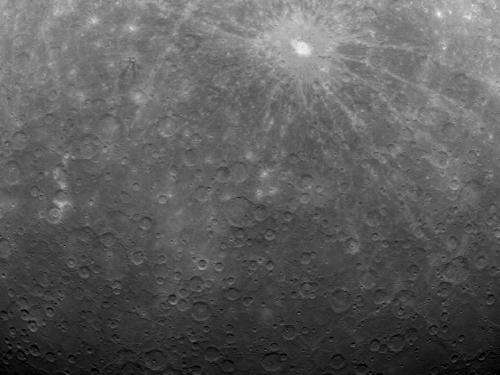
At 5:20 am EDT on Mar. 29, 2011, MESSENGER captured this historic image of Mercury. This image is the first ever obtained from a spacecraft in orbit about the Solar System's innermost planet. Over the subsequent six hours, MESSENGER acquired an additional 363 images before downlinking some of the data to Earth. The MESSENGER team is currently looking over the newly returned data, which are still continuing to come down. Image Credit: NASA/Johns Hopkins University Applied Physics Laboratory/Carnegie Institution of Washington

NASA on Tuesday released the first picture taken of Mercury's surface by the US space agency's orbiting Messenger craft.

"Early this morning, at 5:20 am EDT (0920 GMT), Messenger captured this historic image of Mercury," NASA said.

"This image is the first ever obtained from a spacecraft in orbit about the solar system's innermost planet."

The spacecraft snapped 363 images over the next six hours, and more were expected to be released Wednesday in conjunction with an expert press conference to discuss the findings.

The upper part of the image shows an unusual, dark-rayed crater called Debussy, while the lower part reveals a portion of Mercury near its south pole that has never before been witnessed by spacecraft, NASA said.

NASA's Messenger craft -- which stands for MErcury Surface, Space ENvironment, GEochemistry, and Ranging -- became the first vehicle to orbit Mercury on March 17.

Messenger was launched more than six years ago, traveling through the inner solar system and embarking on flybys of Earth, Venus and Mercury.

The first NASA craft to study Mercury since the Mariner mission more than three decades ago, Messenger has already been able to return a partial map of the planet's crater-filled surface after just a handful of flybys.

(c) 2011 AFP

4.7 /5 (14 votes)  

Filter


Move the slider to adjust rank threshold, so that you can hide some of the comments.


Display comments: newest first

_am_am_il
Mar 29, 2011

Rank: not rated yet
I wonder what those paths are leaving from the middle.. ??
eigenbasis
Mar 29, 2011

Rank: not rated yet
typo *seen not seeb
plasticpower
Mar 29, 2011

Rank: 5 / 5 (6)
They could have at least included a link to the images, now I have to go dig around NASA's website..
haversine
Mar 30, 2011

Rank: 5 / 5 (4)
Start the countdown until some goober claims they've spotted a pyramid or the face of Elvis.
Yellowdart
Mar 30, 2011

Rank: 5 / 5 (3)
Totally looks like the dark side of the moon... :)

I wonder what those paths are leaving from the middle.. ??


NASA picked a fight with a warlock?? :)
Lischyn
Mar 30, 2011

Rank: 5 / 5 (1)
Those paths are canals from a long gone advanced civilization that vacated Mercury when it got too hot and resettled on Mars.
Modernmystic
Mar 30, 2011

Rank: 5 / 5 (2)
Great, now how about we devote some resources to being able to get people back to LEO without having to rely on the Russians....
GSwift7
Mar 30, 2011

Rank: 5 / 5 (1)
Start the countdown until some goober claims they've spotted a pyramid or the face of Elvis


If you turn the picture upside down and and look at the top left corner and then adjust the contrast of your monitor to max and look at it through a glass of water then you can clearly see the score of the upcoming India/Pakistan cricket world cup. I've already placed my bet.

Also, if you look at it the normal way, it says "oooooooooo" all the way accross the planet. I think Mercury is surprised to see us. Either that or it's a message in monary code. /sarc
Bizzles13
Mar 30, 2011

Rank: 5 / 5 (2)

Also, if you look at it the normal way, it says "oooooooooo" all the way accross the planet. I think Mercury is surprised to see us. Either that or it's a message in monary code. /sarc


No silly, it's obviously made of Cheerios.
Yellowdart
Mar 30, 2011

Rank: 5 / 5 (2)
+1 to the both of you.
GSwift7
Mar 30, 2011

Rank: not rated yet
No silly, it's obviously made of Cheerios


We could both be right. The cherios could be saying "Oooooo". Think outside the box!!

If only the moon were still made of milk....
panorama
Mar 30, 2011

Rank: 5 / 5 (1)
If only the moon were still made of milk....

It curdled in to cheese about 6000 years ago.
Rank 4.7 /5 (14 votes)
Related Stories
Relevant PhysicsForums posts
  • Calculating the magnitude
    created2 hours ago
  • What is this spectrum I took?
    created12 hours ago
  • Orientation of Space
    created12 hours ago
  • Geologically Active Moon Now: NASA
    created19 hours ago
  • advice on building a science fair telescope
    createdFeb 22, 2012
  • Rise of the Sun
    createdFeb 22, 2012
  • More from Physics Forums - General Astronomy

More news stories

Spitzer finds solid buckyballs in space

(PhysOrg.com) -- Astronomers using data from NASA's Spitzer Space Telescope have, for the first time, discovered buckyballs in a solid form in space. Prior to this discovery, the microscopic carbon spheres ...

Space & Earth / Astronomy

created 14 hours ago | popularity 4.7 / 5 (12) | comments 8 | with audio podcast

Going up: Japan builder eyes space elevator

A Japanese construction firm claimed Wednesday it could execute an out-of-this-world plan to put tourists in space within 40 years by building an elevator that stretches a quarter of the way to the moon.

Space & Earth / Space Exploration

created 21 hours ago | popularity 3.5 / 5 (13) | comments 26

ENASA satellite finds Earth's clouds are getting lower

(PhysOrg.com) -- Earth's clouds got a little lower -- about one percent on average -- during the first decade of this century, finds a new NASA-funded university study based on NASA satellite data. The results ...

Space & Earth / Earth Sciences

created 18 hours ago | popularity 5 / 5 (8) | comments 13 | with audio podcast

Fresh scandal embroils US climate science debate

A fresh scandal over climate change has erupted in the United States after leaked documents appeared to show a right-wing funded campaign to influence how climate science is taught in schools.

Space & Earth / Environment

created 10 hours ago | popularity 4.1 / 5 (9) | comments 8

World's oceans get an acid bath

Among the repercussions of global climate change, the effect of ocean acidification on marine life is one of the least-understood variables.

Space & Earth / Environment

created 17 hours ago | popularity 4.3 / 5 (6) | comments 4 | with audio podcast


Researchers build first physical 'metatronic' circuit

(PhysOrg.com) -- The technological world of the 21st century owes a tremendous amount to advances in electrical engineering, specifically, the ability to finely control the flow of electrical charges using ...

Faster than light neutrinos? More like faulty wiring

You can shelf your designs for a warp drive engine (for now) and put the DeLorean back in the garage; it turns out neutrinos may not have broken any cosmic speed limits after all.

Physicists surprised by disappearing and reappearing superconductivity in iron selenium chalcogenides

Superconductivity is a rare physical state in which matter is able to conduct electricity -- maintain a flow of electrons -- without any resistance. This phenomenon can only be found in certain materials at low temperatures, ...

CT colonography shown to be comparable to standard colonoscopy

Computerized tomographic (CT) colonography (CTC), also known as virtual colonoscopy, is comparable to standard colonoscopy in its ability to accurately detect cancer and precancerous polyps in people ages 65 and older, according ...

Stanford research team cracks animated NuCaptcha

(PhysOrg.com) -- The research team from Stanford University, led by Elie Bursztein, that previously had cracked regular CAPTCHAs and then audio CAPTCHAs, now has also successfully cracked the animated version called NuCapt ...

Study: Virtual colonoscopy effective screening tool for adults over 65

Computed tomography (CT) colonography can be used as a primary screening tool for colorectal cancer in adults over the age of 65, according to a new study published online in the journal Radiology.