Paleo-Indians settled North America earlier than thought: study
March 24, 2011
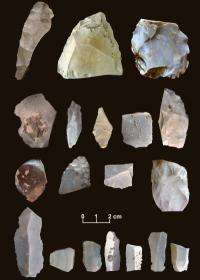
These are some of the artifacts from the 15,500-year-old horizon. Credit: [Image courtesy of Michael R. Waters]
New discoveries at a Central Texas archaeological site by a Texas A&M University-led research team prove that people lived in the region far earlier as much as 2,500 years earlier than previously believed, rewriting what anthropologists know about when the first inhabitants arrived in North America. That pushes the arrival date back to about 15,500 years ago.
Michael Waters, director of Texas A&M's Center for the Study of First Americans, along with researchers from Baylor University, the University of Illinois-Chicago, the University of Minnesota, and Texas State University, have found the oldest archaeological evidence for human occupation in Texas and North America at the Debra L.
Friedkin site, located about 40 miles northwest of Austin. Their work is published in the current issue of Science magazine.
Waters says that buried in deposits next to a small spring-fed stream is a record of human occupation spanning the last 15,500 years. Near the surface is the record of the Late Prehistoric and Archaic occupants of the region. Buried deeper in the soil are layers with Folsom and Clovis occupations going back 12,000 to 13,000 years ago.
"But the kicker was the discovery of nearly 16,000 artifacts below the Clovis horizon that dated to 15,500 years ago," Waters notes.
"Most of these are chipping debris from the making and resharpening of tools, but over 50 are tools. There are bifacial artifacts that tell us they were making projectile points and knives at the site," Waters says. There are expediently made tools and blades that were used for cutting and scraping."
Multiple studies have shown that the site is undisturbed and that the artifacts are in place and over 60 "luminescence dates" show that early people arrived at the site by 15,500 years ago, Waters explains. Luminescence dating technique is a method used to date the sediment surrounding the artifacts. It dates the last time the sediment was exposed to sunlight.
For more than 80 years, it has been argued that the Clovis people were the first to enter the Americas, Waters says. He goes on to say that over the last few decades, there have been several credible sites which date older than Clovis found in North America -- specifically in Wisconsin, Pennsylvania, Florida, and Oregon.
"However, this evidence is not very robust," Waters observes.
"What is special about the Debra L. Friedkin site is that it has the largest number of artifacts dating to the pre-Clovis time period, that these artifacts show an array of different technologies, and that these artifacts date to a very early time.
"This discovery challenges us to re-think the early colonization of the Americas. There's no doubt these tools and weapons are human-made and they date to about 15,500 years ago, making them the oldest artifacts found both in Texas and North America."
This video is not supported by your browser at this time.
Waters has been working at the site since 2006, and analysis of the artifacts collected from the site is ongoing. Waters says, "These studies will help us figure out where these people came from, how they adapted to the new environments they encountered, and understand the origins of later groups like Clovis."-
Six North American sites hold 12,900-year-old nanodiamond-rich soil
Jan 01, 2009 |
not rated yet |
0
-
No evidence for ancient comet or Clovis catastrophe, archaeologists say
Sep 29, 2010 |
not rated yet |
0
-
The voyage to America: Fossilized human feces reveals the first immigrants
Apr 03, 2008 |
not rated yet |
0
-
13,000-Year-Old Stone Tool Cache in Colorado Shows Evidence of Camel, Horse Butchering
Feb 25, 2009 |
not rated yet |
0
-
Clovis-age overkill didn't take out California's flightless sea duck
Mar 17, 2008 |
not rated yet |
0
-
Stars containing dark matter should look different from other stars
Feb 20, 2012 |
4.5 / 5 (17) |
11
-
Physicists discover evidence of rare hypernucleus, a component of strange matter
Feb 17, 2012 |
4.7 / 5 (38) |
22
-
Fast photon control brings quantum photonic technologies closer
Feb 13, 2012 |
5 / 5 (8) |
1
-
Engineers build first sub-10-nm carbon nanotube transistor
Feb 01, 2012 |
4.9 / 5 (36) |
32
-
Something old, something new: Evolution and the structural divergence of duplicate genes
Jan 31, 2012 |
4.6 / 5 (7) |
1
-
Eye biology videos
4 hours ago
-
Flowering Plant Revived After 30,000 Years in Permafrost
Feb 21, 2012
-
Toba volcano eruptions - 1.000 - 10,000 breeding pairsunb
Feb 20, 2012
-
How is a specific gene removed from DNA
Feb 20, 2012
-
Reproduction and Human evolution
Feb 19, 2012
-
Viruses: Living or Non-living organisms
Feb 19, 2012
- More from Physics Forums - Biology
More news stories
Global influence of U.S. Constitution on the decline, study reveals
The U.S. Constitution's global influence is on the decline, finds a new study by David S. Law, JD, PhD, professor of law at Washington University in St. Louis.
Other Sciences / Economics & Business
17 hours ago |
4.5 / 5 (2) |
8
Immigration chief seeks to reassure Silicon Valley
(AP) -- The Obama administration's top immigration official said Wednesday he wants to keep more foreign-born high-tech entrepreneurs in the U.S. But to make that happen, he said he needs those entrepreneurs to turn their ...
9 hours ago |
5 / 5 (2) |
0
What is the value of a green card? Researcher calculates increase in income
Just what does it mean to get a green card? To some applicants, about $1,000 each month.
Other Sciences / Economics & Business
16 hours ago |
not rated yet |
2
Increasingly, children's books are where the wild things aren't: study
Was your favorite childhood book crawling with wild animals and set in places like jungles or deep forests? Or did it take place inside a house or in a city, with few if any untamed creatures in sight?
Other Sciences / Social Sciences
11 hours ago |
4.8 / 5 (4) |
0
Ancient rock art found in Brazil
Researchers have discovered an extremely old anthropomorphic figure engraved in rock in Brazil, according to a report published Feb. 22 in the open access journal PLoS ONE.
Other Sciences / Archaeology & Fossils
9 hours ago |
4.5 / 5 (4) |
0
Researchers build first physical 'metatronic' circuit
(PhysOrg.com) -- The technological world of the 21st century owes a tremendous amount to advances in electrical engineering, specifically, the ability to finely control the flow of electrical charges using ...
Spitzer finds solid buckyballs in space
(PhysOrg.com) -- Astronomers using data from NASA's Spitzer Space Telescope have, for the first time, discovered buckyballs in a solid form in space. Prior to this discovery, the microscopic carbon spheres ...
Faster than light neutrinos? More like faulty wiring
You can shelf your designs for a warp drive engine (for now) and put the DeLorean back in the garage; it turns out neutrinos may not have broken any cosmic speed limits after all.
Physicists surprised by disappearing and reappearing superconductivity in iron selenium chalcogenides
Superconductivity is a rare physical state in which matter is able to conduct electricity -- maintain a flow of electrons -- without any resistance. This phenomenon can only be found in certain materials at low temperatures, ...
CT colonography shown to be comparable to standard colonoscopy
Computerized tomographic (CT) colonography (CTC), also known as virtual colonoscopy, is comparable to standard colonoscopy in its ability to accurately detect cancer and precancerous polyps in people ages 65 and older, according ...
Stanford research team cracks animated NuCaptcha
(PhysOrg.com) -- The research team from Stanford University, led by Elie Bursztein, that previously had cracked regular CAPTCHAs and then audio CAPTCHAs, now has also successfully cracked the animated version called NuCapt ...
Mar 25, 2011
Rank: 5 / 5 (1)
It would seem that a large part of any attempt at research into ancient American humanity has been systematically repressed for half a century.
There should be a 'Zawi Hawass Award' for the Clovis first and only luddites.
Mar 25, 2011
Rank: not rated yet
Mar 25, 2011
Rank: not rated yet
One of the most controversial archaeological sites in the Western Hemisphere is located in the Mojave Desert of California, near the town of Barstow.
The alluvial fan deposits are uniquely deep stratum layers. In 1980, Drs. James Bischoff, Richard Ku, and Roy Shlemon estimated that the soils at this site may date back to over 200,000 years, using a uranium-thorium dating process on the surrounding strata.
The site displays far earlier evidence for the presence of tool-making humans in the Americas. The site has been accepted by the majority of the archaeological community. The Calico site has been developed since 1964 by Ruth DeEtte Simpson with the active involvement of Louis B. Leakey.
Mar 26, 2011
Rank: not rated yet