Quantum engineers remove roadblock in developing next-generation technologies
March 8, 2011
Quantum engineers remove roadblock in developing next-generation technologies

Enlarge

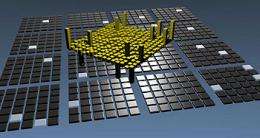
From just 18 randomly selected white tiles (representing measurements) out of a potential 576, the researchers were able to estimate the behaviour of a quantum device (illustrated by the yellow section). Image credit: Alessandro Fedrizzi

(PhysOrg.com) -- An international team has removed a major obstacle to engineer quantum systems that will play a key role in the computers, communication networks, and even biomedical devices of the future.

With the process of miniaturisation advancing by the day, will come to dominate our everyday lives.

At present it is extremely difficult to characterise — the number of measurements required increases exponentially with the number of quantum parts. For example, an 8-qubit quantum computer would require over a billion measurements.

“Imagine that you're building a car but you can't test-drive it. This is the situation that quantum engineers are facing at the moment,” said University of Queensland's Dr Alessandro Fedrizzi, co-author of the study that was recently published in .

“We have now found a way to test quantum devices efficiently, which will help transform them from small-scale laboratory experiments to real-world applications.”

The team also include UQ collaborators Dr Marcelo de Almeida, Professor Andrew White and PhD student Matthew Broome, as well as researchers from Princeton University, the Massachusetts Institute of Technology (MIT), and SC Solutions, Inc. The researchers adapted techniques from “compressive sensing”, a hugely successful mathematical data compression method and for the first time, have applied it to experimental quantum research.

“Audio signals have natural patterns which can be compressed to vastly smaller size without a significant quality loss: this means we now store in a single CD what used to take hundreds. In the same way, compressive sensing now allows us to drastically simplify the measurement of quantum systems,” said Dr Alireza Shabani, the study's main author from Princeton University.

“A common example for data compression is a Sudoku puzzle: only a few numbers will allow you to fill in the whole grid. Similarly, we can now estimate the behaviour of a quantum device from just a few key parameters,” said co-author Dr Robert Kosut from SC Solutions, Inc., who developed the algorithm with Dr Shabani, Dr Masoud Mohseni (MIT) and Professor Hershel Rabitz (Princeton University).

The researchers tested their compressive sensing algorithm on a photonic two-qubit quantum computer built at UQ, and demonstrated they could obtain high-fidelity estimates from as few as 18 measurements, compared to the 240 normally required.

The team expects its technique could be applied in a wide range of architectures including quantum-based computers, , metrology devices and even biotechnology.

More information: The paper, "Efficient Measurement of Quantum Dynamics via Compressive Sensing," by A. Shabani et al., was published in the March 2011 edition of Physical Review Letters. DOI:10.1103/PhysRevLett.106.100401

Provided by University of Queensland (news : web)

4.9 /5 (21 votes)  

Filter


Move the slider to adjust rank threshold, so that you can hide some of the comments.


Display comments: newest first

bimachakti
Mar 08, 2011

Rank: 5 / 5 (2)
The Quantum Technology..
apex01
Mar 08, 2011

Rank: 5 / 5 (2)
I hear about so many quantum tech breakthroughs. So when will there be a quantum desktop computer on my desk?
Jaeherys
Mar 08, 2011

Rank: 1 / 5 (1)
Not for a while I'd expect :(. Oh it would be nice to transfer my brain into a quantum computer!
SmartK8
Mar 08, 2011

Rank: 5 / 5 (1)
apex01: You're having it right now, just in a different universe. But I guess some of those computers will share their states with the one you'll have in the near future. This reminds me, that the universe which will get the quantum computing will make the results invalid for fine couple of billions of other universes. Let's hope MWI (many-worlds interpretation) is just wrong.
syhprum
Mar 09, 2011

Rank: not rated yet
Is there any possibility that these new mathematical tehniques will allow quantum type calculations to be done on a conventual type computer.
Russell_Kirkby
Mar 11, 2011

Rank: not rated yet
Sure; by using ur PC as a terminal.
Rank 4.9 /5 (21 votes)
Related Stories
Relevant PhysicsForums posts
  • slit width order of wavelength
    created3 hours ago
  • Non-Uniform Charge Distribution of a Metal Cone
    created7 hours ago
  • velocity from acceleration if acceleration is a function of space...
    created10 hours ago
  • Electrohydroconvection Engine?
    created12 hours ago
  • Question about entropy=0 in an irreversible process
    created12 hours ago
  • Question about Firing tank shell in freefall
    created14 hours ago
  • More from Physics Forums - Classical Physics

More news stories

Researchers build first physical 'metatronic' circuit

(PhysOrg.com) -- The technological world of the 21st century owes a tremendous amount to advances in electrical engineering, specifically, the ability to finely control the flow of electrical charges using ...

Physics / General Physics

created 10 hours ago | popularity 4.7 / 5 (17) | comments 5 | with audio podcast

Faster than light neutrinos? More like faulty wiring

You can shelf your designs for a warp drive engine (for now) and put the DeLorean back in the garage; it turns out neutrinos may not have broken any cosmic speed limits after all.

Physics / General Physics

created 9 hours ago | popularity 4.2 / 5 (22) | comments 23 | with audio podcast

Physicists surprised by disappearing and reappearing superconductivity in iron selenium chalcogenides

Superconductivity is a rare physical state in which matter is able to conduct electricity -- maintain a flow of electrons -- without any resistance. This phenomenon can only be found in certain materials at low temperatures, ...

Physics / Superconductivity

created 13 hours ago | popularity 5 / 5 (5) | comments 2 | with audio podcast

Less is more: Study of tiny droplets could have big impact on industrial applications

(PhysOrg.com) -- Under a microscope, a tiny droplet slides between two fine hairs like a roller coaster on a set of rails until — poof — it suddenly spreads along them, a droplet no more.

Physics / General Physics

created 10 hours ago | popularity 3.7 / 5 (3) | comments 0 | with audio podcast

Study reveals switching mechanism in promising computer memory device

(PhysOrg.com) -- Sometimes knowing that a new technology works is not enough. You also must know why it works to get marketplace acceptance. New information from the National Institute of Standards and Technology ...

Physics / General Physics

created 17 hours ago | popularity 4 / 5 (4) | comments 0 | with audio podcast


Spitzer finds solid buckyballs in space

(PhysOrg.com) -- Astronomers using data from NASA's Spitzer Space Telescope have, for the first time, discovered buckyballs in a solid form in space. Prior to this discovery, the microscopic carbon spheres ...

Stanford research team cracks animated NuCaptcha

(PhysOrg.com) -- The research team from Stanford University, led by Elie Bursztein, that previously had cracked regular CAPTCHAs and then audio CAPTCHAs, now has also successfully cracked the animated version called NuCapt ...

CT colonography shown to be comparable to standard colonoscopy

Computerized tomographic (CT) colonography (CTC), also known as virtual colonoscopy, is comparable to standard colonoscopy in its ability to accurately detect cancer and precancerous polyps in people ages 65 and older, according ...

Going up: Japan builder eyes space elevator

A Japanese construction firm claimed Wednesday it could execute an out-of-this-world plan to put tourists in space within 40 years by building an elevator that stretches a quarter of the way to the moon.

Scientists create potent molecules aimed at treating muscular dystrophy

While RNA is an appealing drug target, small molecules that can actually affect its function have rarely been found. But now scientists from the Florida campus of The Scripps Research Institute have for the first time designed ...

Flesh-eating bacteria inspire superglue

(PhysOrg.com) -- A bio-inspired superglue has been developed by Oxford University researchers that can’t be matched for sticking molecules together and not letting go.