Samsung begins mass production of 'transparent' LCD panel
March 31, 2011
Samsung begins mass production of transparent LCD panel

Enlarge

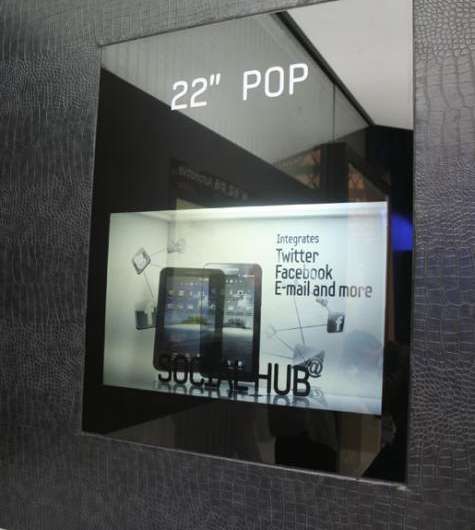
Samsung Electronics announced today that it began mass production of the 22-inch transparent LCD panel in March this year.

The panels come in two colors, the black-and-white type and the color type, and they have a of 500:1 with WSXGA+(1680*1050) resolution.

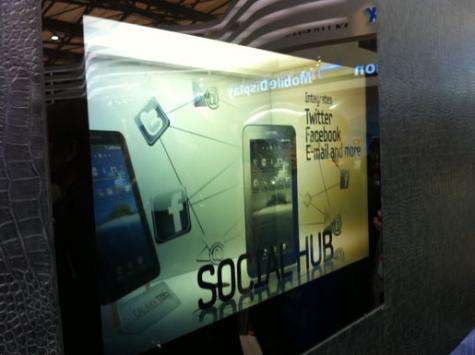
Compared with the conventional LCD panels that use back light unit (BLU) and have 5% transparency, Samsung’s transparent boasts the world’s best transparency rate of over 20% for the black-and-white type and over 15% for the color type.

The transparent LCD panel has a high transparency rate, which enables a person to look right through the panel like glass, and it consumes 90% less electricity compared with a conventional LCD panel using back light unit.

It’s because a transparent LCD panel utilizes ambient light such as sun light, which consequently reduces the dependency on electricity for generating power.
Samsung begins mass production of transparent LCD panel
Enlarge


Also, Samsung’s transparent LCD panel maximizes convenience for not only manufacturers but also consumers by incorporating the High Definition Multimedia Interface (HDMI) and the Universal Serial Bus (USB) interface.

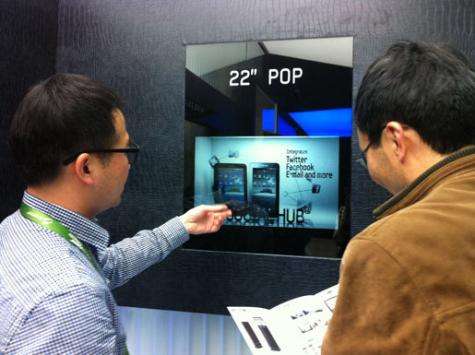
Transparent display panels have endless possibilities as an advertising tool, which can be applied to show windows and outdoor billboards or used in showcase events.

Corporations and schools can also adopt the panel as an interactive communication device, which enables information to be displayed more effectively.
Samsung begins mass production of transparent LCD panel
Enlarge


Younghwan Park, a senior vice president of Samsung Electronics LCD Business, said, “Transparent displays will have a wide range of use in all industry areas as an efficient tool for delivering information and communication. With the world’s first of the transparent LCD panel, Electronics plans to lead the global transparent LCD market by developing various applications.”

Source: Samsung

4.1 /5 (8 votes)  

Filter


Move the slider to adjust rank threshold, so that you can hide some of the comments.


Display comments: newest first

Roidsofsteel
Mar 31, 2011

Rank: 1 / 5 (7)
Who cares! Just more junk to keep coporations in business.
J-n
Mar 31, 2011

Rank: 3 / 5 (2)
For some reason i dont think that these transparent displays are as important of a technology as they seem to be making them out to be.

They're a few % more electrically efficient, they've only got a 500:1 contrast ratio, and a measly 1680X1050 resolution.

All of the things they're saying this new monitor would be great at, current monitors do a great job with already. I guess i'm really not understanding this tech..

It just seems like they've come up with a new paint color for cars and are saying it'll spark a revolution in the automotive industry.
SmaryJerry
Mar 31, 2011

Rank: 4 / 5 (1)
Agreed. I don't see the potential. Althought it's kind of cool.
jselin
Mar 31, 2011

Rank: 4.9 / 5 (7)
Digital overlays! While 20% transparency isnt great its a start. Imagine a window in a vehicle that displays information overlaid on your view of the world. Basically taking the heads up display idea to the next level.

A far far more mature version of this tech could potentially show a pilot where a bogie is in relation to him over the entire cockpit glass. (while simultaneously blotting out glare from the sun)
J-n
Mar 31, 2011

Rank: 5 / 5 (2)
Well if this is a stepping stone for displays that are completely transparent this makes more sense.

Though i think right now pilots do have heads up displays with target tracking etc through an eyepiece connected to their helmets, and other heads up displays in various aircraft.

Take a look at the wiki page for heads-up display, it talks about how the tech is progressing and how (much more often than i thought) it's currently used.

poof
Mar 31, 2011

Rank: 4 / 5 (3)
Digital overlays! While 20% transparency isnt great its a start. Imagine a window in a vehicle that displays information overlaid on your view of the world. Basically taking the heads up display idea to the next level.


This already exists in consumer sports cars, ive seen it myself. I believe they do this through the use of a small projector aiming up from the dash onto the windshield.

This tech is a novelty at best, and probably not a very effective one given they didnt even have anything behind the demo to illustrate it.
neiorah
Apr 01, 2011

Rank: 1 / 5 (1)
More stuff to buy to keep up with the Jones
EWH
Apr 01, 2011

Rank: 5 / 5 (1)
One application for high-transparency LCDs I came up with a few years ago (and found had also been proposed by others) is to enhance the dynamic range of cameras. By putting a small, high-resolution transparent LCD near a focal plane inside the lens (eg at the iris), light can be selectively reduced in highlight regions. Taken to the limit, pictures could be taken even while all pixels on the sensor read a uniform value. The LCD does not have to be the same resolution as the sensor - in works rather like the inverse of putting a coarse matrix of variable LEDs to backlight a display and improve its contrast.

This method could be particularly applicable to video cameras as an improvement on the internal neutral density filters found in professional camcorders, which allow more flexibility in using wider apertures and longer exposures. Samsung is always looking for ways to differentiate its camera offerings, and this could be a way to do so. (DP review just called for adding ND filters.
CreepyD
Apr 01, 2011

Rank: not rated yet
Once it gets more transparent, yeah I can see a few uses for it. Until then, I'm not so sure.
jscroft
Apr 04, 2011

Rank: 5 / 5 (1)
@Roidsofsteel: Yeah, man, corporations are evil! <-- Pointing and laughing. Jackass.
Blakut
Apr 05, 2011

Rank: not rated yet
@EWH What about diffraction spikes?
Eikka
Apr 05, 2011

Rank: 5 / 5 (1)
Good call on the camera. There is one slight problem of polarization though, because an LCD is inherently also a polarization filter, so it blocks out things like reflections from surfaces depending on their orientation.

High transparency LCD can be used for sunlight readable reflective display panels that run without a backlight, in e-readers and billboards. That's the main point.

Or you can put it on a lightbox, and display product information over the real product inside the box, potentially even layering them to produce a 3D image out of slices.

A HUD it won't be, because putting one on the windscreen of a car would require that you focus your eyes in close, which would make everything behind the screen look blurred. Real HUDs use optics to put the image to "infinity" so you can see it clearly at the same time as you're looking at the road ahead.
EWH
Apr 20, 2011

Rank: not rated yet
Re: diffraction spikes - I don't know. A sufficiently coarse resolution would likely help, and the effect should be attenuated by the fact that the pixels are seldom fully opaque. The reduction in light which allows a wider aperture should cut down on overall diffraction loss of resolution, and the increased contrast should further make the screen's diffraction less noticeable. The shallower depth of field should also make more out-of-focus areas where diffractive spikes aren't noticeable. Putting the LCD right at the image plane could also be a solution if spikes are a problem.

The polarization effects could be an issue occasionally, but I think that usually having a polarizer would be an advantage. The LCD should be capable of being pulled out of the optical path anyway to allow better low-light performance.
Rank 4.1 /5 (8 votes)
Relevant PhysicsForums posts

More news stories

PlayStation Vita game gadgets debut outside Asia

Sony's slick PlayStation Vita handheld videogame gadget hit major markets around the world on Wednesday as the Japanese entertainment titan bucked a trend towards play on smartphones.

Electronics / Consumer & Gadgets

created 11 hours ago | popularity not rated yet | comments 0

Energy-recycling computer technology from UM goes global through AMD

An energy-recycling computer circuit born at the University of Michigan will enable a new generation of power efficient laptop PCs and servers.

Electronics / Hardware

created 19 hours ago | popularity 5 / 5 (1) | comments 0

Review: Vita sets new standard for portable games

(AP) -- The PlayStation Vita won't replace your smartphone. For starters, it isn't a telephone (although it will eventually let you use Skype). And it's too big to fit in your pants pocket, unless you're wearing ...

Electronics / Consumer & Gadgets

created Feb 21, 2012 | popularity 3.7 / 5 (3) | comments 2

Engineering research brings seven adult-sized humanoid robots together for first time in US

Seven adult-sized humanoid robots took the stage during Drexel University's celebration of National Engineers Week, in a first-of-its-kind assembly of robotic technology. A showcase event on Feb. 20 introduced all seven of ...

Electronics / Robotics

created Feb 21, 2012 | popularity not rated yet | comments 2

British firm develops 'cheapest wireless tablet'

A British technology company claims to have developed the world's least expensive computer tablet for wireless Internet access.

Electronics / Consumer & Gadgets

created Feb 19, 2012 | popularity 4.6 / 5 (10) | comments 2


Researchers build first physical 'metatronic' circuit

(PhysOrg.com) -- The technological world of the 21st century owes a tremendous amount to advances in electrical engineering, specifically, the ability to finely control the flow of electrical charges using ...

Spitzer finds solid buckyballs in space

(PhysOrg.com) -- Astronomers using data from NASA's Spitzer Space Telescope have, for the first time, discovered buckyballs in a solid form in space. Prior to this discovery, the microscopic carbon spheres ...

Faster than light neutrinos? More like faulty wiring

You can shelf your designs for a warp drive engine (for now) and put the DeLorean back in the garage; it turns out neutrinos may not have broken any cosmic speed limits after all.

Physicists surprised by disappearing and reappearing superconductivity in iron selenium chalcogenides

Superconductivity is a rare physical state in which matter is able to conduct electricity -- maintain a flow of electrons -- without any resistance. This phenomenon can only be found in certain materials at low temperatures, ...

Stanford research team cracks animated NuCaptcha

(PhysOrg.com) -- The research team from Stanford University, led by Elie Bursztein, that previously had cracked regular CAPTCHAs and then audio CAPTCHAs, now has also successfully cracked the animated version called NuCapt ...

Going up: Japan builder eyes space elevator

A Japanese construction firm claimed Wednesday it could execute an out-of-this-world plan to put tourists in space within 40 years by building an elevator that stretches a quarter of the way to the moon.