Scientists plan to drill all the way down to the Earth's mantle
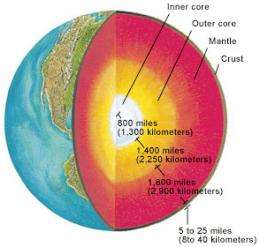
March 25, 2011 by Bob Yirka
Credit: World Book illustration by Raymond Perlman and Steven Brayfield, Artisan-Chicago
(PhysOrg.com) -- In what can only be described as a mammoth undertaking, scientists, led by British co-chiefs, Dr Damon Teagle of the National Oceanography Centre in Southampton, England and Dr Benoit Ildefonse from Montpellier University in France, have announced jointly in an article in Nature that they intend to drill a hole through the Earths crust and into the mantle; a feat never before accomplished, much less seriously attempted.
The Earths mantle is the part of the planet that lies between the crust and the iron ball at its center, and to reach it, would require drilling down from a position in the ocean, because the crust is much thinner there. Even still, it would mean drilling through five miles of solid rock. And if that doesnt sound hard enough, temperatures increase the farther down you go, and could reach as high as 1,050 degrees Fahrenheit; high enough to render useless most modern drill bits. Last but not least is the problem of atmospheric pressure, which increases the deeper you go, to somewhere in the neighborhood of 4 million pounds per square foot near the mantle. That last one may not seem like much of a problem, but with exploratory drilling, it becomes a problem rather quickly when you remember that its not just a hole they plan to dig, but a hole that can be used to extract samples from very far below.
To retrieve a sample, the drillers would have to rely on drills without a riser (drills that use double pipes for venting gases) which would mean pumping seawater down into the hole through the drill pipe with sufficient pressure to force whatever is being dug back up to the surface so that it can be examined.
This would not be the first time that a sample of the mantle would be recovered however, as volcanoes and such have been forcing under-crust material to the surface for eons; it would be the first time that a sample was found though that hasnt been tainted by the process that brought it up to us, and that scientists say, is worth whatever the cost might add up to over time as the project carries on through years of laborious drilling.
The pair plan to begin searching for a suitable site somewhere in the Pacific this spring, but dont expect the technology, nor the funding to allow them to start drilling till perhaps 2018.
© 2010 PhysOrg.com
-
Researchers drill historic hole in atlantic ocean floor
Apr 28, 2005 |
not rated yet |
0
-
Scientists penetrate fossil magma chamber beneath intact ocean crust
Apr 20, 2006 |
not rated yet |
0
-
Scientists dig toward center of the earth
Jan 16, 2006 |
not rated yet |
0
-
First riser-drilling research operations undertaken in Nankai Trough Seismogenic Zone
Jun 29, 2009 |
not rated yet |
0
-
Scientists' Drill Hits Magma: Only Third Time on Record
Jun 29, 2009 |
not rated yet |
0
-
Stars containing dark matter should look different from other stars
Feb 20, 2012 |
4.5 / 5 (17) |
11
-
Physicists discover evidence of rare hypernucleus, a component of strange matter
Feb 17, 2012 |
4.7 / 5 (38) |
22
-
Fast photon control brings quantum photonic technologies closer
Feb 13, 2012 |
5 / 5 (8) |
1
-
Engineers build first sub-10-nm carbon nanotube transistor
Feb 01, 2012 |
4.9 / 5 (36) |
32
-
Something old, something new: Evolution and the structural divergence of duplicate genes
Jan 31, 2012 |
4.6 / 5 (7) |
1
-
Is the Earth really going to die
14 hours ago
-
Do some geologists actually act a lot like Randy Marsh?
Feb 11, 2012
-
Discrepancy between oxygen and carbon-dioxide levels
Feb 09, 2012
-
where gems are found in the world
Feb 09, 2012
-
Wind Waves in Reservoir ~ Wind run-up and Wind set-up
Feb 08, 2012
-
Balance of oxygen in the atmosphere
Feb 01, 2012
- More from Physics Forums - Earth
More news stories
Spitzer finds solid buckyballs in space
(PhysOrg.com) -- Astronomers using data from NASA's Spitzer Space Telescope have, for the first time, discovered buckyballs in a solid form in space. Prior to this discovery, the microscopic carbon spheres ...
14 hours ago |
4.7 / 5 (12) |
8
|
Going up: Japan builder eyes space elevator
A Japanese construction firm claimed Wednesday it could execute an out-of-this-world plan to put tourists in space within 40 years by building an elevator that stretches a quarter of the way to the moon.
Space & Earth / Space Exploration
21 hours ago |
3.5 / 5 (13) |
26
ENASA satellite finds Earth's clouds are getting lower
(PhysOrg.com) -- Earth's clouds got a little lower -- about one percent on average -- during the first decade of this century, finds a new NASA-funded university study based on NASA satellite data. The results ...
Space & Earth / Earth Sciences
18 hours ago |
5 / 5 (8) |
13
|
Fresh scandal embroils US climate science debate
A fresh scandal over climate change has erupted in the United States after leaked documents appeared to show a right-wing funded campaign to influence how climate science is taught in schools.
10 hours ago |
4.1 / 5 (9) |
8
World's oceans get an acid bath
Among the repercussions of global climate change, the effect of ocean acidification on marine life is one of the least-understood variables.
17 hours ago |
4.3 / 5 (6) |
4
|
Researchers build first physical 'metatronic' circuit
(PhysOrg.com) -- The technological world of the 21st century owes a tremendous amount to advances in electrical engineering, specifically, the ability to finely control the flow of electrical charges using ...
Faster than light neutrinos? More like faulty wiring
You can shelf your designs for a warp drive engine (for now) and put the DeLorean back in the garage; it turns out neutrinos may not have broken any cosmic speed limits after all.
Physicists surprised by disappearing and reappearing superconductivity in iron selenium chalcogenides
Superconductivity is a rare physical state in which matter is able to conduct electricity -- maintain a flow of electrons -- without any resistance. This phenomenon can only be found in certain materials at low temperatures, ...
CT colonography shown to be comparable to standard colonoscopy
Computerized tomographic (CT) colonography (CTC), also known as virtual colonoscopy, is comparable to standard colonoscopy in its ability to accurately detect cancer and precancerous polyps in people ages 65 and older, according ...
Stanford research team cracks animated NuCaptcha
(PhysOrg.com) -- The research team from Stanford University, led by Elie Bursztein, that previously had cracked regular CAPTCHAs and then audio CAPTCHAs, now has also successfully cracked the animated version called NuCapt ...
Study: Virtual colonoscopy effective screening tool for adults over 65
Computed tomography (CT) colonography can be used as a primary screening tool for colorectal cancer in adults over the age of 65, according to a new study published online in the journal Radiology.
Mar 25, 2011
Rank: 2.3 / 5 (15)
Mar 25, 2011
Rank: 4.5 / 5 (12)
Mar 25, 2011
Rank: 2 / 5 (20)
Mar 25, 2011
Rank: 4.7 / 5 (9)
The Pacific isn't unstable dude.
Mar 25, 2011
Rank: 2.5 / 5 (11)
Mar 25, 2011
Rank: 3.7 / 5 (10)
Mar 25, 2011
Rank: 3.4 / 5 (5)
Mar 25, 2011
Rank: 2.9 / 5 (11)
Many, many years ago I was suppose to receive samples from the MOHOLE project to sample the Earth's mantle.
As I recall the project was cancelled after it was discovered that the contractor made a large contribution to then President Lyndon Baines Johnson !
In 1981 Professor Dwarka Das Sabu and I used the inventory of radiogenic and primordial noble gases in the Earth and its atmosphere to figure out how the Earth's core, mantle, crust, oceans and atmosphere formed.
"The noble gas record of the terrestrial planets", Geochemical Journal 15, 247-267 (1981).
www.omatumr.com/a...eGas.pdf
With kind regards,
Oliver K. Manuel
Former NASA Principal
Investigator for Apollo
Mar 25, 2011
Rank: 4.9 / 5 (8)
Mar 25, 2011
Rank: 1 / 5 (10)
Mar 25, 2011
Rank: 2 / 5 (9)
Mar 25, 2011
Rank: 3 / 5 (3)
Mar 25, 2011
Rank: 1 / 5 (5)
Mar 25, 2011
Rank: 4.7 / 5 (3)
Project Mohole, begun in 1961; see (http:) //en.wikipedia.org/wiki/Project_Mohole
The Kola Superdeep Borehole in Russia, begun in 1970; see (http:) //en.wikipedia.org/wiki/Kola_Superdeep_Borehole
Japan's Integrated Deep Ocean Drilling Program, begun in 2007; see (http:) //en.wikipedia.org/wiki/Chiky%C5%AB
I don't know that an oceanic location is *required*, but it is in some ways *easier*.
Mar 25, 2011
Rank: 5 / 5 (18)
Also, "pounds per square foot" is not a measure that is as familiar to most PhysOrg readers as is "pounds per square inch"; I suppose that psf was used because 4 million is a more impressive number than 27,800 (the approximate amount in psi). Writers, don't go for spectacular language at the expense of ease of comprehension. (Whichever number is used, though, it's still beyond direct imagining!)
Regardless of square feet or square inches, it would be useful to a large number of readers to express the pressure with a modern unit also: the pascal, the SI unit of pressure. (4,000,000 psf = 190 MPa)
Mar 25, 2011
Rank: 5 / 5 (8)
Mar 25, 2011
Rank: 5 / 5 (1)
Mar 25, 2011
Rank: 1 / 5 (1)
Mar 25, 2011
Rank: 2.8 / 5 (9)
Mar 25, 2011
Rank: 2.5 / 5 (2)
i like this idea
Mar 25, 2011
Rank: 2 / 5 (4)
Mar 25, 2011
Rank: 1.9 / 5 (7)
Mar 25, 2011
Rank: 5 / 5 (1)
However I will keep the dragon in my garage. Don't believe me? Prove the contrary :)
Mar 25, 2011
Rank: 1.6 / 5 (5)
Mar 26, 2011
Rank: 3 / 5 (2)
Hmmmmm......if it had ballast tanks like a submarine, holding liquid lead that could be automatically expelled at a specified depth, and a mechanical sample grabber.
Mar 26, 2011
Rank: 5 / 5 (4)
Mar 26, 2011
Rank: 4.5 / 5 (4)
All in all, seems like the money could be better spent.
Mar 26, 2011
Rank: 4.4 / 5 (5)
I don't understand why we aren't developing methods to tap into a virtually free, totally clean and unlimited source of power that literally sits beneath the feet of every person on the planet.
Mar 26, 2011
Rank: 3 / 5 (2)
Q=UAT and the A=Area is expensive. Who fails to do arithmetic is doomed to nonsense.
Mar 26, 2011
Rank: 3.2 / 5 (6)
Mar 26, 2011
Rank: 3.5 / 5 (6)
It's free in that no one owns the heat in the earth and it can't be owned by mineral rights like oil and gas. It's free because it is everywhere, if you have land to drill and you drill deep enough it's there. It's free in that it doesn't need prospecting to find.
It is obviously no more free to actually develop into energy than any other energy source but in all other respects it is a universal, unlimited, clean source that if developed can meet all our current and projected energy needs virtually forever without any harmful byproducts.
Mar 26, 2011
Rank: 4.7 / 5 (3)
Mar 26, 2011
Rank: 3 / 5 (2)
Mar 26, 2011
Rank: 2.3 / 5 (9)
Mar 26, 2011
Rank: 4.5 / 5 (8)
Bullshit.
"Most Scientists"? Let's see a citation for this wildly unsupportable claim.
Mar 26, 2011
Rank: 3 / 5 (2)
Mar 26, 2011
Rank: not rated yet
Mar 26, 2011
Rank: 4 / 5 (2)
Mar 26, 2011
Rank: 3 / 5 (2)
Mar 27, 2011
Rank: 1 / 5 (5)
Mar 27, 2011
Rank: 4.6 / 5 (9)
No, wait... they poke a hole in the crust... the oceans drain into it... oops!
No, wait... they poke a hole in the crust... and they find out the mantle is surprisingly made of cheese!
No, wait... they poke a hole in the crust... a giant eye looks at them... a beak starts hammering and pecking at the hole... the earth breaks apart... and out pops the mythical and mighty phoenix!
No, wait... they poke a hole in the crust... find the earth is hollow... and there's a lost world inside, full of dinosaurs!
...or aliens!
No, wait... they poke a hole in the crust... and a drill emerges just a few feet away... apparently from scientists poking a hole from another dimension!
No, wait... they poke a hole in the crust... the drill acts as a conductor to the earth's internal dynamo... ZAP!
Mar 27, 2011
Rank: 5 / 5 (1)
Or better yet, express it in bars or atms so that people would actually have some reference point of how much that is.
The Pascal is a very inconvinient unit because it's so small. Pretty much nobody even in metric countries knows how many Pa there is in a bicycle tire, because it's not simply "4", it's 400 or maybe it was kilos, so 400 000, or was it 40 000 or... who cares, I'll just use bars. It's four bars, approximately four times the normal air pressure.
190 MPa would be 1900 bars.
Mar 27, 2011
Rank: not rated yet
Mar 27, 2011
Rank: not rated yet
Mar 27, 2011
Rank: 5 / 5 (2)
Mar 27, 2011
Rank: 4.2 / 5 (5)
I recall a Tom Swift book where the young genius attempted this:
"Tom Swift and His Atomic Earth Blaster"
-Dont remember how it turned out-
Mar 27, 2011
Rank: 3.3 / 5 (4)
CO2 levels variing according to Earth's natural cycles? What form of heretical nonsense is this? Sheeple! Ignore this person who dares infuse facts into public discussion!!
Mar 27, 2011
Rank: 4.5 / 5 (2)
Mar 27, 2011
Rank: 5 / 5 (1)
Perhaps the collaterally co-generated geothermal could be used to power the drill? If the bore is continually cooled by the introducion of cold seawater, then the heat of the material will become less of an issue.
It would be nice to see what mineral facies are down there, since very few intact specimens make it to the surface due to changes in temp/hydro/pressure during their slow transport to the surface.
Mar 27, 2011
Rank: 5 / 5 (2)
It's off-topic, but the solar cycle(more narrowly Total Solar Irradiance), while certainly having an effect upon climate/change, is only one factor involved. If you additionally factor in that the Earth's orbit is now taking us into the distal part of the Northern Hemisphere's irradiance cycle, climate should be cooling -when in fact, we observe the opposite. Observation is contrary to expectation.
Quite a puzzle for the sheeple, eh?
Mar 27, 2011
Rank: not rated yet
Mar 27, 2011
Rank: 1 / 5 (1)
Mar 27, 2011
Rank: not rated yet
yeah, why not go in AT a volcano?
Mar 27, 2011
Rank: 1 / 5 (1)
Mar 28, 2011
Rank: 1 / 5 (2)
I foresee so many problems.... Doesn't anyone else?
What if it generates enough steam to build up pressure inside the mantle! Simultaneous Volcanoe blast anyone?
Water flows from higher to lower ground and they are creating a hole from higher ground to lower ground? What if they fail to seal this 'hole' and water starts leaking downward. Maybe we will manage to cool down the mantle by a few degrees! Who knows what effect that will have!
What if the extreme temperature at the code sucks out all the water and empties our oceans!!
Mar 28, 2011
Rank: not rated yet
Mar 28, 2011
Rank: not rated yet
Mar 28, 2011
Rank: 4 / 5 (1)
Mar 28, 2011
Rank: not rated yet
You have to pump water and mud into the hole quickly in order to keep it open as you go deeper.
The other two major deep drilling projects were done in Germany (5.7 miles) and Russia (7.6 miles). Both holes actually encountered salt water at about twice the concentration of sea water flowing through crushed granite or cracks. Both were forced to shut down due to the increasing temperature.
However, that's been a decade or more so trying again with better technology may allow them to drill deeper, esp if they are able to drill in a location with a thinner crust or depth to the mantle.
You want to avoid volcanos as well, as the contents coming out of a surface volcano differ from say the magma oozing out of the seafloor.
Mar 28, 2011
Rank: 2.3 / 5 (3)
...why they just don't fake it, like they did it with the moon landing and moon rocks... :-)
Mar 28, 2011
Rank: 5 / 5 (1)
Mar 28, 2011
Rank: not rated yet
vespero mundi expectando
Mar 29, 2011
Rank: 1 / 5 (1)
Mar 29, 2011
Rank: 5 / 5 (2)
Mar 29, 2011
Rank: 5 / 5 (2)
good luck, dr teagle
Mar 29, 2011
Rank: 5 / 5 (2)
Mar 29, 2011
Rank: 1.7 / 5 (6)
Mar 29, 2011
Rank: 1 / 5 (1)
Sure, sure, poke a hole in the planet and let all the air out sending it spinning and zooming off like a balloon in the darkness and absolute coldness of space ! What'll they think up next?
Mar 29, 2011
Rank: not rated yet
Mar 29, 2011
Rank: 1 / 5 (1)
Mar 29, 2011
Rank: 4 / 5 (4)
They search for the final resting place of Tanar of Pelucidor.
Mar 29, 2011
Rank: not rated yet
Mar 29, 2011
Rank: 5 / 5 (3)
Whoever downranked you for that has no imagination. Your Edgar Rice Burroughs reference deserves a 5.
I fondly remember spending many a youthful hour reading ERB's tales. What an imagination!
Mar 29, 2011
Rank: 1 / 5 (2)
My imagination is going into over-time with an image of a hole leading from the ocean floor all the way to the molten core, and then all the water cascading in and snuffing the core like water on a candle.
Mar 29, 2011
Rank: 1 / 5 (2)
Mar 29, 2011
Rank: not rated yet
Mar 29, 2011
Rank: 3 / 5 (2)
Mar 29, 2011
Rank: 1 / 5 (2)
Mar 29, 2011
Rank: 3 / 5 (2)
Mar 29, 2011
Rank: 4.2 / 5 (5)
1) There is no jesus unless you mean some hispanic guy with contacts (amigos).
2) You appear to be enamoured with fictional stereotypes and equate their antics with what scientists do. This is in error.
3) Re your jesus comment: you also seem to think that the less we know about the earth and everything else, the better off we will be. This is also in error. I believe this hispanic fellow may have led you astray in this respect.
Mar 29, 2011
Rank: 1 / 5 (3)
Taxpayers.
The climate scandal exposed the game federal funding agencies developed soon after Eisenhowers 1961 warning in farewell address to the nation:
The prospect of domination of the nations scholars by Federal employment, project allocations, and the power of money is ever present and is gravely to be regarded.
Yet, in holding scientific research and discovery in respect, as we should, we must also be alert to the equal and opposite danger that public policy could itself become the captive of a scientific-technological elite.
It is the task of statesmanship to mold, to balance, and to integrate these and other forces, new and old, within the principles of our democratic system ever aiming toward the supreme goals of our free society.
Eisenhower's Farewell Address to the Nation
mcadams.posc.mu.edu/ike.htm
www.youtube.com/w...ld5PR4ts
With kind regards,
Oliver K. Manuel
Former NASA PI for Apollo
Mar 30, 2011
Rank: 5 / 5 (1)
actually, that was 1943. at that time, there had been fewer than 10 years research on the atomic bomb. (he would later recant his statement)
we've been drilling prolifically for over 100 years.
admiral leahy had also never worked in a scientific or engineering capacity.
but nice try.
Mar 30, 2011
Rank: not rated yet
photon torpedos to make the hole then containment fields to keep it open, all far-fetched sci-fi just now but it's defo not a task for an oil drill.
Mar 30, 2011
Rank: 3 / 5 (2)
Mar 30, 2011
Rank: 5 / 5 (2)
I thank you for your kind words. In retrospect, however, perhaps I should downrank myself for misspelling Pelucidar!, not Pelucidor. It was too early for me to shoot from the hip, it seems.
Mar 30, 2011
Rank: not rated yet
Mar 30, 2011
Rank: not rated yet
Did you read, Tarzan at the Earth's Core? That was fun. It's actually the first Tarzan book I read. After that (of course) I had to read them all. What fun.
Mar 30, 2011
Rank: not rated yet
Wouldn't this be Earthly Trepanation, not acupuncture? These scientists are trying to open the earth's third nostril, and I for one welcome it.
Mar 31, 2011
Rank: not rated yet
and we've been boring holes into the ground long before black powder and explosives. afraid youre just missing out on the analogy and scale here
Mar 31, 2011
Rank: 5 / 5 (1)
Mar 31, 2011
Rank: 5 / 5 (2)
I love comments like these.
Who are YOU to be spending your time surfing the internet? It's hell in a handbasket out there, man, and here you are enjoying yourself!
Apr 02, 2011
Rank: 1 / 5 (2)
Actually, the U.S. currently has about 1.3 trillion barrels worth of known oil deposits which are currently not being drilled at all. Based on current consumption rates, this is enough to power the United States for about 170 to 180 years, and is about the same amount as the remainder of the world combined.
So... we should just keep burning everyone elses oil as long as they sell it to us, depleting them of resources,a nd then we (that is, our American descendants,) can use our own oil for dirt cheap for nearly two centuries. All of the American haters and Israel haters of the world can shove it, BTW.
170 to 180 years ought to be long enough for us to advance nuclear technologies and other alternatives beyond our modern comprehension or speculation: Computers, robots, nanotech, A.I, medicine; all will be maxed out by then.
Apr 02, 2011
Rank: 1 / 5 (1)
Apr 02, 2011
Rank: 3.4 / 5 (5)
-You got a source for your info QC?
Apr 02, 2011
Rank: 3 / 5 (4)
Here, do a little research:
http://en.wikiped...d_States
Apr 02, 2011
Rank: 5 / 5 (4)
Apr 03, 2011
Rank: 1 / 5 (3)
Apr 03, 2011
Rank: not rated yet