Getting to know the strong force, one of the four fundamental forces of the universe
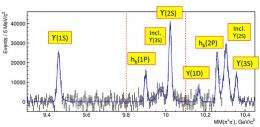
(PhysOrg.com) -- In new work, high-energy physicists have observed two long-sought quantum states in the bottomonium family of sub-atomic particles. The result will help researchers better understand one of the four fundamental forces of the universe — the strong force — that helps govern the interactions of matter.
Researchers from an international group of high-energy physicists called the Belle Collaboration observed the hb (pronounced h-sub-b) particles in data from Japan's KEK particle accelerator in Tsukuba, Japan. The Belle Collaboration presented their findings at the 25th annual particle physics conference at La Thuile, Italy in early March.
"We want to understand the underlying unifying theory of everything. Part of this is obtaining a deeper understanding of the strong force," said physicist David Asner of the Department of Energy's Pacific Northwest National Laboratory and a member of the Belle Collaboration. "The study of these new states will let us test theories describing the strong force."
Monsieur Meson
Most people have heard of gravity and even electromagnetism, but these are only two of the four forces studied by physicists. Researchers need to explore two others, the so-called "strong" and "weak" forces, to get a well-rounded understanding of the universe.
To study the strong force, researchers turn to quarks, particles smaller than individual pieces of the atom. In fact, quarks come together to make protons and neutrons, the components of an atom's nucleus. In addition, quarks can also form mesons, particles made up of quarks and their anti-matter counterparts. And just as electromagnetism binds electrons to the nucleus in an atom, the strong force binds quarks together within a proton, a neutron, or a meson.
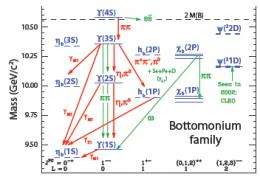
The mesons Asner and colleagues study are made from bottom quarks -- one of six flavors of quarks. In this family of mesons called bottomonium, a bottom quark and anti-bottom quark zoom around each other in one of more than a dozen different orbits, some higher in energy, some lower. Each orbit corresponds to a different "state" of bottomonium with just the two quarks but a different mass, thanks to Einstein's Theory of Relativity.
Mesons such as bottomonium are made and studied in huge instruments called particle accelerators such as KEK in Japan or the Tevatron at Fermi National Accelerator Laboratory in Batavia, Ill., also known as atom smashers. In the KEK accelerator, electrons smash at high speed into their anti-matter counterparts, positrons. The collisions make bottomonium particles containing high amounts of energy, which then fall apart into lower-energy bottomonium states. It's a little like identifying a model of car by smashing it to bits and examining the pieces.
Physicists have been identifying and cataloguing these bottomonium states since 1977, when researchers found the first bottomonium particle.
Out for a Spin
The Belle Collaboration, comprised of 400 physicists from 14 countries, has been smashing electrons and positrons at Japan's KEK-B for more than a decade. Asner and colleagues at PNNL, along with Todd Pedlar at Luther College in Decorah, Iowa, joined the Belle Collaboration in 2010 and began analyzing previously collected data, searching for a certain type of bottomonium state called a spin singlet.
Although physicists refer to "spin", the quarks are not actually rotating on their axes. Instead spin refers to magnetism — the quark and anti-quark are like tiny bar magnets with a north and south pole. In a spin singlet, the quark and anti-quark "magnetic poles" point in the opposite direction and cancel each other out. Only one type of spin singlet had been observed before — ηb (eta-sub-b) — by researchers at the SLAC National Accelerator Laboratory in 2008.
The spin singlet ηb has the lowest energy of all the bottomonium states, and the spin singlet that Asner and colleagues were looking for, hb, had slightly higher energy.
Physics theory predicted the spin singlet hb would appear in the debris from one of the highest energy bottomonium states, but only about once every 100 times that the particular bottomonium particle fell to pieces. In addition, the high energy particle spits out other unrelated particles as it slams down into the hb state. These shrapnel bits ricochet around and hit each other, causing background noise.
From Theory to Reality
Between the rarity of hb's appearance and the high background noise, the analysis team had to sift through large amounts of data to find their needle in the haystack. The team included Asner's group and two Russian scientists — Roman Mizuk from the Institute for Theoretical and Experimental Physics in Moscow and Alexander Bondar from the Budker Institute of Nuclear Physics, Novosibirsk.
The team found not only hb, but another bottomonium particle of somewhat higher energy, hb(2P), and determined their masses. In addition, the smashing produced more of the particles than expected, suggesting that hb and hb(2P) arise from what physicists call an "exotic" process, which means simply they're not (yet) sure how they arise.
The team also observed a particular kind of "hyperfine splitting" in bottomonium for the first time. How the two quarks spin around each other in the hb singlet causes it to be slightly heavier relative to the average masses of other bottomonium states. This small mass difference is known as "hyperfine splitting", and its measurement is the only means of determining the direct interaction between the quark spins when they are in certain orbits known as the P-waves. This is the first time P-wave hyperfine splitting has been observed in bottomonium.
The heaviest quarks — such as the bottom quark — give some of the most precise measurements of the fundamental properties of the strong force. The results of the measurements Asner and his collaborators have made represent a significant advance in the understanding of the bottomonium system, and the role of spin interactions in quark-antiquark systems. Understanding how these systems operate will help them and other scientists test the strong force and its role in the universe.
More information: The Belle Collaboration, First observation of hb(1P) and hb(2P), arXiv:1103.3419v1, March 17, 2011, arxiv.org/abs/1103.3419
Provided by Pacific Northwest National Laboratory


