Bacteria in wasp antennae produce antibiotic cocktails
April 12, 2011
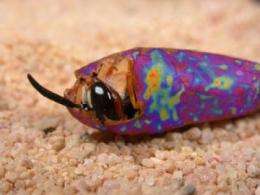
The beewolf larva hibernates for several months in its cocoon before the adult insect hatches. Antibiotics on the surface of the cocoon, produced by symbionts, guarantee protection against microbial pests during such a protracted developmental stage. The amount of antibiotics was visualized by means of imaging techniques based on mass spectrometry (LDI imaging) and merged as pseudocolours onto the cocoon. Credit: Johannes Kroiss and Martin Kaltenpoth, MPI for Chemical Ecology, Jena (Photomontage).
Bacteria that grow in the antennae of wasps help ward off fungal threats by secreting a 'cocktail' of antibiotics explains a scientist at the Society for General Microbiology's Spring Conference in Harrogate.
Dr Martin Kaltenpoth describes how this is the first known example of non-human animals using a combination prophylaxis strategy similar to the one used in human medicine. This discovery could help us find novel antimicrobials for human use and lead to more effective strategies for using them.
Female beewolf digger wasps cultivate symbiotic Streptomyces bacteria in unique antennal glands and secrete them into their larval brood cells. The larvae take up the bacteria and incorporate them in the cocoon while spinning it. On the cocoon, the bacteria provide protection against a wide range of potentially detrimental fungi and bacteria by producing a cocktail of at least nine different antibiotic substances.
Dr Kaltenpoth from the Max Planck Institute for Chemical Ecology in Germany explains why the results are so fascinating. "We are studying one of the few known symbiotic interactions in which the bacterial partner defends its host against pathogens - rather than providing a nutritional benefit, which is more common. Such defensive interactions have so far been largely overlooked, yet they are probably much more widespread than is currently recognized."
Studying more about insect-bacteria symbioses also has potential clinical benefits. "Learning about defensive symbioses will help us understand how mutualistic interactions between insects and bacteria evolve," suggested Dr Kaltenpoth. "Importantly, it will also tell us more about the exploitation of bacterial antibiotics by animals other than humans and about the, as yet, surprisingly little-studied role of antibiotics in nature."
The symbiotic bacteria secrete a mixture of antimicrobial compounds on the walls of the cocoon to ward off microbial threats. A similar combination prophylaxis (also known as combination therapy) approach is increasingly used in human medicine. Such a treatment exploits the complementary action of two or more antibiotics. It results in a higher efficacy against a broader spectrum of pathogens and is known to prevent micro-organisms from developing resistance to the antibiotic substance. "Understanding how insects use this approach to defend themselves against pathogens may provide us with insight to help design better strategies to combat increasingly resistant human pathogens," explained Dr Kaltenpoth. "What's more, identifying the components of the antibiotic cocktails produced by a wide range of beewolf species may yield novel antimicrobial compounds that might be useful for human medicine."
Provided by Society for General Microbiology
-
Beewolves protect their offspring with antibiotics
Feb 28, 2010 |
not rated yet |
0
-
Researchers find compound effective in destroying antibiotic-resistant biofilms
Apr 08, 2010 |
not rated yet |
0
-
Nanotechnology used to probe effectiveness of antibiotics
Feb 04, 2009 |
not rated yet |
0
-
Antibiotics have long-term impacts on gut flora
Nov 01, 2010 |
not rated yet |
0
-
Combatting antibiotic resistant bacteria
Jan 31, 2011 |
not rated yet |
0
-
Stars containing dark matter should look different from other stars
Feb 20, 2012 |
4.5 / 5 (17) |
11
-
Physicists discover evidence of rare hypernucleus, a component of strange matter
Feb 17, 2012 |
4.7 / 5 (38) |
22
-
Fast photon control brings quantum photonic technologies closer
Feb 13, 2012 |
5 / 5 (8) |
1
-
Engineers build first sub-10-nm carbon nanotube transistor
Feb 01, 2012 |
4.9 / 5 (36) |
32
-
Something old, something new: Evolution and the structural divergence of duplicate genes
Jan 31, 2012 |
4.6 / 5 (7) |
1
-
Eye biology videos
4 hours ago
-
Flowering Plant Revived After 30,000 Years in Permafrost
Feb 21, 2012
-
Toba volcano eruptions - 1.000 - 10,000 breeding pairsunb
Feb 20, 2012
-
How is a specific gene removed from DNA
Feb 20, 2012
-
Reproduction and Human evolution
Feb 19, 2012
-
Viruses: Living or Non-living organisms
Feb 19, 2012
- More from Physics Forums - Biology
More news stories
Surprising diversity at a synapse hints at complex diversity of neural circuitry
A new study reveals a dazzling degree of biological diversity in an unexpected place a single neural connection in the body wall of flies.
10 hours ago |
5 / 5 (4) |
0
|
Men might not 'become extinct' after all: Theory of the 'rotting' Y chromosome dealt a fatal blow
If you were to discover that a fundamental component of human biology has survived virtually intact for the past 25 million years, you'd be quite confident in saying that it is here to stay.
13 hours ago |
5 / 5 (6) |
1
|
New family of legless amphibians found in India
Since before the age of dinosaurs it has burrowed unbothered beneath the monsoon-soaked soils of remote northeast India - unknown to science and mistaken by villagers as a deadly, miniature snake.
21 hours ago |
5 / 5 (8) |
3
Climate change affects bird migration timing in North America
Bird migration timing across North America has been affected by climate change, according to a study published Feb. 22 in the open access journal PLoS ONE.
9 hours ago |
4.5 / 5 (2) |
2
New iridescent lizard species found in Cambodia
A new species of lizard with striking iridescent rainbow skin, a long tail and very short legs has been discovered in the rainforest in northeast Cambodia, conservationists announced Wednesday.
10 hours ago |
not rated yet |
0
Researchers build first physical 'metatronic' circuit
(PhysOrg.com) -- The technological world of the 21st century owes a tremendous amount to advances in electrical engineering, specifically, the ability to finely control the flow of electrical charges using ...
Spitzer finds solid buckyballs in space
(PhysOrg.com) -- Astronomers using data from NASA's Spitzer Space Telescope have, for the first time, discovered buckyballs in a solid form in space. Prior to this discovery, the microscopic carbon spheres ...
Faster than light neutrinos? More like faulty wiring
You can shelf your designs for a warp drive engine (for now) and put the DeLorean back in the garage; it turns out neutrinos may not have broken any cosmic speed limits after all.
Physicists surprised by disappearing and reappearing superconductivity in iron selenium chalcogenides
Superconductivity is a rare physical state in which matter is able to conduct electricity -- maintain a flow of electrons -- without any resistance. This phenomenon can only be found in certain materials at low temperatures, ...
CT colonography shown to be comparable to standard colonoscopy
Computerized tomographic (CT) colonography (CTC), also known as virtual colonoscopy, is comparable to standard colonoscopy in its ability to accurately detect cancer and precancerous polyps in people ages 65 and older, according ...
Stanford research team cracks animated NuCaptcha
(PhysOrg.com) -- The research team from Stanford University, led by Elie Bursztein, that previously had cracked regular CAPTCHAs and then audio CAPTCHAs, now has also successfully cracked the animated version called NuCapt ...