Beetle bling: Researchers discover optical secrets of 'metallic' beetles
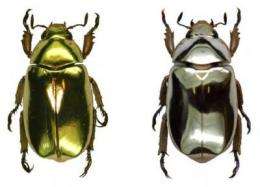
Costa Rica was once regarded as the poorest of all the colonies of the Spanish Empire, sadly deficient in the silver and gold so coveted by conquistadors. As it turns out, all of the glittering gold and silver those explorers could have ever wanted was there all along, in the country's tropical rainforests—but in the form of two gloriously lustrous species of beetle.
Today, the brilliant gold- (Chrysina aurigans) and silver-colored (Chrysina limbata) beetles have given optics researchers new insights into the way biology can recreate the appearance of some of nature's most precious metals, which in turn may allow researchers to produce new materials based on the natural properties found in the beetles' coloring.
A team of researchers at the University of Costa Rica has found that the beetles' metallic appearance is created by the unique structural arrangements of many dozens of layers of exo-skeletal chitin in the elytron, a hardened forewing that protects the delicate hindwings that are folded underneath. A paper about the discovery appears in the first issue of the Optical Society's (OSA) newest open access journal, Optical Materials Express, which launched this month.
The beetles were captured in the University of Costa Rica's Alberto Brenes Mesén Biological Reserve, a tropical rainforest environment. "The metallic appearance of these beetles may allow them to be unnoticed, something that helps them against potential predators," says physicist and study leader William E. Vargas. The surface of their elytra "reflects light in a way that they look as bright spots seen from any direction," he explains. "In a tropical rainforest, there are many drops of water suspended from the leaves of trees at ground level, along with wet leaves, and these drops and wet leaves redirect light by refraction and reflection respectively, in different directions. Thus, metallic beetles manage to blend with the environment."
To interpret the cause of this metallic look, Vargas and his team assumed that a sequence of layers of chitin appears through the cuticle, with successive layers having slightly different refractive indices.. In these beetles, the cuticle, which is just 10 millionths of a meter deep, has some 70 separate layers of chitin—a nitrogen-containing complex sugar that creates the hard outer skeletons of insects, crabs, shrimps, and lobsters. The chitin layers become progressively thinner with depth, forming a so-called "chirped" structure.
"Because the layers have different refractive indices," Vargas says, "light propagates through them at different speeds. The light is refracted through—and reflected by—each interface giving, in particular, phase differences in the emerging reflected rays. For several wavelengths in the visible range, there are many reflected rays whose phase differences allow for constructive interference. This leads to the metallic appearance of the beetles."
This is similar to the way in which a prism breaks white light into the colors of the rainbow by refraction, but in the case of these beetles, different wavelengths, or colors of light are reflected back more strongly by different layers of chitin. This creates the initial palette of colors that enable the beetles to produce their distinctive hues. The mystery the researchers still needed to understand in more detail, however, was how the beetles could so perfectly create the structure causing the brilliant metallic tones of silver and gold.
Using a device they specially designed to measure the reflection of light when it strikes the curved surface of the beetles' elytra, Vargas and his colleagues found that as light strikes the interface between each successive layer (the first interface being the boundary between the outside air and the top chitin layer), some of its energy is reflected and some is transmitted down to the next interface.
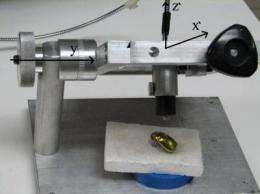
"This happens through the complete sequence of interfaces," Vargas says.
Because a portion of the light is reflected, it combines with light of the exact same wavelength as it passes back through layer upon layer of chitin, becoming brighter and more intense. Ocean waves can exhibit the same behavior, combining to produce rare but powerful rogue waves. In the case of the beetles, this "perfect storm" of light amplification produces not only the same colors but also the striking sheen and glimmer that we normally associate with fine jewelry.
In the two beetle species, interference patterns are produced by slightly different wavelengths of light, thus producing either silver or gold colors. "For the golden-like beetle, the constructive interference is found for wavelengths larger than 515 nm, the red part of the visible wavelength range," Vargas says, "while for the silver-like beetle it happens for wavelengths larger than 400 nm—that is, for the entire visible wavelength range."
"The detailed understanding of the mechanism used by the beetles to produce this metallic appearance opens the possibility to replicate the structure used to achieve it," Vargas says, "and thus produce materials that, for example, might look like gold or silver but are actually synthesized from organic media."
This potentially could lead to new products or consumer electronics that can perfectly mimic the appearance of precious metals. Other products could be developed for architectural applications that require coatings with a metallic appearance. Vargas notes that in the solar industry, for example, chirped multilayer reflectors could be used as back layers supporting the active or light-absorbing medium, to improve the absorption of the back-reflected light.
More information: The article, "Visible light reflection spectra from cuticle layered materials," by Cristian Campos-Fernández, Daniel E. Azofeifa, Marcela Hernández-Jiménez, Adams Ruiz-Ruiz and William E. Vargas appears in the journal Optical Materials Express. It can be accessed at: www.opticsinfobase.org/ome/abs … t.cfm?URI=ome-1-1-85
Abstract
The brilliant metallic appearance of two kinds of beetles, the Chrysina aurigans and the Chrysina limbata, is displayed visually as well as from normalized reflection measurements of non polarized visible light under normal incidence. The C. limbata is reflective over the visible spectral wavelength range, with a silver-like aspect, while the golden-like C. aurigans is reflective for wavelengths larger than 525 nm, and with a well defined sequence of minima and maxima depicted in the reflection spectra. Both specimens show selective reflection of circular polarized light with the effect being significantly weaker for the C. limbata. A transfer matrix formalism is applied to approach the main features displayed in the measured reflection spectra, by assuming a chirped multilayer structure with decreasing thicknesses of successive layers through the cuticle of the beetles.
Provided by Optical Society of America


