Predicting learning using brain analysis
April 19, 2011
Predicting learning using brain analysis

Enlarge

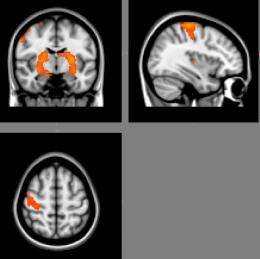
These figures correlate fMRI activation with how finger sequences are grouped into integrated clusters. This leads to the the production of fluid low-cost movements.

(PhysOrg.com) -- An international team of scientists has developed a way to predict how much a person can learn, based on studies at UC Santa Barbara's Brain Imaging Center.

A study published in this week's (PNAS) details the findings.

Researchers collected brain imaging data from people performing a motor task and then analyzed this data using new . They found evidence that the flexibility of a person's brain can be used to predict how well someone will learn. The researchers view flexibility as how different areas of the brain link up in different combinations.

"What we wanted to do was find a way to predict how much someone is going to learn in the future, independent of how they are as a performer," said Scott T. Grafton, senior author and professor of psychology at UC Santa Barbara. Grafton is also director of the UCSB Brain Imaging Center.

The team ran an experiment over three sessions in which 18 volunteers had to push a series of buttons, similar to a sequence of notes on a piano keyboard, as fast as possible. They then divided functional MRI images of each volunteer's brain into 112 different regions and analyzed how these different areas connected while they performed the task.

"Our study has obvious implications clinically," said Grafton. "If you're a patient in , should you just take tomorrow off? Or will it be a good day? We don't know that, but that would be a potential application — tailoring intervention to capacity to change. In healthy people, this information could accelerate learning — when you should study, when you should practice, when you should try to acquire a new skill."
Scientists discover how to predict learning using brain analysis
Enlarge

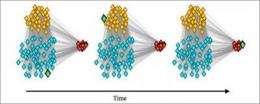
Brain regions function coherently together as modules (here shown in gold, blue, and red). A flexible brain region (shown in green) is one that changes module allegiance at different points in time. Credit: Danielle S. Bassett

The new study uses computational methods developed to analyze what the researchers call multilayer networks, in which each layer might represent a network at one snapshot in time, or a different set of connections between the same set of brain regions. These layers are combined into a larger mathematical object, which can contain a potentially huge amount of data and is difficult to analyze. Previous methods could only deal with each layer separately.

"Parts of the brain communicate with one another very strongly, so they form a sort of module of intercommunicating regions of the brain," said first author Danielle S. Bassett, postdoctoral fellow in physics at UC Santa Barbara. "In this way, brain activity can segregate into multiple functional modules. What we wanted to measure is how fluid those modules are."

Bassett explained that there are flexible regions with allegiances that change through time. "That flexibility seems to be the factor that predicts learning," said Bassett. "So, if you are very flexible, then you will end up learning better on the second day, and if you are not very flexible, then you learn less."

Bassett's education is highly interdisciplinary, with studies in physics, mathematics, psychology, and neuroscience. She received her Ph.D. in physics at the University of Cambridge where she had supervisors in several disciplines, including psychiatry. Her current studies are carried out within UC Santa Barbara's Department of Physics and Department of Psychology.

More information: Authors of the PNAS study, in addition to Bassett and Grafton, are Nicholas F. Wymbs, UC Santa Barbara; Mason A. Porter, University of Oxford; Peter J. Mucha, University of North Carolina, and Jean M. Carlson, UC Santa Barbara.

Provided by University of California - Santa Barbara

4.2 /5 (5 votes)  

Rank 4.2 /5 (5 votes)
Related Stories
Relevant PhysicsForums posts
  • stomach not emptying
    createdFeb 16, 2012
  • White reflections in photos in one eye
    createdFeb 15, 2012
  • Is Everyday Technology Killing Us?
    createdFeb 08, 2012
  • Exercise and weight loss
    createdFeb 08, 2012
  • Why do we have head aches? Our brains can't feel anything.
    createdFeb 07, 2012
  • "The end of diseases" by David Agus, interview from Daily Show with Jon Stewart
    createdFeb 04, 2012
  • More from Physics Forums - Medical Sciences

More news stories

CT colonography shown to be comparable to standard colonoscopy

Computerized tomographic (CT) colonography (CTC), also known as virtual colonoscopy, is comparable to standard colonoscopy in its ability to accurately detect cancer and precancerous polyps in people ages 65 and older, according ...

Medicine & Health / Cancer

created 3 hours ago | popularity not rated yet | comments 0

What can animals' survival instincts tell us about understanding human emotion?

Can animals' survival instincts shed additional light on what we know about human emotion? New York University neuroscientist Joseph LeDoux poses this question in outlining a pioneering theory, drawn from two decades of research, ...

Medicine & Health / Neuroscience

created 14 hours ago | popularity 5 / 5 (3) | comments 4 | with audio podcast

Study: Virtual colonoscopy effective screening tool for adults over 65

Computed tomography (CT) colonography can be used as a primary screening tool for colorectal cancer in adults over the age of 65, according to a new study published online in the journal Radiology.

Medicine & Health / Other

created 3 hours ago | popularity not rated yet | comments 0

Injectable gel could repair tissue damaged by heart attack

(Medical Xpress) -- University of California, San Diego researchers have developed a new injectable hydrogel that could be an effective and safe treatment for tissue damage caused by heart attacks.

Medicine & Health / Cardiology

created 17 hours ago | popularity 4.7 / 5 (6) | comments 3 | with audio podcast

Mini molecules could help fight battle of aortic bulge

When aortic walls buckle, the body's main blood pipe forms an ever-growing bulge. To thwart a deadly rupture, a team of Stanford University School of Medicine researchers has found two tiny molecules that may be able to orchestrate ...

Medicine & Health / Cardiology

created 13 hours ago | popularity 5 / 5 (1) | comments 0 | with audio podcast


Researchers build first physical 'metatronic' circuit

(PhysOrg.com) -- The technological world of the 21st century owes a tremendous amount to advances in electrical engineering, specifically, the ability to finely control the flow of electrical charges using ...

Spitzer finds solid buckyballs in space

(PhysOrg.com) -- Astronomers using data from NASA's Spitzer Space Telescope have, for the first time, discovered buckyballs in a solid form in space. Prior to this discovery, the microscopic carbon spheres ...

Faster than light neutrinos? More like faulty wiring

You can shelf your designs for a warp drive engine (for now) and put the DeLorean back in the garage; it turns out neutrinos may not have broken any cosmic speed limits after all.

Physicists surprised by disappearing and reappearing superconductivity in iron selenium chalcogenides

Superconductivity is a rare physical state in which matter is able to conduct electricity -- maintain a flow of electrons -- without any resistance. This phenomenon can only be found in certain materials at low temperatures, ...

Stanford research team cracks animated NuCaptcha

(PhysOrg.com) -- The research team from Stanford University, led by Elie Bursztein, that previously had cracked regular CAPTCHAs and then audio CAPTCHAs, now has also successfully cracked the animated version called NuCapt ...

Going up: Japan builder eyes space elevator

A Japanese construction firm claimed Wednesday it could execute an out-of-this-world plan to put tourists in space within 40 years by building an elevator that stretches a quarter of the way to the moon.