Chimpanzees' contagious yawning evidence of empathy, not just sleepiness, study shows
April 6, 2011
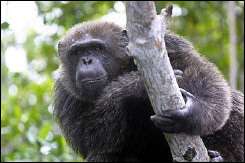
Contagious yawning is not just a marker of sleepiness or boredom. For chimpanzees, it may actually be a sign of a social connection between individuals.
New research at the Yerkes National Primate Research Center, Emory University, may help scientists understand empathy, the mechanism thought to underlie contagious yawning, in both chimpanzees and humans. The research also may help show how social biases strengthen or weaken empathy.
Scientists at Yerkes discovered chimpanzees yawn more after watching familiar chimpanzees yawn than after watching strangers yawn. The Public Library of Science One (PLoS ONE) is publishing the study online on Wednesday, April 6, 2011.
Yerkes researchers Matthew Campbell, PhD, and Frans de Waal, PhD, propose that when yawning spreads between chimpanzees, it reflects an underlying empathy between them.
"The idea is that yawns are contagious for the same reason that smiles, frowns and other facial expressions are contagious," they write. "Our results support the idea that contagious yawning can be used as a measure of empathy, because the biases we observed were similar to empathy biases previously seen in humans."
Campbell is a FIRST postdoctoral fellow at Yerkes and Emory (Fellowship in Research and Science Teaching). De Waal is director of the Living Links Center at Yerkes and C.H. Candler Professor of Psychology at Emory.
They studied 23 adult chimpanzees that were housed in two separate groups. The chimpanzees viewed several nine-second video clips of other chimpanzees, in both groups, either yawning or doing something else. They yawned 50 percent more frequently in response to seeing members of their group yawn compared to seeing others yawn.
In humans, scientists have identified certain parts of the brain that are activated both when someone experiences pain and when they see someone else experiencing pain. In these experiments, people tend to show more sensitivity for members of the same social group.
The results raise the question of whether contagious yawning among humans shows the same biases: favoring members of the same social group over different social groups.
The authors note one complication: chimpanzees live in small communities where unfamiliar individuals are by definition seen as members of a separate social group. In contrast, humans do not necessarily see strangers as belonging to an "outgroup." For this reason, the in-group/out-group distinction may be more absolute in chimpanzees than in humans. Chimpanzees in the wild are known to be extremely hostile to external groups, which probably adds to the effects found in this study.
The authors say that contagious yawning could be a window into social and emotional connections between individuals, and suggest that insight into barriers to chimpanzee empathy may help break down those barriers for humans.
"Empathy is difficult to measure directly because it is a largely internal response: mimicking the emotional response of another. Contagious yawning allows for a measurement of empathic response that is purely behavioral, and thus can be applied more widely," Campbell writes. "Anyone who wants to increase human empathy towards outsiders should consider that techniques to this effect could be tested out on chimpanzees and other animals."
More information: Campbell MW, de Waal FBM (2011) Ingroup-Outgroup Bias in Contagious Yawning by Chimpanzees Supports Link to Empathy. PLoS ONE 6(4): e18283. doi:10.1371/journal.pone.0018283
-
Children under 4 and children with autism don't yawn contagiously
Sep 15, 2010 |
not rated yet |
0
-
Yawning toons make an ape gape
Sep 08, 2009 |
not rated yet |
0
-
Chimp, bonobo study sheds light on the social brain
Apr 05, 2011 |
not rated yet |
0
-
Human-like altruism shown in chimpanzees
Jun 25, 2007 |
not rated yet |
0
-
Humans and chimps register faces by using similar brain regions
Dec 18, 2008 |
not rated yet |
0
-
Stars containing dark matter should look different from other stars
Feb 20, 2012 |
4.5 / 5 (17) |
11
-
Physicists discover evidence of rare hypernucleus, a component of strange matter
Feb 17, 2012 |
4.7 / 5 (38) |
22
-
Fast photon control brings quantum photonic technologies closer
Feb 13, 2012 |
5 / 5 (8) |
1
-
Engineers build first sub-10-nm carbon nanotube transistor
Feb 01, 2012 |
4.9 / 5 (36) |
32
-
Something old, something new: Evolution and the structural divergence of duplicate genes
Jan 31, 2012 |
4.6 / 5 (7) |
1
-
Eye biology videos
4 hours ago
-
Flowering Plant Revived After 30,000 Years in Permafrost
Feb 21, 2012
-
Toba volcano eruptions - 1.000 - 10,000 breeding pairsunb
Feb 20, 2012
-
How is a specific gene removed from DNA
Feb 20, 2012
-
Reproduction and Human evolution
Feb 19, 2012
-
Viruses: Living or Non-living organisms
Feb 19, 2012
- More from Physics Forums - Biology
More news stories
Surprising diversity at a synapse hints at complex diversity of neural circuitry
A new study reveals a dazzling degree of biological diversity in an unexpected place a single neural connection in the body wall of flies.
11 hours ago |
5 / 5 (4) |
0
|
Men might not 'become extinct' after all: Theory of the 'rotting' Y chromosome dealt a fatal blow
If you were to discover that a fundamental component of human biology has survived virtually intact for the past 25 million years, you'd be quite confident in saying that it is here to stay.
14 hours ago |
5 / 5 (6) |
1
|
New family of legless amphibians found in India
Since before the age of dinosaurs it has burrowed unbothered beneath the monsoon-soaked soils of remote northeast India - unknown to science and mistaken by villagers as a deadly, miniature snake.
21 hours ago |
5 / 5 (9) |
3
Climate change affects bird migration timing in North America
Bird migration timing across North America has been affected by climate change, according to a study published Feb. 22 in the open access journal PLoS ONE.
10 hours ago |
4.5 / 5 (2) |
2
New iridescent lizard species found in Cambodia
A new species of lizard with striking iridescent rainbow skin, a long tail and very short legs has been discovered in the rainforest in northeast Cambodia, conservationists announced Wednesday.
10 hours ago |
not rated yet |
0
Researchers build first physical 'metatronic' circuit
(PhysOrg.com) -- The technological world of the 21st century owes a tremendous amount to advances in electrical engineering, specifically, the ability to finely control the flow of electrical charges using ...
Spitzer finds solid buckyballs in space
(PhysOrg.com) -- Astronomers using data from NASA's Spitzer Space Telescope have, for the first time, discovered buckyballs in a solid form in space. Prior to this discovery, the microscopic carbon spheres ...
Faster than light neutrinos? More like faulty wiring
You can shelf your designs for a warp drive engine (for now) and put the DeLorean back in the garage; it turns out neutrinos may not have broken any cosmic speed limits after all.
Physicists surprised by disappearing and reappearing superconductivity in iron selenium chalcogenides
Superconductivity is a rare physical state in which matter is able to conduct electricity -- maintain a flow of electrons -- without any resistance. This phenomenon can only be found in certain materials at low temperatures, ...
Stanford research team cracks animated NuCaptcha
(PhysOrg.com) -- The research team from Stanford University, led by Elie Bursztein, that previously had cracked regular CAPTCHAs and then audio CAPTCHAs, now has also successfully cracked the animated version called NuCapt ...
Going up: Japan builder eyes space elevator
A Japanese construction firm claimed Wednesday it could execute an out-of-this-world plan to put tourists in space within 40 years by building an elevator that stretches a quarter of the way to the moon.
Apr 06, 2011
Rank: not rated yet
Apr 06, 2011
Rank: not rated yet
Apr 07, 2011
Rank: not rated yet