Giant black holes revealed in the nuclei of merging galaxies
April 26, 2011
Science results - giant black holes revealed in the nuclei of merging galaxies

Enlarge

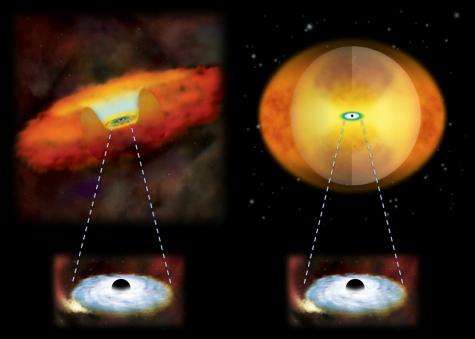
Figure 1: Schematic diagrams of obscured AGNs. left: A doughnut-shaped dusty medium hides an active mass-accreting SMBH. Photons from the central AGN (= a mass accreting SMBH) can escape along the doughnut axis and ionize the gas there. Since the emission pattern of such AGN-ionized gas clouds differs from those in star-forming regions, we can use optical spectroscopy to easily infer the presence of an AGN hidden behind the dusty medium. right: Dust in all lines-of-sight obscures and buries the active mass-accreting SMBH, which is very difficult to detect with conventional optical spectroscopy. Credits: NASA for the images of mass accreting SMBH (lower), and mass accreting SMBH surrounded by doughnut-shaped dusty medium (upper left). NAOJ, Naomi Ishikawa, for the upper-right image.

Subaru Telescope research team led by Dr. Masatoshi Imanishi at the National Astronomical Observatory of Japan sampled many infrared bright, merging galaxies and determined the presence of active supermassive black holes (SMBH) deeply buried in their centers.

The scientists used the 8.2 m Subaru Telescope atop Mauna Kea (4200 m in elevation) as well as the Gemini South telescope at Cerro Pachon, Chile (2700 m in elevation) to perform high-spatial-resolution infrared imaging observations of nearby infrared luminous merging galaxies. Observations with both telescopes revealed that some samples show characteristics of rapid , while others display the signature of active galactic nuclei (AGN) that draw their energy from SMBH.

According to prevailing galaxy formation theories, small gas-rich galaxies with central SMBHs collide and merge, and then grow into the matured galaxies of the current universe. This is why the investigation of nearby infrared luminous merging galaxies helps to clarify the process of . The collision and compression of gas clouds from the galaxy merger causes the rapid formation of new stars, a heating-up of the surrounding dust, and the consequent production of strong infrared radiation. Also the supply of material increases the accretion to the SMBHs.

Although the merging galaxies enhance star formation as well as accretion to SMBHs, they also hinder these processes. A large amount of gas and dust are supplied to their nuclear regions, a process that can easily bury the compact SMBHs and make them difficult to find. By chance some objects have a ring-shaped distribution of the dust and gas, allowing observers to peek into the effect of the active SMBHs (Figure 1).

To detect emission behind dust and gas, the current research team made observations at 18 micrometers, using Subaru Telescope's COMICS (Cooled Mid-Infrared Camera and Spectrometer) as well as Gemini South's T-ReCS (Thermal-Region Camera ). By utilizing the time exchange program, the team could use both telescopes to survey objects all over the sky. Subaru's observations captured images in the northern hemisphere and Gemini South, in the southern hemisphere.

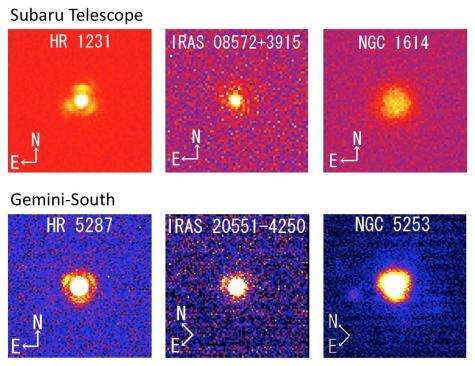
How, then, could they confirm the presence of active SMBHs? It was neither an easy nor a trivial task to discover active SMBHs in merging galaxies. The researchers had used their methodology and choice of instruments to overcome a number of challenges. First they needed to identify an object had a bright infrared emission but was compact in size. Both AGN activity (a mass accreting SMBH) and compact star formation region are spatially confined. Measuring the luminosity in the infrared was the key for the finally categorizing their source. If the emission surface brightness at the nucleus of a merging galaxy is substantially higher than the maximum brightness expected from star-formation, then one can infer that the emission comes from a luminous buried AGN, because an accreting SMBH can emit radiation much more efficiently than a star. Observations at infrared 18 micrometers with both the Subaru and Gemini South telescopes demonstrated that some infrared luminous merging galaxies show a star formation type of emission (spatially extended with modest surface brightness) while others had an emission typical of AGNs (spatially compact with high surface brightness) (Figure 2). Ten of the current sample of eighteen objects showed the characteristics of the AGNs.
Science results - giant black holes revealed in the nuclei of merging galaxies
Enlarge

Figure 2: High-spatial-resolution infrared 18-micrometer images, obtained with the Subaru telescope (top) and the Gemini South telescope (bottom). The field of view (FOV) is 8 x 8 arcsec2. N and E indicate north and east directions, respectively. left: Image of a standard star. Three dots (top) or three dots with a ring pattern (bottom) demonstrate that the image has reached or is close to the limit for its highest possible resolution. middle: Image of an infrared luminous merging galaxy, with indication of a luminous AGN. The infrared emission is very compact, indistinguishable from the stellar image. The emission surface brightness is estimated to be significantly higher than the upper limit achieved by star-formation activity. right: Image of an infrared luminous merging galaxy, typical of a star-formation dominated source. The emission is spatially extended, and the emission surface brightness is within a range explained by star-formation activity.

The team's coherent, logical steps used to investigate the presence of in merging galaxies yielded clear and important results, which were published in the Astronomical Journal: Imanishi et al. 2011 Astronomical Journal, 141, 156). Comparison of the results from high spatial resolution infrared observations with those from research using infrared spectroscopy to investigate deeply buried AGNs shows that both are reliable energy diagnostic tools and provide a consistent picture of the nature of hidden energy sources in merging galaxies.

Provided by Subaru Telescope

4.2 /5 (5 votes)  

Filter


Move the slider to adjust rank threshold, so that you can hide some of the comments.


Display comments: newest first

omatumr
Apr 26, 2011

Rank: 1 / 5 (4)
Thanks for this interesting story.

I expect that continued observations will show that the nuclei of galaxies - called "active supermassive black holes (SMBH)" here - are actually fragmenting from the same nuclear forces that prevent the formation of black holes: Neutron repulsion [1].

1. "Neutron Repulsion", The APEIRON Journal, in press, 19 pages (2011)

http://arxiv.org/...2.1499v1

Rank 4.2 /5 (5 votes)
Related Stories
Relevant PhysicsForums posts
  • Calculating the magnitude
    created2 hours ago
  • What is this spectrum I took?
    created13 hours ago
  • Orientation of Space
    created13 hours ago
  • Geologically Active Moon Now: NASA
    created20 hours ago
  • advice on building a science fair telescope
    createdFeb 22, 2012
  • Rise of the Sun
    createdFeb 22, 2012
  • More from Physics Forums - General Astronomy

More news stories

Spitzer finds solid buckyballs in space

(PhysOrg.com) -- Astronomers using data from NASA's Spitzer Space Telescope have, for the first time, discovered buckyballs in a solid form in space. Prior to this discovery, the microscopic carbon spheres ...

Space & Earth / Astronomy

created 14 hours ago | popularity 4.7 / 5 (12) | comments 8 | with audio podcast

Going up: Japan builder eyes space elevator

A Japanese construction firm claimed Wednesday it could execute an out-of-this-world plan to put tourists in space within 40 years by building an elevator that stretches a quarter of the way to the moon.

Space & Earth / Space Exploration

created 21 hours ago | popularity 3.5 / 5 (13) | comments 26

ENASA satellite finds Earth's clouds are getting lower

(PhysOrg.com) -- Earth's clouds got a little lower -- about one percent on average -- during the first decade of this century, finds a new NASA-funded university study based on NASA satellite data. The results ...

Space & Earth / Earth Sciences

created 18 hours ago | popularity 5 / 5 (8) | comments 13 | with audio podcast

Fresh scandal embroils US climate science debate

A fresh scandal over climate change has erupted in the United States after leaked documents appeared to show a right-wing funded campaign to influence how climate science is taught in schools.

Space & Earth / Environment

created 11 hours ago | popularity 4.1 / 5 (9) | comments 8

World's oceans get an acid bath

Among the repercussions of global climate change, the effect of ocean acidification on marine life is one of the least-understood variables.

Space & Earth / Environment

created 18 hours ago | popularity 4.3 / 5 (6) | comments 4 | with audio podcast


Researchers build first physical 'metatronic' circuit

(PhysOrg.com) -- The technological world of the 21st century owes a tremendous amount to advances in electrical engineering, specifically, the ability to finely control the flow of electrical charges using ...

Faster than light neutrinos? More like faulty wiring

You can shelf your designs for a warp drive engine (for now) and put the DeLorean back in the garage; it turns out neutrinos may not have broken any cosmic speed limits after all.

Physicists surprised by disappearing and reappearing superconductivity in iron selenium chalcogenides

Superconductivity is a rare physical state in which matter is able to conduct electricity -- maintain a flow of electrons -- without any resistance. This phenomenon can only be found in certain materials at low temperatures, ...

Stanford research team cracks animated NuCaptcha

(PhysOrg.com) -- The research team from Stanford University, led by Elie Bursztein, that previously had cracked regular CAPTCHAs and then audio CAPTCHAs, now has also successfully cracked the animated version called NuCapt ...

Flesh-eating bacteria inspire superglue

(PhysOrg.com) -- A bio-inspired superglue has been developed by Oxford University researchers that can’t be matched for sticking molecules together and not letting go.

Scientists create potent molecules aimed at treating muscular dystrophy

While RNA is an appealing drug target, small molecules that can actually affect its function have rarely been found. But now scientists from the Florida campus of The Scripps Research Institute have for the first time designed ...