Ink with tin nanoparticles could print future circuit boards
April 12, 2011 By Lisa Zyga feature
Ink with tin nanoparticles could print future circuit boards

Enlarge

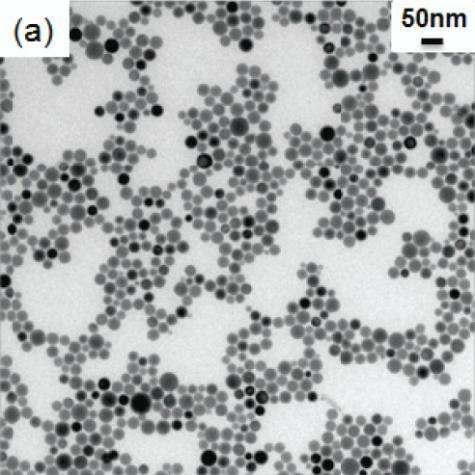
This image, taken with a transmission electron microscope, shows 29.1-nm nanoparticles that were used to make conductive ink. Image credit: Yun Hwan Jo, et al. ©2011 IOP Publishing Ltd.

(PhysOrg.com) -- Almost all electronic devices contain printed circuit boards, which are patterned with an intricate copper design that guides electricity to make the devices functional. In a new study, researchers have taken steps toward fabricating circuit boards with an inkjet printer. They have synthesized tin (Sn) nanoparticles and then added them to the ink to increase its conductivity, leading to an improved way to print circuit boards.

The researchers, from KAIST and the Korea Institute of Machinery and Materials, both in Daejoen, South Korea, have published their study on using tin in highly conductive ink in a recent issue of Nanotechnology.

Currently, most circuit boards are printed using multi-step methods such as conventional vacuum deposition and photolithographic patterning. However, these methods have disadvantages since they require a high processing temperature, involve toxic waste, and are expensive. Fabricating circuit boards using inkjet printing overcomes these limitations, and in comparison to the other methods is fast, simple, and inexpensive. Inkjet printing could be used for a variety of devices, such as RFID tags, LEDs, , organic thin-film transistors, and biomedical devices.

Recently, several studies have investigated different materials, such as polymers, carbon nanotubes, and metal nanoparticles, which could be used for the conductive ink. Although polymers and carbon nanotubes have advantages for printing on flexible displays, their is too low for them to be used for conductive ink materials. have higher conductivity, and so are more suitable for conductive ink materials.

“The greatest significance of our work is that it is the first attempt to print conductive patterns with the Sn-containing conductive ink,” coauthor Yun Hwan Jo of KAIST told PhysOrg.com. “Several papers reported the synthesis of Sn nanoparticles for interconnection materials. However, no obvious melting temperature depression was observed due to the relatively large size and low uniformity of the Sn nanoparticles. In addition, there has been no report for fabricating conductive ink with Sn nanoparticles.”

In their study, Jo and coauthors synthesized a large amount of uniformly sized tin nanoparticles. As they explained, synthesizing tin nanoparticles that have a very small size is important because it leads to a lower melting temperature compared to that of bulk tin. For instance, while bulk tin melts at 232 °C, tin nanoparticles with a diameter of 11.3 nm melt at 177 °C. A lower melting temperature is beneficial because it means lower energy consumption, less substrate warping, and fewer thermal stress problems. The researchers also applied surface treatments to the conductive ink to decrease the resistance by a factor of 20.

“Two factors, cost and low temperature, are the advantages of the Sn-containing conductive ink,” Jo said. “Ag, Cu and Au nanoparticles are widely used to fabricate conductive ink. However, Au and Ag are expensive. And the melting temperature of Ag, Cu and Au nanoparticles is higher than that of Sn nanoparticles (177.3 °C, this experiment).”

By adding the tin nanoparticles to an ink solution, the researchers printed patterns of highly conductive ink from an . As the first demonstration of inkjet printing with tin nanoparticles, the results show that the new technique looks promising for printing various that require conductive patterns.

“We are under study to fabricate conductive lines with conductive Sn ink via inkjet printing for flexible OLED devices,” Jo said. “We are optimizing the jetting conditions to draw complicated patterns using conductive Sn ink.”

More information: Yun Hwan Jo, et al. “Synthesis and characterization of low temperature Sn nanoparticles for the fabrication of highly conductive ink.” Nanotechnology 22 (2011) 225701 (8pp). DOI: 10.1088/0957-4484/22/22/225701

Copyright 2010 PhysOrg.com.
All rights reserved. This material may not be published, broadcast, rewritten or redistributed in whole or part without the express written permission of PhysOrg.com.

4.6 /5 (8 votes)  

Filter


Move the slider to adjust rank threshold, so that you can hide some of the comments.


Display comments: newest first

Roland
Apr 12, 2011

Rank: 5 / 5 (2)
Cu-Pb solder is being replaced with Cu-Sn. This has a problem: the tin tends to migrate and grow microscopic fibers, eventually causing short circuits. Will these Sn nanoparticles eventually migrate and form fibers? This needs a long-term (several year) test.
jimmie
Apr 12, 2011

Rank: not rated yet
how bout fixing the link ?
88HUX88
Apr 13, 2011

Rank: not rated yet
Sn-Pb is being replaced with Sn-Ag-Cu, previously the lead inhibited tin whiskers. It depends on the application as to whether the whiskers kill people (aerospace) or just inconvenience them (mp3 players). Studies are underway in industry and academia at the moment.
Ricochet
Apr 14, 2011

Rank: 5 / 5 (1)
"We've secretly replaced the electronics in Major Barnes' F-16 with tin-based circuits. Let's see if he notices..."
HAL9000
Apr 17, 2011

Rank: not rated yet
Tin whiskers at the post-assembly solder joints and component leads can be significantly mitigated by flooding the assembled PCB with a conformal coating or potting compound. Weight and cost gains are fractional. The material is inconvenient for assemblers and messy for repair techs, but Major Barnes would approve.
HAL9000
Apr 17, 2011

Rank: 5 / 5 (1)
Sn-Pb is being replaced with Sn-Ag-Cu, previously the lead inhibited tin whiskers. It depends on the application as to whether the whiskers kill people (aerospace) or just inconvenience them (mp3 players). Studies are underway in industry and academia at the moment.


But silver introduces it's own evils: The most popular Sn-Ag-Cu alloy (SAC305) is seeing field failure modes related to silver corrosion. Industries with high caustic atmospheres (e.g., tire manufacturers, pulp paper mills) have seen wholesale failure of production floor electronics that otherwise meet the E.U's RoHS Directive (lead-free). To a lesser extent simple salt air can variably attack the silver element in the solder joint, leading to solder joint corrosion and electrical failure. Sometimes going green can get mean...
HAL9000
Apr 17, 2011

Rank: 5 / 5 (1)
Cu-Pb solder is being replaced with Cu-Sn. This has a problem: the tin tends to migrate and grow microscopic fibers, eventually causing short circuits. Will these Sn nanoparticles eventually migrate and form fibers? This needs a long-term (several year) test.


The point is understood but the alloy is off: Traditional eutectic tin/lead (63/37 SnPb) solder is being replaced on bare printed circuit boards with either immersion silver, nickel/gold, or an organic solderable protectorate ("OSP"). While the vast majority of tin whiskers are born from post-assembly solder joints or the tin-plated component leads, the bare board itself (the subject of this article) is largely coated in a whisker-mitigating polymer known as Solder Mask.
Rank 4.6 /5 (8 votes)
Relevant PhysicsForums posts
  • Strength reduction factors for welded edge joints
    created4 hours ago
  • Specific heat of Al
    createdFeb 21, 2012
  • Strongest steel?
    createdFeb 19, 2012
  • stabilizing Zirconia
    createdFeb 18, 2012
  • How to calculate strength of welds (welded joints)?
    createdFeb 17, 2012
  • Polycarbonate fracture toughness????
    createdFeb 16, 2012
  • More from Physics Forums - Materials & Chemical Engineering

More news stories

New nanotechnology converts heat into power when it's needed most

Never get stranded with a dead cell phone again. A promising new technology called Power Felt, a thermoelectric device that converts body heat into an electrical current, soon could create enough juice to make another call ...

Nanotechnology / Nanophysics

created 18 hours ago | popularity 4 / 5 (8) | comments 6 | with audio podcast

New technique produces free-standing piezoelectric ferroelectric nanostructures from PZT material

(PhysOrg.com) -- Researchers have developed a “soft template infiltration” technique for fabricating free-standing piezoelectrically active ferroelectric nanotubes and other nanostructures from PZT ...

Nanotechnology / Nanophysics

created 18 hours ago | popularity 5 / 5 (5) | comments 4 | with audio podcast

Graphene is thinnest known anti-corrosion coating

New research has established the "miracle material" called graphene as the world's thinnest known coating for protecting metals against corrosion. Their study on this potential new use of graphene appears ...

Nanotechnology / Nanomaterials

created 14 hours ago | popularity 4.6 / 5 (7) | comments 2 | with audio podcast

Researchers discover how different nanomaterial surfaces affect proteins

A new study led by nanotechnology and biotechnology experts at Rensselaer Polytechnic Institute is providing important details on how proteins in our bodies interact with nanomaterials. In their new study, published in the ...

Nanotechnology / Bio & Medicine

created 11 hours ago | popularity 5 / 5 (2) | comments 1 | with audio podcast

A new twist on nanowires

Nanowires — microscopic fibers that can be “grown” in the lab — are a hot research topic today, with a variety of potential applications including light-emitting diodes (LEDs) and sensors. ...

Nanotechnology / Nanophysics

created 20 hours ago | popularity 4.8 / 5 (4) | comments 0 | with audio podcast


Researchers build first physical 'metatronic' circuit

(PhysOrg.com) -- The technological world of the 21st century owes a tremendous amount to advances in electrical engineering, specifically, the ability to finely control the flow of electrical charges using ...

Spitzer finds solid buckyballs in space

(PhysOrg.com) -- Astronomers using data from NASA's Spitzer Space Telescope have, for the first time, discovered buckyballs in a solid form in space. Prior to this discovery, the microscopic carbon spheres ...

Faster than light neutrinos? More like faulty wiring

You can shelf your designs for a warp drive engine (for now) and put the DeLorean back in the garage; it turns out neutrinos may not have broken any cosmic speed limits after all.

Physicists surprised by disappearing and reappearing superconductivity in iron selenium chalcogenides

Superconductivity is a rare physical state in which matter is able to conduct electricity -- maintain a flow of electrons -- without any resistance. This phenomenon can only be found in certain materials at low temperatures, ...

Stanford research team cracks animated NuCaptcha

(PhysOrg.com) -- The research team from Stanford University, led by Elie Bursztein, that previously had cracked regular CAPTCHAs and then audio CAPTCHAs, now has also successfully cracked the animated version called NuCapt ...

Going up: Japan builder eyes space elevator

A Japanese construction firm claimed Wednesday it could execute an out-of-this-world plan to put tourists in space within 40 years by building an elevator that stretches a quarter of the way to the moon.