Millions in malaria drugs stolen
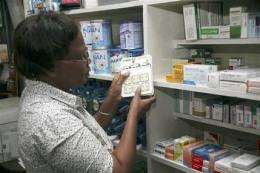
(AP) -- A global health fund believes millions of dollars worth of its donated malaria drugs have been stolen in recent years, vastly exceeding the levels of theft previously suspected, according to confidential documents obtained by The Associated Press.
The internal investigation by the Global Fund to Fight AIDS, Tuberculosis and Malaria comes two months into a new anti-corruption program that the fund launched after an AP report detailing fraud in their grants attracted intense scrutiny from donors.
In internal documents detailing drug thefts, officials identified 13 countries, mostly in Africa, where millions of dollars worth of malaria drugs have gone missing. According to the reports, drug theft in which donated drugs are sold on the black market "appears to be on the rise and (is) becoming increasingly sophisticated."
The reports were provided to the AP by an official with a different health organization, who did so on condition of anonymity because he was granted confidential access to the documents by a Global Fund staffer.
Global Fund spokesman Jon Liden confirmed the fund suspects $2.5 million worth of malaria drugs were stolen from Togo, Tanzania, Sierra Leone, Swaziland and Cambodia, dating mainly from 2009 to 2011, but with some cases going further back. He said investigations are under way to determine how much more was stolen elsewhere.
"We take this very seriously and we will do what it takes to protect our investment," he said.
An AP report in January exposed high rates of misappropriated money in some Global Fund grants and bruised the reputation of the multibillion-dollar fund, backed by big names including Bono and Bill Gates and hailed as an alternative to the bureaucracy of the United Nations.
But the fact that these revelations have come to light at all may be due to stricter self-policing and greater transparency at the Global Fund, compared with other aid organizations.
Malaria infects more than 250 million people every year, killing about 1 million, the vast majority of whom are children in Africa. Because there is a huge demand for malaria drugs, which are widely available at pharmacies and on private markets, they are easier to sell than drugs for other diseases like AIDS, which are mainly handed out at health clinics.
After discovering the scope of the malaria drug thefts, the new Global Fund documents indicate the fund took prompt action, suspending grants for medicines to be stored at government warehouses in Swaziland and Malawi.
Other than the drugs confirmed stolen in Togo, Tanzania, Sierra Leone, Swaziland and Cambodia, specific dollar figures were not available for the other nine countries, all in Africa and including Nigeria and Kenya, where the Global Fund has large programs.
The fund singled out a $200 million contract for malaria drugs in Tanzania in which it suspects theft took place. It listed the theft at more than $1 million but said "the potential cost of the misappropriation is not yet quantified." In Togo, the fund reported $850,000 worth of drugs disappeared in 2008 in a case of "insider stealing."
The audits that the AP wrote about in January suggested that tens of thousands of dollars worth of malaria drugs are stolen every year.
The Global Fund's inspector general said in a report to its board of directors late last year that it was beginning to investigate allegations of "organized theft of anti-malarial drugs" in African countries, after discovering that drugs were ending up on store shelves in African countries instead of going to the intended recipients for free.
The new documents obtained by the AP - which are the results of that investigation - show that in about 70 percent of cases, the drugs were stolen at government-operated warehouses by security personnel, warehouse managers and doctors.
"The cases show that drug misappropriations are well-organized and predominantly planned by insiders using falsified documents," one of the reports said. The documents also state that pilfered drugs are being shipped to other countries for resale, often within hours of their arrival.
Officials wrote there is a "parallel market for the sale of Global Fund-procured drugs" and that many other investigations on alleged thefts in other countries are under way.
Liden said cutting African governments from the medicine supply chain isn't realistic and that setting up independent distribution systems would be too expensive.
"We thoroughly reject the idea that we need to simply clamp down on drugs being sent to poor countries," he said. "That will cost lives."
After the U.S. government discovered evidence that its malaria drugs were disappearing in Angola and Malawi several years ago, it stopped using local government warehouses and set up entirely separate systems to give out U.S. medicines. The Global Fund has occasionally set up separate distribution systems on a temporary basis in Angola and Malawi.
Some experts say the Global Fund's drug distribution system needs to be overhauled.
"If drugs are sitting in a warehouse just waiting to be pilfered, we need to figure out a different way to make sure the people who really need them actually get them," said David Sullivan, a malaria expert at the Johns Hopkins Bloomberg School of Public Health in Baltimore.
Many health officials aren't surprised that malaria drugs are being targeted by criminals, and say no donor agency is immune.
"It's an unfortunate reality that when staff are poorly paid and systems under-resourced, the temptation of selling drugs for money will always be there," said Nathan Ford, a medical coordinator for Doctors Without Borders.
More information: http://www.theglobalfund.org
©2010 The Associated Press. All rights reserved. This material may not be published, broadcast, rewritten or redistributed.


