Newly merged black hole eagerly shreds stars
April 8, 2011
Newly merged black hole eagerly shreds stars

Enlarge

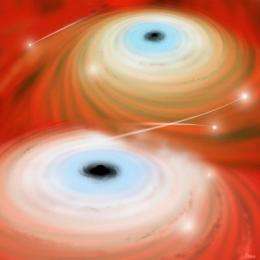
In this artist's conception, two black holes are about to merge. When they combine, gravitational wave radiation will "kick" the black hole like a rocket engine, sending it rampaging through nearby stars. Credit: David A. Aguilar (CfA)

A galaxy's core is a busy place, crowded with stars swarming around an enormous black hole. When galaxies collide, it gets even messier as the two black holes spiral toward each other, merging to make an even bigger gravitational monster.

Once it is created, the monster goes on a rampage. The merger kicks the black hole into surrounding stars. There it finds a hearty meal, shredding and swallowing stars at a rapid clip. According to new research by Nick Stone and Avi Loeb (Harvard-Smithsonian Center for Astrophysics), upcoming sky surveys might offer astronomers a way to catch a gorging black hole "in the act."

Before the merger, as the two black holes whirl around each other, they stir the like the blade of a blender. Their strong gravity warps space, sending out ripples known as gravitational waves. When the merge, they emit gravitational waves more strongly in one direction. That inequality kicks the black hole in the opposite direction like a rocket engine.

"That kick is very important. It can shove the black hole toward stars that otherwise would have been at a safe distance," said Stone.

"Essentially, the black hole can go from starving to enjoying an all-you-can-eat buffet," he added.

When tidal forces rip a star apart, its remains will spiral around the black hole, smashing and rubbing together, heating up enough to shine in the ultraviolet or X-rays. The black hole will glow as brightly as an , or supernova, before gradually fading in a distinctive way.

Importantly, a wandering, supermassive black hole is expected to swallow many more stars than a black hole in an undisrupted galactic center. A stationary black hole disrupts one star every 100,000 years. In the best-case scenario, a wandering black hole could disrupt a star every decade. This would give astronomers a much better opportunity of spotting these events, particularly with new survey facilities like Pan-STARRS and the .

Catching the signal from a disrupted star is a good start. However, astronomers really want to combine that information with gravitational wave data from the black hole merger. The Laser Interferometer Space Antenna (LISA), a future mission designed to detect and study , could provide that data.

Gravitational wave measurements yield very accurate distances (to better than one part in a hundred, or 1 percent). However, they don't provide precise sky coordinates. A star's tidal disruption will let astronomers pinpoint the galaxy containing the recently merged black-hole binary.

By correlating the galaxy's redshift (a change in its light that's caused by the expanding universe) with an accurate distance, astronomers can infer the equation of state of dark energy. In other words, they can learn more about the force that's accelerating cosmic expansion, and which dominates the cosmic mass/energy budget today.

"Instead of 'standard candles' like supernovae, the black hole binary would be a 'standard siren.' Using it, we could create the most accurate cosmic 'ruler' possible," stated Loeb.

Finding a merged black hole also would allow theorists to explore a new regime of Einstein's general theory of relativity.

"We could test general relativity in the regime of strong gravity with unprecedented precision," said Loeb.

Provided by Harvard-Smithsonian Center for Astrophysics (news : web)

Filter


Move the slider to adjust rank threshold, so that you can hide some of the comments.


Display comments: newest first

omatumr
Apr 08, 2011

Rank: 1.7 / 5 (10)
The main question is whether these massive objects are

a.) Fragmenting from repulsive interactions between neutrons to produce nuclei of new stars, or

b.) "Shredding" nearby stars.

For reasons given here [Neutron Repulsion, The APEIRON Journal, in press, 19 pages,
http://arxiv.org/...2.1499v1 ], I suspect that the correct answer is a.)

With kind regards,
OLiver K. Manuel
MrPressure
Apr 09, 2011

Rank: 1 / 5 (7)
I just wonder, how they see huge black holes galaxys centre 10 - 13 billion years ago?

Why this huge black holes galaxys centre are not more bigger what they was 10 billin years ago?

i think, it is because there is no drawing force at all.

Galaxys born inside to outisde.

galaxys open up just like flowers, you know.

Galaxys centre huge denser expanding / exploding and emit energywaves who have a nature of atoms.

It is entropy.

also quarks and particle like phtons and neutrinos expanding and emit smaller denser and thats why old light is redshifting, you know.

There is no expanding space at all!

.

mayan
Apr 09, 2011

Rank: 1 / 5 (5)
LIFE started from coal, has benzene rings which started life on earth. Avoid coal and look for oil wells
omatumr
Apr 10, 2011

Rank: 1 / 5 (4)
Neutron repulsion is explained in this video:

www.youtube.com/w...yLYSiPO0

With kind regards,
Oliver K. Manuel
omatumr
Apr 10, 2011

Rank: 1 / 5 (4)
Noumenal
Apr 10, 2011

Rank: 5 / 5 (3)
these are some awful comments
spaceagesoup
Apr 11, 2011

Rank: not rated yet
lol with Noumenal, indeed!

I don't have the physics to assess this, but am curious if the current gamma ray event 110328A (not willing to call two weeks a single burst) is a result of a merged black hole system going through its neighbours...
yyz
Apr 11, 2011

Rank: 5 / 5 (2)
@spaceagesoup,

It is rather interesting (but coincidental) that news of 110328A breaks around the time of this story. At this point, though, I think it's too early to tell precisely what's going on with this galaxy wrt the outburst.

There's still too little hard info available to make an informed guess. There has been some talk as to if this object is related to blazars (which includes BL Lac and Optically Violent Variable galaxies) which exhibit relatavistic jets beamed toward us.

Stan Woosley (UCSC)has opined that this could be a scaled-up version of what we see in standard GRBs. In this case the core of the massive star collapses to form a BH while the outer layers take days to fall in, producing the prolonged outburst: http://www.scienc...t_galaxy

This mechanism has been invoked before to explain a handful of unusual (long-duration)GRBs, so there might be some connection.
Rank 5 /5 (9 votes)
Related Stories
Relevant PhysicsForums posts
  • Calculating the magnitude
    created2 hours ago
  • What is this spectrum I took?
    created12 hours ago
  • Orientation of Space
    created12 hours ago
  • Geologically Active Moon Now: NASA
    created19 hours ago
  • advice on building a science fair telescope
    createdFeb 22, 2012
  • Rise of the Sun
    createdFeb 22, 2012
  • More from Physics Forums - General Astronomy

More news stories

Spitzer finds solid buckyballs in space

(PhysOrg.com) -- Astronomers using data from NASA's Spitzer Space Telescope have, for the first time, discovered buckyballs in a solid form in space. Prior to this discovery, the microscopic carbon spheres ...

Space & Earth / Astronomy

created 14 hours ago | popularity 4.7 / 5 (12) | comments 8 | with audio podcast

Going up: Japan builder eyes space elevator

A Japanese construction firm claimed Wednesday it could execute an out-of-this-world plan to put tourists in space within 40 years by building an elevator that stretches a quarter of the way to the moon.

Space & Earth / Space Exploration

created 21 hours ago | popularity 3.5 / 5 (13) | comments 26

ENASA satellite finds Earth's clouds are getting lower

(PhysOrg.com) -- Earth's clouds got a little lower -- about one percent on average -- during the first decade of this century, finds a new NASA-funded university study based on NASA satellite data. The results ...

Space & Earth / Earth Sciences

created 18 hours ago | popularity 5 / 5 (8) | comments 13 | with audio podcast

Fresh scandal embroils US climate science debate

A fresh scandal over climate change has erupted in the United States after leaked documents appeared to show a right-wing funded campaign to influence how climate science is taught in schools.

Space & Earth / Environment

created 10 hours ago | popularity 4.1 / 5 (9) | comments 8

World's oceans get an acid bath

Among the repercussions of global climate change, the effect of ocean acidification on marine life is one of the least-understood variables.

Space & Earth / Environment

created 17 hours ago | popularity 4.3 / 5 (6) | comments 4 | with audio podcast


Researchers build first physical 'metatronic' circuit

(PhysOrg.com) -- The technological world of the 21st century owes a tremendous amount to advances in electrical engineering, specifically, the ability to finely control the flow of electrical charges using ...

Faster than light neutrinos? More like faulty wiring

You can shelf your designs for a warp drive engine (for now) and put the DeLorean back in the garage; it turns out neutrinos may not have broken any cosmic speed limits after all.

Physicists surprised by disappearing and reappearing superconductivity in iron selenium chalcogenides

Superconductivity is a rare physical state in which matter is able to conduct electricity -- maintain a flow of electrons -- without any resistance. This phenomenon can only be found in certain materials at low temperatures, ...

CT colonography shown to be comparable to standard colonoscopy

Computerized tomographic (CT) colonography (CTC), also known as virtual colonoscopy, is comparable to standard colonoscopy in its ability to accurately detect cancer and precancerous polyps in people ages 65 and older, according ...

Stanford research team cracks animated NuCaptcha

(PhysOrg.com) -- The research team from Stanford University, led by Elie Bursztein, that previously had cracked regular CAPTCHAs and then audio CAPTCHAs, now has also successfully cracked the animated version called NuCapt ...

Study: Virtual colonoscopy effective screening tool for adults over 65

Computed tomography (CT) colonography can be used as a primary screening tool for colorectal cancer in adults over the age of 65, according to a new study published online in the journal Radiology.