Scientists create stable, self-renewing neural stem cells
April 25, 2011
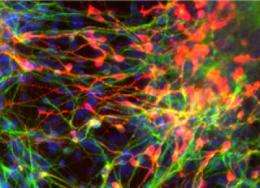
The image depicts stained mature neurons, derived from precursor cells, expressing the neurotransmitter dopamine. Credit: UC San Diego School of Medicine
In a paper published in the April 25 early online edition of the Proceedings of the National Academy of Sciences, researchers at the University of California, San Diego School of Medicine, the Gladstone Institutes in San Francisco and colleagues report a game-changing advance in stem cell science: the creation of long-term, self-renewing, primitive neural precursor cells from human embryonic stem cells (hESCs) that can be directed to become many types of neuron without increased risk of tumor formation.
"It's a big step forward," said Kang Zhang, MD, PhD, professor of ophthalmology and human genetics at Shiley Eye Center and director of the Institute for Genomic Medicine, both at UC San Diego. "It means we can generate stable, renewable neural stem cells or downstream products quickly, in great quantities and in a clinical grade millions in less than a week that can be used for clinical trials and, eventually, for clinical treatments. Until now, that has not been possible."
Human embryonic stem cells hold great promise in regenerative medicine due to their ability to become any kind of cell needed to repair and restore damaged tissues. But the potential of hESCs has been constrained by a number of practical problems, not least among them the difficulty of growing sufficient quantities of stable, usable cells and the risk that some of these cells might form tumors.
To produce the neural stem cells, Zhang, with co-senior author Sheng Ding, PhD, a former professor of chemistry at The Scripps Research Institute and now at the Gladstone Institutes, and colleagues added small molecules in a chemically defined culture condition that induces hESCs to become primitive neural precursor cells, but then halts the further differentiation process.
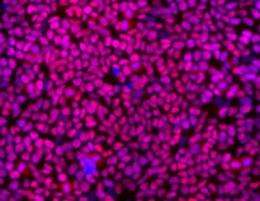
Depicts cultured, self-renewing primitive neural precursors derived from human embryonic stem cells using molecule inhibitors. Credit: UC San Diego
"And because it doesn't use any gene transfer technologies or exogenous cell products, there's minimal risk of introducing mutations or outside contamination," Zhang said. Assays of these neural precursor cells found no evidence of tumor formation when introduced into laboratory mice.By adding other chemicals, the scientists are able to then direct the precursor cells to differentiate into different types of mature neurons, "which means you can explore potential clinical applications for a wide range of neurodegenerative diseases," said Zhang. "You can generate neurons for specific conditions like amyotrophic lateral sclerosis (ALS or Lou Gehrig's disease), Parkinson's disease or, in the case of my particular research area, eye-specific neurons that are lost in macular degeneration, retinitis pigmentosa or glaucoma."
The new process promises to have broad applications in stem cell research. The same method can be used to push induce pluripotent stem cells (stem cells artificially derived from adult, differentiated mature cells) to become neural stem cells, Zhang said. "And in principle, by altering the combination of small molecules, you may be able to create other types of stem cells capable of becoming heart, pancreas, or muscle cells, to name a few."
The next step, according to Zhang, is to use these stem cells to treat different types of neurodegenerative diseases, such as macular degeneration or glaucoma in animal models.
Provided by University of California - San Diego (news : web)
-
New study hopeful on neural stem cells
Aug 05, 2006 |
not rated yet |
0
-
Researchers find stem cells from monkey teeth can stimulate growth and generation of brain cells
Nov 11, 2008 |
not rated yet |
0
-
Creating ideal neural cells for clinical use
Apr 13, 2009 |
not rated yet |
0
-
Researchers Stimulate Growth of Neural Stem Cells in Adult Brain for Treatment of Neurological Disorders
Nov 15, 2006 |
not rated yet |
0
-
Induced neural stem cells: Not quite ready for prime time
Feb 15, 2010 |
not rated yet |
0
-
Stars containing dark matter should look different from other stars
Feb 20, 2012 |
4.5 / 5 (17) |
11
-
Physicists discover evidence of rare hypernucleus, a component of strange matter
Feb 17, 2012 |
4.7 / 5 (38) |
22
-
Fast photon control brings quantum photonic technologies closer
Feb 13, 2012 |
5 / 5 (8) |
1
-
Engineers build first sub-10-nm carbon nanotube transistor
Feb 01, 2012 |
4.9 / 5 (36) |
32
-
Something old, something new: Evolution and the structural divergence of duplicate genes
Jan 31, 2012 |
4.6 / 5 (7) |
1
-
Eye biology videos
4 hours ago
-
Flowering Plant Revived After 30,000 Years in Permafrost
Feb 21, 2012
-
Toba volcano eruptions - 1.000 - 10,000 breeding pairsunb
Feb 20, 2012
-
How is a specific gene removed from DNA
Feb 20, 2012
-
Reproduction and Human evolution
Feb 19, 2012
-
Viruses: Living or Non-living organisms
Feb 19, 2012
- More from Physics Forums - Biology
More news stories
Surprising diversity at a synapse hints at complex diversity of neural circuitry
A new study reveals a dazzling degree of biological diversity in an unexpected place a single neural connection in the body wall of flies.
10 hours ago |
5 / 5 (4) |
0
|
Men might not 'become extinct' after all: Theory of the 'rotting' Y chromosome dealt a fatal blow
If you were to discover that a fundamental component of human biology has survived virtually intact for the past 25 million years, you'd be quite confident in saying that it is here to stay.
13 hours ago |
5 / 5 (6) |
1
|
New family of legless amphibians found in India
Since before the age of dinosaurs it has burrowed unbothered beneath the monsoon-soaked soils of remote northeast India - unknown to science and mistaken by villagers as a deadly, miniature snake.
21 hours ago |
5 / 5 (8) |
3
Climate change affects bird migration timing in North America
Bird migration timing across North America has been affected by climate change, according to a study published Feb. 22 in the open access journal PLoS ONE.
9 hours ago |
4.5 / 5 (2) |
2
New iridescent lizard species found in Cambodia
A new species of lizard with striking iridescent rainbow skin, a long tail and very short legs has been discovered in the rainforest in northeast Cambodia, conservationists announced Wednesday.
10 hours ago |
not rated yet |
0
Researchers build first physical 'metatronic' circuit
(PhysOrg.com) -- The technological world of the 21st century owes a tremendous amount to advances in electrical engineering, specifically, the ability to finely control the flow of electrical charges using ...
Spitzer finds solid buckyballs in space
(PhysOrg.com) -- Astronomers using data from NASA's Spitzer Space Telescope have, for the first time, discovered buckyballs in a solid form in space. Prior to this discovery, the microscopic carbon spheres ...
Faster than light neutrinos? More like faulty wiring
You can shelf your designs for a warp drive engine (for now) and put the DeLorean back in the garage; it turns out neutrinos may not have broken any cosmic speed limits after all.
Physicists surprised by disappearing and reappearing superconductivity in iron selenium chalcogenides
Superconductivity is a rare physical state in which matter is able to conduct electricity -- maintain a flow of electrons -- without any resistance. This phenomenon can only be found in certain materials at low temperatures, ...
CT colonography shown to be comparable to standard colonoscopy
Computerized tomographic (CT) colonography (CTC), also known as virtual colonoscopy, is comparable to standard colonoscopy in its ability to accurately detect cancer and precancerous polyps in people ages 65 and older, according ...
Stanford research team cracks animated NuCaptcha
(PhysOrg.com) -- The research team from Stanford University, led by Elie Bursztein, that previously had cracked regular CAPTCHAs and then audio CAPTCHAs, now has also successfully cracked the animated version called NuCapt ...

Apr 25, 2011
Rank: 4 / 5 (4)
Apr 25, 2011
Rank: 1 / 5 (1)
Apr 26, 2011
Rank: not rated yet
Apr 26, 2011
Rank: 5 / 5 (1)
Apr 29, 2011
Rank: not rated yet
Apr 30, 2011
Rank: 1 / 5 (1)