Solar power goes viral: Modified virus improves solar-cell efficiency by one-third
(PhysOrg.com) -- Researchers at MIT have found a way to make significant improvements to the power-conversion efficiency of solar cells by enlisting the services of tiny viruses to perform detailed assembly work at the microscopic level.
In a solar cell, sunlight hits a light-harvesting material, causing it to release electrons that can be harnessed to produce an electric current. The new MIT research, published online this week in the journal Nature Nanotechnology, is based on findings that carbon nanotubes — microscopic, hollow cylinders of pure carbon — can enhance the efficiency of electron collection from a solar cell's surface.
Previous attempts to use the nanotubes, however, had been thwarted by two problems. First, the making of carbon nanotubes generally produces a mix of two types, some of which act as semiconductors (sometimes allowing an electric current to flow, sometimes not) or metals (which act like wires, allowing current to flow easily). The new research, for the first time, showed that the effects of these two types tend to be different, because the semiconducting nanotubes can enhance the performance of solar cells, but the metallic ones have the opposite effect. Second, nanotubes tend to clump together, which reduces their effectiveness.
And that’s where viruses come to the rescue. Graduate students Xiangnan Dang and Hyunjung Yi — working with Angela Belcher, the W. M. Keck Professor of Energy, and several other researchers — found that a genetically engineered version of a virus called M13, which normally infects bacteria, can be used to control the arrangement of the nanotubes on a surface, keeping the tubes separate so they can’t short out the circuits, and keeping the tubes apart so they don’t clump.
The system the researchers tested used a type of solar cell known as dye-sensitized solar cells, a lightweight and inexpensive type where the active layer is composed of titanium dioxide, rather than the silicon used in conventional solar cells. But the same technique could be applied to other types as well, including quantum-dot and organic solar cells, the researchers say. In their tests, adding the virus-built structures enhanced the power conversion efficiency to 10.6 percent from 8 percent — almost a one-third improvement.
This dramatic improvement takes place even though the viruses and the nanotubes make up only 0.1 percent by weight of the finished cell. “A little biology goes a long way,” Belcher says. With further work, the researchers think they can ramp up the efficiency even further.
The viruses are used to help improve one particular step in the process of converting sunlight to electricity. In a solar cell, the first step is for the energy of the light to knock electrons loose from the solar-cell material (usually silicon); then, those electrons need to be funneled toward a collector, from which they can form a current that flows to charge a battery or power a device. After that, they return to the original material, where the cycle can start again. The new system is intended to enhance the efficiency of the second step, helping the electrons find their way: Adding the carbon nanotubes to the cell “provides a more direct path to the current collector,” Belcher says.
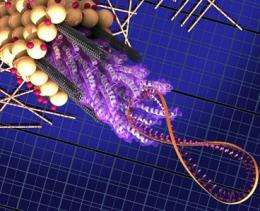
The viruses actually perform two different functions in this process. First, they possess short proteins called peptides that can bind tightly to the carbon nanotubes, holding them in place and keeping them separated from each other. Each virus can hold five to 10 nanotubes, each of which is held firmly in place by about 300 of the virus's peptide molecules. In addition, the virus was engineered to produce a coating of titanium dioxide (TiO2), a key ingredient for dye-sensitized solar cells, over each of the nanotubes, putting the titanium dioxide in close proximity to the wire-like nanotubes that carry the electrons.
The two functions are carried out in succession by the same virus, whose activity is “switched” from one function to the next by changing the acidity of its environment. This switching feature is an important new capability that has been demonstrated for the first time in this research, Belcher says.
In addition, the viruses make the nanotubes soluble in water, which makes it possible to incorporate the nanotubes into the solar cell using a water-based process that works at room temperature.
Prashant Kamat, a professor of chemistry and biochemistry at Notre Dame University who has done extensive work on dye-sensitized solar cells, says that while others have attempted to use carbon nanotubes to improve solar cell efficiency, “the improvements observed in earlier studies were marginal,” while the improvements by the MIT team using the virus assembly method are “impressive.”
“It is likely that the virus template assembly has enabled the researchers to establish a better contact between the TiO2 nanoparticles and carbon nanotubes. Such close contact with TiO2 nanoparticles is essential to drive away the photo-generated electrons quickly and transport it efficiently to the collecting electrode surface.”
Kamat thinks the process could well lead to a viable commercial product: “Dye-sensitized solar cells have already been commercialized in Japan, Korea and Taiwan,” he says. If the addition of carbon nanotubes via the virus process can improve their efficiency, “the industry is likely to adopt such processes.”
Belcher and her colleagues have previously used differently engineered versions of the same virus to enhance the performance of batteries and other devices, but the method used to enhance solar cell performance is quite different, she says.
Because the process would just add one simple step to a standard solar-cell manufacturing process, it should be quite easy to adapt existing production facilities and thus should be possible to implement relatively rapidly, Belcher says.
More information: Virus-templated self-assembled single-walled carbon nanotubes for highly efficient electron collection in photovoltaic devices, Xiangnan Dang, Hyunjung Yi, Moon-Ho Ham, Jifa Qi, Dong Soo Yun, Rebecca Ladewski, Michael S. Strano, Paula T. Hammond & Angela M. Belcher, Nature Nanotechnology (2011) doi:10.1038/nnano.2011.50
Abstract
The performance of photovoltaic devices could be improved by using rationally designed nanocomposites with high electron mobility to efficiently collect photo-generated electrons. Single-walled carbon nanotubes exhibit very high electron mobility, but the incorporation of such nanotubes into nanocomposites to create efficient photovoltaic devices is challenging. Here, we report the synthesis of single-walled carbon nanotube–TiO2 nanocrystal core–shell nanocomposites using a genetically engineered M13 virus as a template. By using the nanocomposites as photoanodes in dye-sensitized solar cells, we demonstrate that even small fractions of nanotubes improve the power conversion efficiency by increasing the electron collection efficiency. We also show that both the electronic type and degree of bundling of the nanotubes in the nanotube/TiO2 complex are critical factors in determining device performance. With our approach, we achieve a power conversion efficiency in the dye-sensitized solar cells of 10.6%.
Provided by Massachusetts Institute of Technology


