Thermophiles lurking in your basement
Ever wondered what exotic life forms may be lurking in the dark, hidden corners of your home? Scientists wonder too. Studies have shown that our modern plumbing systems provide sanctuary to a menagerie of microbes. A new pilot project plans to elicit the help of homeowners to catalogue the life growing in their water heaters. The research may give clues to how microbes evolve in the wild.
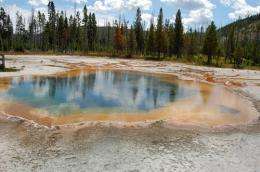
Forty years ago, scientists discovered certain heat-loving microbes, or thermophiles, living in domestic water heaters. These same bugs are found in hot springs, like those in Yellowstone and Iceland.
"We are asking people to sample the hot spring in their own basement," says Christopher House from Penn State University.
House and his colleagues will be doing follow-up testing on these samples to get a sense of the biodiversity in the water heater environment. With financial support from the NASA Astrobiology Institute, they hope to collect a wide geographic sampling from across the country.
"Are the thermophiles in New York the same as in Alaska or Hawaii?" House wonders.
Thermophiles have special astrobiological significance, since early Mars may have had hot springs and Saturn's moon Europa may have hydrothermal vents beneath its icy crust. And some genetic studies have suggested that all life on Earth may have evolved from heat-loving organisms.
"What I think is interesting is that we could learn something about the evolution of new life forms from what's growing in your home," says plant pathologist David Geiser, also from Penn State but not involved with this project.
Heat sensitivity
The thought of an extreme form of life in our water supply might set off alarms. Have we humans unwittingly helped create some super-bug by keeping our water heater settings too high?
House assures that there is nothing to worry about. "These microbes are harmless," he says.
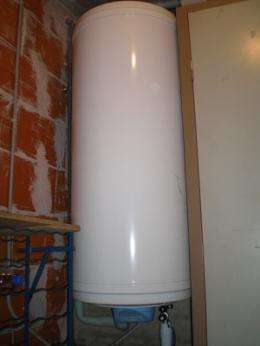
Surprisingly, many thermophiles find our hot water too cold. The most extreme organisms thrive above 80 degrees Celsius (176 degrees Fahrenheit), which is much higher than any water heater temperature. To date, the most prevalent thermophiles isolated from water heaters have been those from the genus Thermus, which survive in temperatures from about 50 to 80 degrees Celsius (112 to 176 degrees Fahrenheit).
House points out that Thermus and other thermophiles don't necessarily die when the temperature drops below their comfort zone. They simply become inactive, or "frozen."
Home bodies
This is the first citizen science project focused on microbiology in the home, according to House. Previous studies of the indoor environment have been carried out by trained scientists. For example, a 2009 paper from the Proceedings of the National Academy of Sciences showed a rather disturbing amount of bacteria living in our shower heads.
"My intent is not to expose any lack of cleanliness in people's homes," House says.
But regardless, most people are (blissfully) unaware of how many microbes inhabit their homes. Our water supply is typically treated to kill pathogens, but still many bugs get through.
Geiser studies the fungi that cling to our sink drains. He believes indoor microbes can be extremophiles because they survive harsh chemicals, intermittent water flow and other "unnatural" things we do in our households.
"It's been a major challenge for microbes to take advantage of this relatively recent niche, which we try to make as inhospitable as possible for them," Geiser says.
Microbiology at home
Volunteers to House's project will first be asked to fill out a survey on their plumbing and water heater. They will then be instructed to take a sample from one of their hot water taps and pass it through a filter that traps microbes. A temperature and pH reading of the hot water will be taken separately.
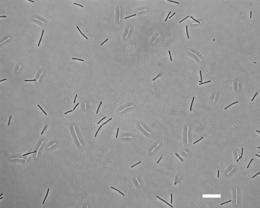
The citizen scientists will also be asked take a portion of the microbe sample from the filter and incubate it in their oven for an hour. The heat will "pasteurize" the sample by killing low-temperature bugs, while culturing the growth of any thermophiles present.
All the collected material will be sent to House and his colleagues, who will do a thorough analysis of the water chemistry and full DNA tests of the microbial samples. House expects to find various strains of Thermus in the incubated cultures, but other thermophiles may show up.
Could an entirely new species be found? "It's always possible, says House. The DNA tests will use generic sequences that should catch just about anything.
"This does sound like an interesting study," says Laura Baumgartner from the University of Colorado, Boulder, who was involved in the earlier shower head investigation. "I suspect that you will find that each water heater supports a slightly different microbiota, which may be a subset of that found in the house water."
The project is in the midst of organizing a pool of 100 to 200 volunteers from all 50 states (interested individuals can apply here). The focus is on families without scientific backgrounds.
"We hope to inspire kids about microbiology and astrobiology," House says.
Evolutionary factors
Once the data is all in, House and his colleagues will look to see if particular strains of thermophiles cluster in particular regions of the country. This could be an indication of allopatric speciation, which is the evolution of new species based on geographic separation.
It's well known that two populations of animals or plants that are spatially separated will eventually develop genetic differences, but the importance of geography is not so clear for microbes. Since hot springs are like secluded islands, the thermophiles living there are considered a great model system for studying microbial evolution.
"Because they are isolated we use these populations as replicates of Nature's evolutionary experiment," says Rachel Whitaker, a microbiologist from the University of Illinois. "We are trying to understand how varying conditions between locations changes the evolutionary process in each population."
House hopes his project with "domesticated" thermophiles will support the work of Whitaker and others by uncovering factors, like water pH or temperature, that may be influencing the biodiversity in water heaters.
Provided by Astrobio.net


