Business information consumption: 9,570,000,000,000,000,000,000 bytes per year
April 6, 2011
Business information consumption: 9,570,000,000,000,000,000,000 bytes per year

(PhysOrg.com) -- Three scientists at UC San Diego have rigorously estimated the annual amount of business-related information processed by the world's computer servers in terms that Guttenberg and Galileo would have appreciated: the digital equivalent of a 5.6-billion-mile-high stack of books from Earth to Neptune and back to Earth, repeated about 20 times a year.

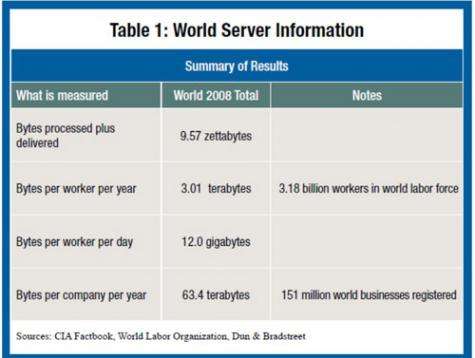
The world's roughly 27 million processed 9.57 zettabytes of information in 2008, according to a paper to be presented April 7 at Storage Networking World's (SNW's) annual meeting in Santa Clara, Calif.

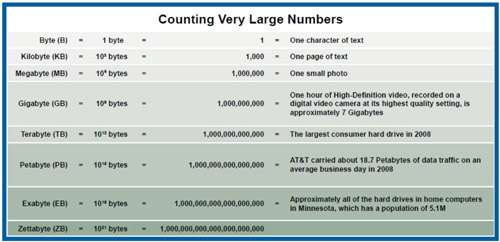
The first-of-its kind rigorous estimate was generated with server-processing performance standards, server-industry reports, interviews with information technology experts, sales figures from server manufacturers and other sources. (One zettabyte is 10 to the 21st power, or a million million gigabytes.)

The study estimated that enterprise server workloads are doubling about every two years, which means that by 2024 the world's enterprise servers will annually process the digital equivalent of a stack of books extending more than 4.37 light-years to Alpha Centauri, our closest neighboring star system in the Galaxy. (Each book is assumed to be 4.8 centimeters thick and contain 2.5 megabytes of information.)

"Most of this information is incredibly transient: it is created, used, and discarded in a few seconds without ever being seen by a person," said Roger Bohn, one of the report's co-authors and a professor of technology management at UC San Diego's School of International Relations and Pacific Studies. "It's the underwater base of the iceberg that runs the world that we see."

The authors of the report titled "How Much Information: 2010 Report on Enterprise Server Information" are Bohn, James E. Short, a research scientist at UC San Diego's School of International Relations and Pacific Studies and research director of the HMI? project, and Chaitanya K. Baru, a distinguished scientist at the San Diego Supercomputer Center.
Business information consumption: 9,570,000,000,000,000,000,000 bytes per year
Enlarge


The paper follows an earlier report on information consumption by U.S. households as part of The How Much Information? project. The effort is designed to conduct a census of the world's information in 2008 and onward, and is supported by AT&T, Cisco Systems, IBM, Intel, LSI, Oracle and Seagate Technology. Early support was provided by the Alfred P. Sloan Foundation.

"The exploding growth in stored collections of numbers, images and other data is well known, but mere data becomes more important when it is actively processed by servers as representing meaningful information delivered for an ever-increasing number of uses," said Short. "As the capacity of servers to process the digital universe's expanding base of information continues to increase, the development itself creates unprecedented challenges and opportunities for corporate information officers."

The workload of all 27 million of the world's enterprise servers in use in 2008 was estimated by using cost and performance benchmarks for online transaction processing, Web services and virtual machine processing.

"Of course, we couldn't directly measure the allocation of workload to millions of servers worldwide, but we received important guidance from experts, industry data and our own judgment," Short said. "Since our capacity assumptions, methodology and calculations are complex, we have prepared a separate technical paper as background to explain our methodology and provide sample calculations."

Servers amount to the unseen, ubiquitous, humming computational infrastructure of modern economies. The study estimated that each of the 3.18 billion workers in the world's labor force received an average of 3 terabytes of information per year.

Rather than focusing on raw processing power, the new analysis focused on server performance per dollar invested as a more consistent yardstick across a wide array of server types and sizes. "While midrange servers doubled their Web processing and business application workloads every 2 years, they doubled their performance per dollar every 1.5 years," Bohn said.

The 36-page "How Much Information?" report said total worldwide sales of all servers has remained stable at about $50-$55 billion per year for five years ending in 2008, while new-server performance as measured by industry benchmarks went up five- to eight-fold during the same period. Entry-level servers costing less than $25,000 processed about 65 percent of the world's information in 2008, midrange servers processed 30 percent, and high-end servers costing $500,000 or more processed 5 percent of the world's information in 2008.

The report's authors note that the estimated workload of the world's servers may be an underestimate because server-industry sales figures don't fully include the millions of servers built in-house from component parts by Google, Microsoft, Yahoo! and others.

The study estimated a sharp increase in virtualization beginning in 2006, in which many distinct "virtual servers" can run on one physical server. Virtualization is a way to improve energy efficiency, scalability and overall performance of large-scale information processing. One of its uses is for cloud computing in which server-processing power is provided as a centrally administered commodity that business clients can pay for as needed.

"Corporations and organizations that have huge and growing databases are compelled to rethink how they accomplish economies of scale, which is why many are now embracing cloud computing initiatives and green datacenters," said Baru. "In addition, a corporation's competitiveness will increasingly hinge on its ability to employ innovative search techniques that help users discover data and obtain useful results, and automatically offer recommendations for subsequent searches."

Measuring worldwide flows of information is an inexact science, and the How Much Information project will issue additional analyses as improved metrics become available and accepted. In 2007, the International Data Corporation and EMC Corp. reported that the total digital universe of information created, captured or replicated digitally was 281 exabytes and would not reach 1 until 2010. The study by Short, Bohn and Baru included estimates of the amount of data processed as input and delivered by servers as output. For example, one email message may flow through multiple servers and be counted multiple times.

The How Much paper points to the importance of data archiving and digital-data preservation. "Preserving data is an increasingly important challenge for business organizations and arbitrary age limits make little sense," said Baru. "In the future, data archiving and preservation will require as much enthusiasm in research and industry settings as we have provided to data generation and data processing."

Provided by University of California - San Diego (news : web)

4.4 /5 (8 votes)  

Filter


Move the slider to adjust rank threshold, so that you can hide some of the comments.


Display comments: newest first

Skeptic_Heretic
Apr 06, 2011

Rank: 3 / 5 (2)
And now that number is wrong.

That's the problem with this calculation, the rate of data influx is ever increasing, however, their method is fairly excellent, and as far as estimations go, I'd agree with the manner in which the work was done.
Quantum_Conundrum
Apr 06, 2011

Rank: 1 / 5 (1)
And now that number is wrong.

That's the problem with this calculation, the rate of data influx is ever increasing, however, their method is fairly excellent, and as far as estimations go, I'd agree with the manner in which the work was done.


Most of the "data" is redundant anyway. How many times per day does this web site get viewed?

All the submit, cancel buttons and other stuff is re-loaded every time the page reloads, the pictures and logos, etc, take up as much or more as anything else, and all represent data that is being processed, even if it is templates, switches and stuff like that.

Most of it is completely redundant, exact same thing over and over.

Heck, the majority may even be the actual markup for HTML and Javascript.
J-n
Apr 06, 2011

Rank: not rated yet
Redundant, yes, i suspect SYN/ACK packages account for more than the reloads on pages tho.
GSwift7
Apr 06, 2011

Rank: 5 / 5 (1)
the digital equivalent of a 5.6-billion-mile-high stack of books from Earth to Neptune and back to Earth


Wow, that's a really fantastic number. Impossible to conceptualize on our human scale.

..., repeated about 20 times a year.


I nearly fell out of my chair when I got to that part.
Skeptic_Heretic
Apr 06, 2011

Rank: 5 / 5 (1)
Most of the "data" is redundant anyway. How many times per day does this web site get viewed?

But that's temporary data. Thde important bit is how many times and when did you or I visit the article, then the dynamics and viewership stats. A single web page visit creates an astronomical amount of data that can be saved or discarded.

As for redundant data, redundant data still has a timestamp.
Quantum_Conundrum
Apr 06, 2011

Rank: 3 / 5 (2)
Actually, the numbers are not correct.

Though the metric scale goes up in words corresponding to groups of 1000, i.e. kilo, mega, giga, terra, in computer science, it goes up as multiples of 2^10, or 1024...

So kilobyte is not 1000, it is 1024
Megabyte is not 1,000,000, it is 1024^2, or 1048576, etc

1 Zettabyte is therefore: 1024^7 = 1,180,591,620,717,411,303,424

Doesn't look like a big deal, but if you divide that back into the number above, you find that it's actually only 8.106 Zettabytes...

by the time you get to the 7th power, those missing "24s" make that much difference...

So your stack of books, using the real definition of "N-bytes", including megabytes, but assuming their 4.8cm thickness, is actually:

148,425,292,969 kilometers

Which is 32.59 times the distance to Neptune, or 16 round trips, not 20.

Also, Neptune is nowhere near 5.6 billion miles, it is about half that, at 4.55 billion kilometers...

In general, bad writing here...
Skeptic_Heretic
Apr 06, 2011

Rank: 5 / 5 (1)
by the time you get to the 7th power, those missing "24s" make that much difference...

True, but they didn't make that mistake in the research, only in the journalism.

edit: damn broke my own rule of "read the whole post". You covered that, my bad.
Quantum_Conundrum
Apr 06, 2011

Rank: not rated yet
If we doubled the data every 2 years, as this article claims, and for the sake of argument round up, then that would be multiply this amount of data by 2^7, or 128.

This would give 1037.5 Zettabytes (using 1024^n computer science formula.)

The distance this would be is:

1.8998E13 km

Which is only 2 light years...
Quantum_Conundrum
Apr 06, 2011

Rank: not rated yet
Anyway, as computers continue to advance, we may need several more prefixes added to the standard terminology...

1037 Zettabytes by 2024...

We could do double prefixes, like this:

1 Kilo-Zettabyte (2024)
1 Mega-Zettabyte (2038?)
1 Giga-Zettabyte (2051?)
Bobamus_Prime
Apr 06, 2011

Rank: not rated yet
QC:
Actually, the numbers are not correct.


148,425,292,969 kilometers

Which is 32.59 times the distance to Neptune, or 16 round trips, not 20.

Also, Neptune is nowhere near 5.6 billion miles, it is about half that, at 4.55 billion kilometers...

In general, bad writing here...


If you read the headline
5.6-billion-mile-high stack of books from Earth to Neptune and back to Earth
It is correct. Just using an estimation of Neptune being located 30 AU away would give you 2.79 billion miles for a 1way trip, the headline said it was round trip so ya... 5.6 billion miles is spot on.
plasticpower
Apr 06, 2011

Rank: not rated yet
I don't like when bytes are compared to paper books. A single book can fit into 0.25Mb but will contain massive amounts of useful information compared to a 150Mb Youtube video.
Quantum_Conundrum
Apr 06, 2011

Rank: not rated yet
Plasticpower:

Point taken.

Books are probably a more efficient medium for data than web pages also.

to get an idea how much of the data transmitted by servers is markup, just use the "view source" option in your web browser on this page. Before this post, I got 1278 lines, and the letter "A" appears 3870 times. A text copy of the markup for this page is 84kb, but this doesn't count the external javascripts, style sheets, and images which are linked to, which are generated dynamically by the virtual engine and template engines on the server, and also must be transmitted and loaded...
Cynical1
Apr 07, 2011

Rank: 5 / 5 (1)
Like my Grandpa used to say - you don't know how much useless crap is in the universe, 'til someone gets a grant to study it...
Actually, he didn't say that...
Jayman
Apr 07, 2011

Rank: not rated yet
Is that all? I account for 7-8 zeros myself !!
Quantum_Conundrum
Apr 07, 2011

Rank: not rated yet
Is that all? I account for 7-8 zeros myself !!


Actually, based on world population and the fact many people don't use the internet at all, that amount distributed across the average person who actually uses the internet comes to around 500gigabytes per person.

So you actually count for around 11 to 11.5 of those zeros...we all do...
CWonPhysOrg
Apr 10, 2011

Rank: not rated yet
Sorry, but I can't forgo a chuckle about the term "Rigorously Estimated" ... as in Joe Sixpack "rigorously estimated" his IRS liability.

... just struck me funny.
Rank 4.4 /5 (8 votes)
Relevant PhysicsForums posts
  • Computer Architecture Help
    createdFeb 15, 2012
  • Emulators on lower powered spartphones - PSX4droid
    createdFeb 14, 2012
  • Digital scratch pad?
    createdFeb 13, 2012
  • Quantum computer faster than regular computer?
    createdFeb 13, 2012
  • Synergistic relations between computer science and technology.
    createdFeb 06, 2012
  • how do iphone gloves work?
    createdFeb 05, 2012
  • More from Physics Forums - Computing & Technology

More news stories

Stanford research team cracks animated NuCaptcha

(PhysOrg.com) -- The research team from Stanford University, led by Elie Bursztein, that previously had cracked regular CAPTCHAs and then audio CAPTCHAs, now has also successfully cracked the animated version called NuCapt ...

Technology / Computer Sciences

created 17 hours ago | popularity 5 / 5 (3) | comments 6 | with audio podcast report

Tiny, implantable medical device can propel itself through bloodstream

Someday, your doctor may turn to you and say, "Take two surgeons and call me in the morning." If that day arrives, you may just have Ada Poon to thank.

Technology / Engineering

created 17 hours ago | popularity 5 / 5 (9) | comments 8 | with audio podcast

Italian engineer invents floating solar panels

Rays of the winter sun bounce off gleaming mirrors on the tiny lake of Colignola in Italy, where engineers have built a cost-effective prototype for floating, rotating solar panels.

Technology / Energy & Green Tech

created 21 hours ago | popularity 4.7 / 5 (6) | comments 5

Microsoft hits Motorola, Google with EU complaint

Microsoft on Wednesday lodged a formal complaint with the European Union's competition regulator against Motorola Mobility and its soon-to-be owner Google, saying Motorola's aggressive enforcement of patent ...

Technology / Business

created 16 hours ago | popularity 2 / 5 (1) | comments 2

Calif. pledges better mobile privacy disclosures

(AP) -- Mobile applications seeking to collect personal information will have to forewarn users as part of an agreement reached in California.

Technology / Internet

created 9 hours ago | popularity not rated yet | comments 0


Researchers build first physical 'metatronic' circuit

(PhysOrg.com) -- The technological world of the 21st century owes a tremendous amount to advances in electrical engineering, specifically, the ability to finely control the flow of electrical charges using ...

Spitzer finds solid buckyballs in space

(PhysOrg.com) -- Astronomers using data from NASA's Spitzer Space Telescope have, for the first time, discovered buckyballs in a solid form in space. Prior to this discovery, the microscopic carbon spheres ...

Faster than light neutrinos? More like faulty wiring

You can shelf your designs for a warp drive engine (for now) and put the DeLorean back in the garage; it turns out neutrinos may not have broken any cosmic speed limits after all.

Physicists surprised by disappearing and reappearing superconductivity in iron selenium chalcogenides

Superconductivity is a rare physical state in which matter is able to conduct electricity -- maintain a flow of electrons -- without any resistance. This phenomenon can only be found in certain materials at low temperatures, ...

CT colonography shown to be comparable to standard colonoscopy

Computerized tomographic (CT) colonography (CTC), also known as virtual colonoscopy, is comparable to standard colonoscopy in its ability to accurately detect cancer and precancerous polyps in people ages 65 and older, according ...

Study: Virtual colonoscopy effective screening tool for adults over 65

Computed tomography (CT) colonography can be used as a primary screening tool for colorectal cancer in adults over the age of 65, according to a new study published online in the journal Radiology.