Talk to the animals (w/ video)
May 2, 2011 Miles O'Brien and Jon Baime
Talk to the Animals

Enlarge

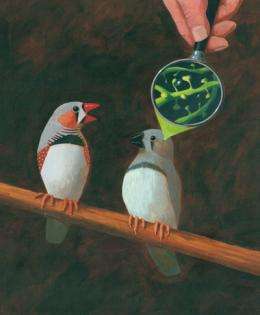
Juvenile songbirds were used in a study by researchers at Duke University Medical Center and their findings provided fundamental insight into how the brain changes in juvenile male songbirds during the juvenile's critical periods for behavioral learning. Credit: Painting by John Holdway, Jr. (www.JohnHoldway.com)

When African Grey parrots talk, do they mimic sounds or consciously understand their speech? Irene Pepperberg, a comparative psychologist at both Brandeis and Harvard universities believes African Greys actually know what they’re talking about.

"They understand things like categories of color, material and shape, number concepts, and concepts of bigger and smaller, concepts of similarity and difference, and absence; things we once thought that a bird could not comprehend, these parrots are showing us it's possible," says Pepperberg.

With support from the National Science Foundation (NSF), Pepperberg studies the cognitive and communicative abilities of African Greys. She says the have the social skills of a 2-year-old child and the intelligence of a 5-year-old. That statement might ruffle some feathers, but in Pepperberg's lab at Brandeis University in Waltham, Mass., she's out to prove that talking with the animals isn't just the stuff of fiction.

To start, talking with these birds means simplifying language down to "motherese." Instead of asking what something is made of, Pepperberg will ask, "What matter?" And, when she asks the bird "What shape?" instead of saying "square," they say "four-corner," to clarify the relationship between shape and numbers of points on an object.

One of the things Pepperberg studies is the parrots' ability to identify partially obscured shapes.

"In the wild, we expect these birds to be able to do that because if you see part of a predator, you want to respond as if it is an entire predator," says Pepperberg.

She demonstrates this by showing a parrot a square, partially obscured by a circle, and the bird is still able to identify the shape as "four-corner."

If the parrot responds to "What shape?" by just saying "corner," Pepperberg asks "How many corners?" and the parrot responds "four." The bird doesn't get it right 100 percent of the time, but Pepperberg's data suggests they understand the concept of a square even when it is partially obscured.

When testing, Pepperberg is cautious, making sure she doesn't send subtle cues to the birds. "We have controlled for that many times," she explains. "We have different people training versus testing. We mix up different types of questions in each test session. The testing is basically blind."

Pepperberg says her research on talking with birds has benefits for humans. "A colleague has used our training techniques--a two-person modeling system--with autistic children to help them learn speech and communication skills," she says.

Pepperberg believes that despite the birds having a brain the size of a shelled walnut, their contribution to understanding language and intelligence is significant. "All of our work is trying to show people that 'birdbrain' should really be a compliment," she adds.

Provided by National Science Foundation (news : web)

Filter


Move the slider to adjust rank threshold, so that you can hide some of the comments.


Display comments: newest first

Isaacsname
May 02, 2011

Rank: 3.7 / 5 (3)
Having grown up raising and breeding Greys myself, I have always been a fan of Irene's work, it's nice to see her on Physorg. Make sure you check out her website too :)

http://www.alexfo...erg.html

Someday we will realize it is not the failure of other life to understand us, we hold those failures in our own hands.

R.I.P. Alex.
pubwvj
May 02, 2011

Rank: 3 / 5 (6)
It amazes me what researchers think they have "discovered". I have taught my dogs sign language and they sign back to me to tell me about things. Additionally I've learned some of their language so I know what they're saying both to each other and to me. It's useful, especially with working dogs on a farm. They're not just parroting and in some cases they've made new signs and taught them to me to express new things they needed to communicate. They key is to observe and listen.
BillFox
May 02, 2011

Rank: 2 / 5 (6)
I have taught my dogs sign language and they sign back to me to tell me about things.


I have taught my dogs to speak and we have deep philosophical conversations.
knikiy
May 03, 2011

Rank: 1 / 5 (2)
Humans have a lot invested in their species arrogance, proportional to their degree of separation from the natural world. But we're doing one bang-up job of managing the planet, and if we destroy it in the process, well that just sorta proves how great we are, don't it?
Rank 5 /5 (10 votes)
Related Stories
Relevant PhysicsForums posts
  • Eye biology videos
    created4 hours ago
  • Flowering Plant Revived After 30,000 Years in Permafrost
    createdFeb 21, 2012
  • Toba volcano eruptions - 1.000 - 10,000 breeding pairsunb
    createdFeb 20, 2012
  • How is a specific gene removed from DNA
    createdFeb 20, 2012
  • Reproduction and Human evolution
    createdFeb 19, 2012
  • Viruses: Living or Non-living organisms
    createdFeb 19, 2012
  • More from Physics Forums - Biology

More news stories

Surprising diversity at a synapse hints at complex diversity of neural circuitry

A new study reveals a dazzling degree of biological diversity in an unexpected place – a single neural connection in the body wall of flies.

Biology / Other

created 11 hours ago | popularity 5 / 5 (4) | comments 0 | with audio podcast

Men might not 'become extinct' after all: Theory of the 'rotting' Y chromosome dealt a fatal blow

If you were to discover that a fundamental component of human biology has survived virtually intact for the past 25 million years, you'd be quite confident in saying that it is here to stay.

Biology / Biotechnology

created 14 hours ago | popularity 5 / 5 (6) | comments 1 | with audio podcast

New family of legless amphibians found in India

Since before the age of dinosaurs it has burrowed unbothered beneath the monsoon-soaked soils of remote northeast India - unknown to science and mistaken by villagers as a deadly, miniature snake.

Biology / Plants & Animals

created 21 hours ago | popularity 5 / 5 (9) | comments 3

Climate change affects bird migration timing in North America

Bird migration timing across North America has been affected by climate change, according to a study published Feb. 22 in the open access journal PLoS ONE.

Biology / Ecology

created 10 hours ago | popularity 4.5 / 5 (2) | comments 2

New iridescent lizard species found in Cambodia

A new species of lizard with striking iridescent rainbow skin, a long tail and very short legs has been discovered in the rainforest in northeast Cambodia, conservationists announced Wednesday.

Biology / Plants & Animals

created 10 hours ago | popularity not rated yet | comments 0


Researchers build first physical 'metatronic' circuit

(PhysOrg.com) -- The technological world of the 21st century owes a tremendous amount to advances in electrical engineering, specifically, the ability to finely control the flow of electrical charges using ...

Spitzer finds solid buckyballs in space

(PhysOrg.com) -- Astronomers using data from NASA's Spitzer Space Telescope have, for the first time, discovered buckyballs in a solid form in space. Prior to this discovery, the microscopic carbon spheres ...

Faster than light neutrinos? More like faulty wiring

You can shelf your designs for a warp drive engine (for now) and put the DeLorean back in the garage; it turns out neutrinos may not have broken any cosmic speed limits after all.

Physicists surprised by disappearing and reappearing superconductivity in iron selenium chalcogenides

Superconductivity is a rare physical state in which matter is able to conduct electricity -- maintain a flow of electrons -- without any resistance. This phenomenon can only be found in certain materials at low temperatures, ...

Stanford research team cracks animated NuCaptcha

(PhysOrg.com) -- The research team from Stanford University, led by Elie Bursztein, that previously had cracked regular CAPTCHAs and then audio CAPTCHAs, now has also successfully cracked the animated version called NuCapt ...

Going up: Japan builder eyes space elevator

A Japanese construction firm claimed Wednesday it could execute an out-of-this-world plan to put tourists in space within 40 years by building an elevator that stretches a quarter of the way to the moon.